

Recent heavy rainfall warnings issued by the national meteorological agency for the Seoul metropolitan area and the Gangwon and Chungcheong regions have drawn criticism following significant discrepancies between the predictions and the actual precipitation. While the agency anticipated torrential downpours, the heaviest rainfall occurred unexpectedly in the Gyeongbuk region, leading to questions about the accuracy of the forecasts.
Forecasting Heavy Rains, But Not Where Expected
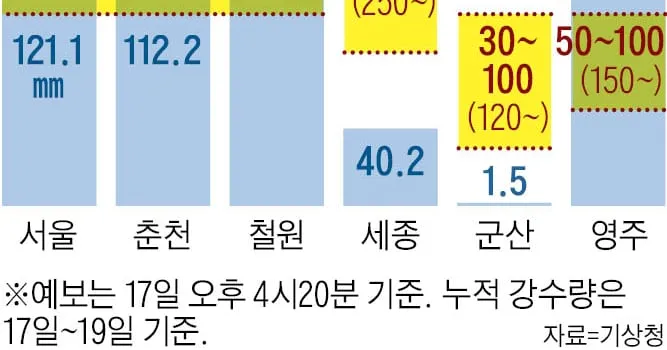
The Korea Meteorological Administration (KMA) had issued advisories for the weekend of July 18-19, predicting rainfall amounts of 100 to 200 millimeters (mm) for Seoul, Incheon, and Gyeonggi Province, with some areas potentially receiving over 300 mm. Similar predictions of 100 to 200 mm, and up to 300 mm in some locations, were made for Gangwon Province. However, data collected from the KMA’s Automatic Weather System (AWS) between July 17 and 19 revealed a different picture.
The area that experienced the most rainfall nationwide was Yeongju in Gyeongbuk Province, recording 206.8 mm. This was followed by Jeokseong-myeon in Paju, Gyeonggi Province, with 197.5 mm; Cheorwon in Gangwon Province, with 171.1 mm; Boryeong in Chungnam Province, with 126 mm; Deogyusan in Muju, Jeonbuk Province, with 122.5 mm; and Damyang in Jeonnam Province, with 104.5 mm.
Notably, none of the predicted heavy rainfall zones in the Seoul metropolitan area or Gangwon Province exceeded 200 mm. Even in the Chungcheong region, where up to 250 mm was forecast, the highest recorded rainfall was 126 mm in Boryeong. In stark contrast, some areas where only light to moderate rain was expected experienced very little precipitation at all. Gyeongnam and Jeonbuk regions, which were forecast to receive between 20-60 mm and 30-100 mm respectively, saw minimal rainfall.
Unexpected Deluges in Gyeongbuk
Conversely, parts of the Gyeongbuk region, which had been forecast to receive comparatively less rain, were hit by downpours exceeding expectations. The KMA had predicted 50 to 100 mm for central and northern Gyeongbuk, with isolated areas possibly reaching over 150 mm. However, Yeongju alone received over 200 mm, making it the wettest location in the country and significantly surpassing the initial forecast.
The timing and location of the rainfall also proved to be a point of contention. The KMA had predicted rain for the Seoul metropolitan area throughout the weekend of July 18-19. However, rain in Seoul and surrounding metropolitan areas began to cease on the morning of July 18 and did not return at all on July 19. This led to disappointment for residents who had cancelled outdoor activities based on the forecast.
One office worker, identified as Mr. Lee, 50, residing in Seongnam, Gyeonggi Province, expressed his frustration. “I didn’t plan any outdoor activities for the weekend because I expected rain, but it didn’t rain at all, which was quite disappointing,” he stated, highlighting the disruption caused by the inaccurate prediction.
Agency Defends Overall Forecast Accuracy
In response to the criticism, an official from the KMA defended the agency’s forecasting methodology. The official explained that predictions of maximum rainfall amounts often refer to localized, extreme precipitation possibilities rather than widespread conditions. “Announcing the maximum possible rainfall for a region is a warning about localized extreme precipitation, not a prediction for the entire area,” the official stated. “Overall, we believe this forecast was accurate.”
This incident underscores the inherent challenges in precise weather forecasting, particularly concerning the exact location and intensity of severe weather events. While the KMA maintains the general accuracy of its broader predictions, the specific deviations in this case have raised concerns among the public and meteorology observers regarding the reliability of localized heavy rainfall warnings.
Understanding Weather Forecasts
Weather forecasting involves complex atmospheric modeling that considers numerous variables. Factors such as temperature, air pressure, humidity, wind patterns, and the interaction of different air masses all play a crucial role. Even with advanced technology and sophisticated models, predicting the exact location and timing of heavy rainfall can be difficult due to the dynamic nature of weather systems.
Localized heavy downpours, often referred to as convective rainfall, can form rapidly and dissipate just as quickly. These events are particularly challenging to pinpoint with high accuracy days in advance. While broad forecasts for general conditions like temperature or the likelihood of rain across a wide area tend to be more reliable, predictions for intense, short-lived events require constant updates and can be subject to significant shifts.
The KMA, like meteorological agencies worldwide, uses a combination of observational data, satellite imagery, radar, and numerical weather prediction models. These models simulate the atmosphere’s future state based on current conditions. However, small uncertainties in the initial data or the model itself can lead to amplified errors over time, especially for phenomena like thunderstorms and flash floods.
Public Perception and Future Improvements
The discrepancy between the forecast and the actual rainfall highlights the importance of clear communication regarding the uncertainties inherent in weather predictions. When specific warnings are issued for heavy rainfall, the public naturally expects those conditions to materialize in the designated areas. The KMA’s explanation about localized extreme possibilities aims to clarify this, but the impact of a missed forecast on individual plans and preparedness can be significant.
Moving forward, meteorological agencies continually work to refine their models and data assimilation techniques to improve the accuracy of forecasts, especially for severe weather events. Enhanced radar technology, more sophisticated satellite data, and improved computational power contribute to better predictions. Public understanding of the nuances of weather forecasting, including the difference between general trends and specific extreme event warnings, is also crucial for effective preparedness.
While the recent forecast inaccuracies have led to criticism, they also serve as a reminder of the complexity of atmospheric science and the ongoing efforts to enhance our ability to predict the weather with greater precision.
