

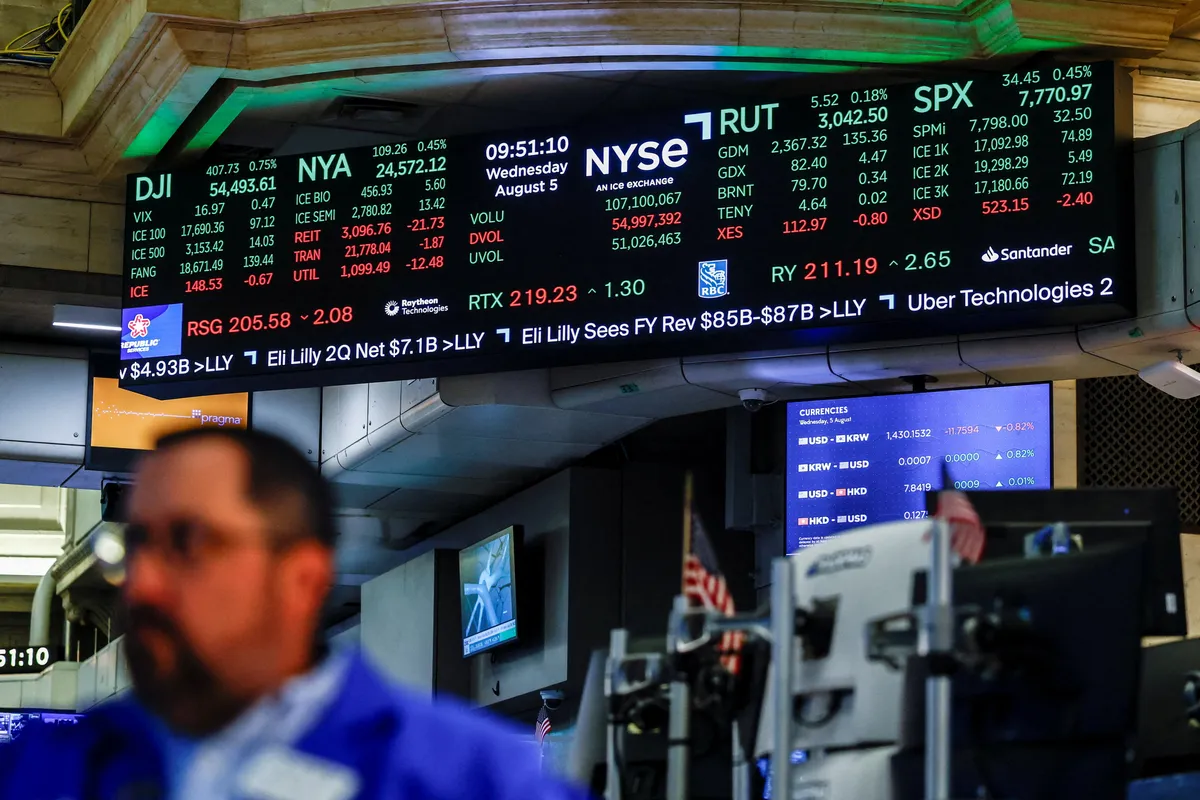
New York stock markets experienced a slight downturn on August 14th, as concerns over weakening consumer spending cast a shadow over economic growth prospects. Investors reacted to disappointing retail sales data, leading to modest declines across major indices.
Market Performance
The Dow Jones Industrial Average closed down by 107.58 points, or 0.20%, settling at 53,732.41. The broader S&P 500 index saw a decrease of 13.23 points, or 0.17%, ending the session at 7785.76. The tech-heavy Nasdaq Composite also registered a loss, falling 73.86 points, or 0.28%, to close at 26,729.16.
Despite the day’s pullback, the S&P 500 and Nasdaq managed to extend their winning streaks for a third consecutive week, with gains of 0.4% and 0.1% respectively over the week. The Dow, however, ended the week with a 0.6% loss.
Economic Data Fuels Recession Fears
The primary driver behind the market’s cautious sentiment was the release of key economic indicators, particularly concerning U.S. consumer spending. Retail sales for July showed a significant contraction, falling by 0.6% compared to the previous month. This marked the largest monthly decline since May of the prior year, when sales dropped by 1.1%, and significantly missed economists’ expectations of a 0.1% increase.
This disappointing retail sales figure has implications for monetary policy. It provides further support for the Federal Reserve’s (Fed) stance on potentially holding benchmark interest rates steady in September. However, the slowdown in consumer activity has also heightened concerns about the broader impact on economic growth.
Analyst Perspectives on Consumer Spending
Investment analyst Bret Kenwell commented on the implications of the latest data. “A single month of weak consumer spending doesn’t necessarily mean the economy is teetering on the brink,” Kenwell stated. “However, when viewed alongside disappointing Gross Domestic Product (GDP) figures and employment data, it becomes increasingly difficult to ignore.”
The data suggests that consumers may be pulling back on discretionary spending, a crucial component of the U.S. economy. Factors such as persistent inflation, rising interest rates, and lingering economic uncertainty could be contributing to this trend. A sustained period of reduced consumer spending could lead to slower business revenue, potentially impacting corporate earnings and, consequently, stock market valuations.
Geopolitical Tensions Add to Market Uncertainty
In addition to domestic economic concerns, geopolitical tensions in the Middle East also contributed to market unease. Escalating conflict in the region, following the recent attack on a second Saudi Arabian oil facility, has led to renewed concerns about potential supply disruptions and their impact on global energy markets. The United States’ indication that it may continue its sanctions against Iran further heightened these tensions.
These geopolitical developments can create volatility in the markets, particularly impacting sectors sensitive to energy prices, such as transportation and manufacturing. Investors often seek safe-haven assets during periods of geopolitical uncertainty, which can lead to outflows from riskier assets like equities.
Looking Ahead
Market participants will be closely monitoring upcoming economic data releases, including inflation reports and further employment figures, to gauge the resilience of the U.S. economy. The Federal Reserve’s upcoming policy meeting will also be a key focus, as investors seek clarity on the future path of interest rates. The interplay between domestic economic trends and global geopolitical events will likely continue to shape market sentiment in the near term.
The current economic environment presents a complex picture, with mixed signals regarding growth and inflation. While some sectors may show resilience, the overall trend suggests a need for caution. Investors are advised to stay informed and consider diversification strategies to navigate potential market fluctuations.
