

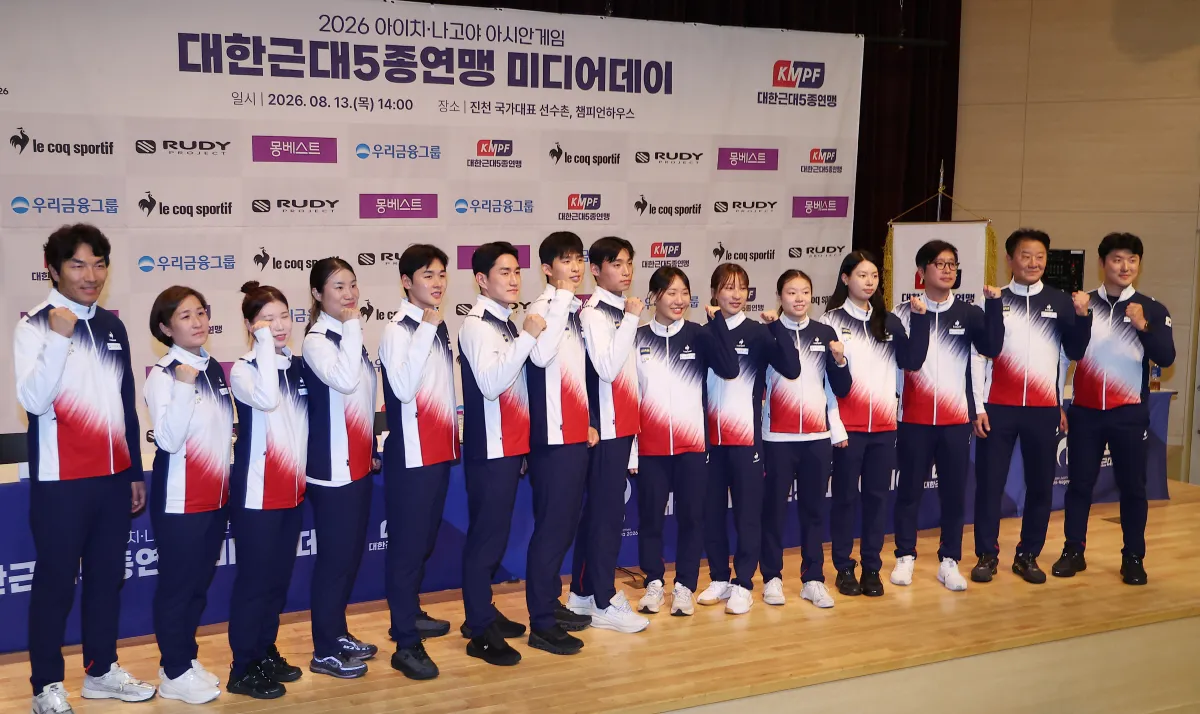
South Korea’s national modern pentathlon team is gearing up for the upcoming Asian Games with a strong ambition to defend their titles and secure multiple gold medals. The team held a media day on September 13th in Jincheon, Chungbuk, to discuss their preparations and objectives for the 2026 Aichi-Nagoya Asian Games.
A Sport of Diverse Disciplines
Modern pentathlon is a unique sport that tests athletes across five distinct disciplines: fencing, swimming, shooting, running, and obstacle course racing. This demanding combination requires a blend of physical prowess, strategic thinking, and mental fortitude. At the Asian Games, four gold medals are at stake across men’s and women’s individual and team events.
A Legacy of Success and Ambitious Goals
The South Korean team has a commendable track record in recent Asian Games. In the 2018 Jakarta-Palembang Games, they secured one gold, two silver, and one bronze medal. Their performance improved at the 2023 Hangzhou Games, where they clinched two gold, two silver, and one bronze, making them the top-performing nation in the sport.
The modern pentathlon events at the upcoming games are scheduled to commence on September 16th, with all four gold medals to be decided by September 20th, shortly after the opening ceremony. This means the race for the first gold medal for the South Korean contingent will be intense and swift.
Captain Jeon Woong-tae Leads the Charge
Team captain Jeon Woong-tae, a historic figure as the first Olympic medalist in modern pentathlon for South Korea (bronze at the 2021 Tokyo Olympics), expressed his team’s determination. “All our junior athletes have a fierce glint in their eyes,” Jeon stated. “There’s a clear will to show everything they’ve got in this competition. I want both the men’s and women’s teams to each win two gold medals.”
Jeon himself is aiming for a remarkable achievement: a third consecutive gold medal in the individual event, marking his second consecutive ‘double crown’ victory. The men’s team features strong contenders including Seo Chang-wan, Kim Young-ha, and Lee Jong-hyun, alongside Jeon.
The women’s team is equally formidable, with Seong Seung-min, a bronze medalist at the 2024 Paris Olympics and the first Asian female athlete to reach the podium in the sport, leading the charge. She is joined by Shin Soo-min, Jang Eun, and Kim Yu-ri.
Adapting to a New Discipline: Obstacle Course Racing
A significant change for this Asian Games is the inclusion of obstacle course racing, replacing equestrian show jumping after the Paris Olympics. This new discipline involves athletes rapidly navigating various obstacles.
The South Korean team has been actively preparing for this shift, even inviting a coach from the Philippines to impart specialized knowledge. Kim Sung-jin, the national team director, explained the evolution of their training. “Initially, when obstacle course racing was introduced, our focus was solely on clearing the obstacles,” Kim said. “However, under foreign guidance, we’ve learned about the flow and stances for clearing obstacles, as well as techniques for continuous movement. This has significantly improved our athletes’ records. We aim to learn even more techniques by receiving guidance until the World Championships.”
Athletes Embrace the Challenge
Seo Chang-wan, who won the individual event at the second leg of the World Cup in May, shared his experience adapting to the new discipline. “At first, it felt awkward and difficult,” he admitted. “But as I continued, my skills improved, and now I find it enjoyable. I’ve adapted well without any issues. In the Hangzhou Games, my first Asian Games, I was filled with anxiety and overthought things, preventing me from showing my full potential. This time, I will give 100% to win a gold medal.”
Seong Seung-min, who has achieved the most international success among South Korean athletes in obstacle course racing since its introduction, highlighted the spectator appeal of the new event. “With equestrian, it was just me and the horse competing. But in obstacle course racing, two athletes start simultaneously, making it more exciting for viewers,” she noted. “Successfully clearing the fixed obstacles 1 through 3 is particularly crucial.”
Looking Ahead: World Championships and Final Preparations
The South Korean modern pentathlon team is set to compete in the World Championships in Wuxi, China, from September 24th to 30th. Following this crucial event, they will travel to Nagoya, Japan, the host city for the Asian Games, on September 13th to finalize their preparations.
Rivalries and Expectations
Jeon Woong-tae acknowledged the traditional rivalries in the Asian Games, primarily between South Korea, China, and Japan. “The Asian Games have traditionally been a battle between our country, China, and Japan,” Jeon explained. “Recently, China’s team has become very strong with well-rounded members and generational changes, so we need to be particularly mindful of them. I want to show our nation standing at the top once again. We will use the World Championships as a stepping stone to perform well.”
Seong Seung-min also expressed caution regarding their competitors. “Chinese athletes, including Jang Ming-wi, a gold medalist at the Hangzhou Games, are outstanding in obstacle course racing. Other events also seem similar to my own abilities, and Japanese athletes have also improved significantly, so we need to be careful,” she stated. “I will prepare meticulously, paying close attention to every event.”
With a blend of seasoned champions and emerging talents, the South Korean modern pentathlon team is poised to make a strong showing at the Asian Games, aiming to uphold their reputation and bring home a haul of gold medals.
