

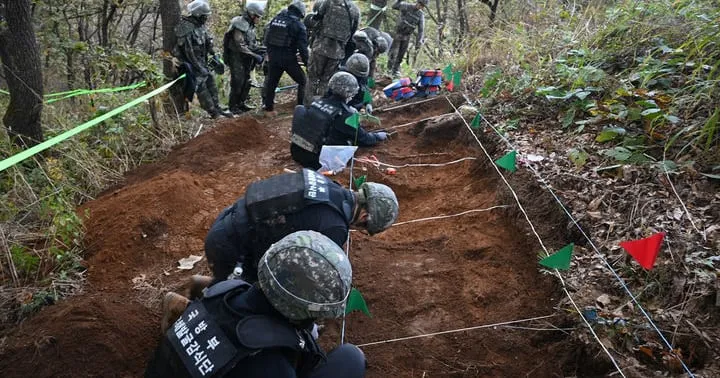
The United States has confirmed the identities of 112 American service members whose remains were repatriated from North Korea in 2018. These remains are believed to be from individuals who went missing during the Korean War. For over seven years, North Korea has remained silent in response to U.S. government requests for cooperation on the identification and recovery of remains, including those potentially located within the Demilitarized Zone (DMZ).
Ongoing Efforts to Identify Korean War Missing
Officials from the U.S. Department of Defense’s Defense POW/MIA Accounting Agency (DPAA) held a series of informational sessions in Omaha, Nebraska, from October 6th to 7th, local time. These sessions focused on the experiences of U.S. and Chinese prisoners of war during the Korean War.
During these events, Kelly McKeague, the Director of the DPAA, announced the significant progress made in identifying remains. He stated that out of 55 boxes of remains transferred from North Korea following the 2018 Singapore Summit between the U.S. and North Korea, 112 individuals have been identified as U.S. service members. The remaining 90 sets of remains were handed over to South Korean authorities.
Plans for Expanded Recovery Operations
McKeague further revealed plans for the U.S. to resume not only investigative operations but also actual recovery and excavation efforts within the DMZ. These initiatives are slated to recommence in early 2024, following extensive coordination with South Korea and the United Nations Command (UNC). The goal is to locate and repatriate more missing service members.
In addition to the DMZ operations, a joint underwater recovery team is scheduled to be deployed by the end of October. This team will support the South Korean Navy’s 함정 (hamjeong – warship) and diving assets in searching for the wreckage of a downed military aircraft off the coast of Busan. The aircraft is believed to have crashed during the Korean War.
Challenges in North Korean Cooperation
The DPAA Director noted that the last direct engagement with North Korean military personnel concerning the recovery of remains occurred in March 2019. Since then, North Korea has maintained a consistent stance of non-cooperation. McKeague described the situation as a prolonged period of silence, stating, “The U.S. government has attempted to communicate at all levels, but for over seven years, all requests have been met with absolute silence.” He characterized this lack of cooperation as a violation of international law and a breach of humanitarian principles.
Historical Context of Missing Service Members
The Korean War, which lasted from 1950 to 1953, resulted in a significant number of missing in action (MIA) personnel from both sides. The United States has consistently sought the return of its fallen soldiers, recognizing the profound importance of providing closure to the families of those who made the ultimate sacrifice. The repatriation of remains in 2018 marked a rare moment of cooperation between the U.S. and North Korea on this sensitive issue.
The DPAA’s mission is to account for all unidentified American prisoners of war and missing personnel from past conflicts. This involves a complex and often challenging process of investigation, recovery, identification, and repatriation. The agency utilizes a variety of methods, including forensic analysis, historical research, and joint field operations, to achieve its objectives.
The continued silence from North Korea presents a significant obstacle to these efforts. Despite numerous attempts at diplomatic engagement, the U.S. has been unable to secure the necessary cooperation to conduct thorough investigations and recovery operations in areas where remains are believed to be located. This includes the heavily fortified Demilitarized Zone, which separates North and South Korea.
Future Prospects and Humanitarian Concerns
The planned resumption of recovery operations in the DMZ signals the U.S. commitment to bringing its missing service members home. However, the success of these operations hinges on the possibility of gaining access to certain areas and potentially, albeit unlikely in the current climate, some level of cooperation from North Korea. The underwater search near Busan also highlights the diverse geographical locations where evidence of missing personnel might be found.
The identification of 112 service members from the 2018 transfer is a testament to the meticulous work of forensic scientists and historians. Yet, it also underscores the vast number of personnel still unaccounted for. The U.S. government continues to advocate for humanitarian access and cooperation, emphasizing the moral imperative to account for every fallen service member and provide answers to their grieving families. The prolonged lack of response from Pyongyang remains a central challenge in resolving these long-standing cases.
