

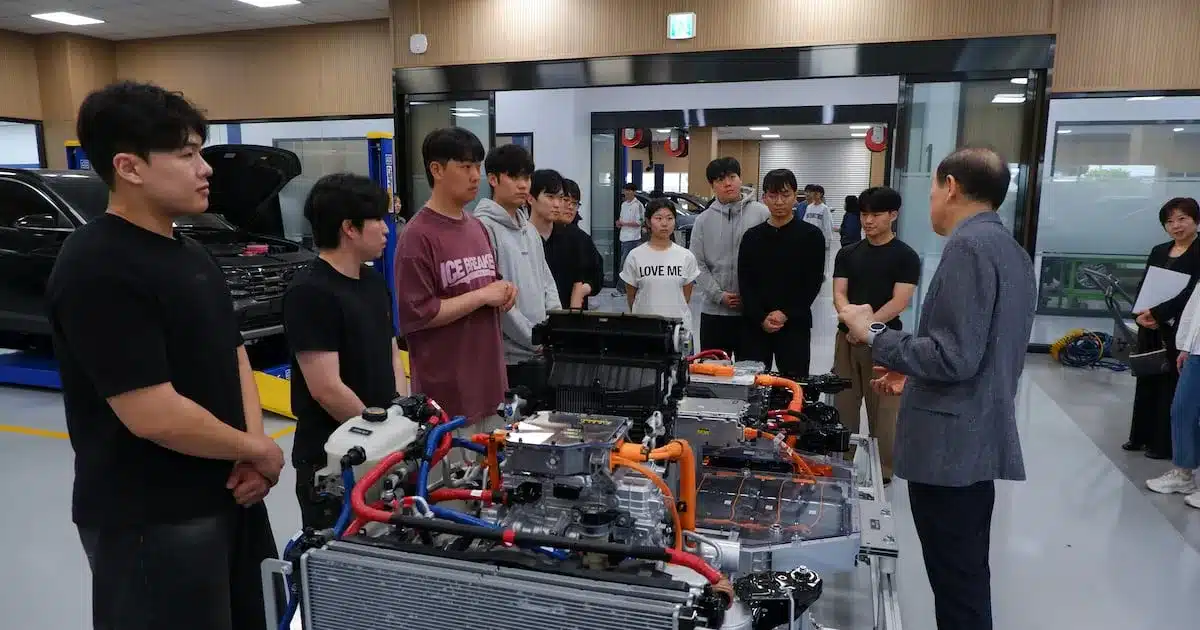
Ulsan University is revolutionizing its educational approach by establishing ‘field-based classrooms’ in collaboration with local industries. This initiative aims to bridge the gap between academic learning and the practical demands of the modern workforce, ensuring graduates possess the skills and experience sought by employers. The program, spearheaded by the Ulsan University RISE (Regional Innovation System & Education) program, focuses on cultivating talent tailored to the region’s core industries, including automotive, shipbuilding, and chemicals.
Bridging Academia and Industry with ‘EdgeCam’
A prime example of this innovative strategy is the ‘EdgeCam’ (Edge Campus in Ulsan) facility established in partnership with Hyundai Motor Company. Here, students from Ulsan University’s Mechanical Automotive Engineering track engage in hands-on learning, surrounded by actual vehicle components. Under the guidance of instructors like Heo Jong-yun, a former executive at Hyundai Motor Company, students gain firsthand exposure to automotive structures and key parts. This moves beyond theoretical knowledge acquired in traditional lecture halls, offering practical training directly relevant to industrial settings.
The core philosophy behind EdgeCam is to transform actual industrial sites into educational spaces or to replicate them within the university campus. This allows students to acquire the practical skills essential for their future careers. Ulsan University has expanded its EdgeCam initiative from an initial target of 10 locations to 17, creating customized talent development programs across 11 key industrial sectors in Ulsan. These sectors include automotive, shipbuilding, chemicals, energy, semiconductors, and AI-driven transformation (AX).
Curriculum Revitalization and Student Engagement
To ensure educational content aligns with industry needs, Ulsan University has developed or revised over 130 courses and related materials. This significant overhaul reflects a commitment to providing students with up-to-date, relevant knowledge. The impact on student participation has been substantial. In the past year, 3,467 students participated in these industry-focused programs, exceeding the initial target of 685 students by more than fivefold.
Furthermore, the university has forged employment linkage agreements with 15 local companies. This ensures that students who acquire the desired competencies at university and through field training can seamlessly transition into employment. The ‘Capstone Design’ program, where students tackle real-world problems posed by companies or the local community, has also seen a surge in participation. The number of teams and students involved more than doubled from 39 teams (181 students) in the first semester of last year to 84 teams (398 students) in the second semester.
Expanding Research, Entrepreneurship, and Digital Transformation Initiatives
Beyond direct educational programs, Ulsan University has intensified its collaborative efforts with industries in research and entrepreneurship support. The university has undertaken over 50 joint research and development (R&D) projects under its ‘Industry-Academia Cooperation’ framework. Additionally, 20 entrepreneurship clubs are active, with 1,576 students participating in entrepreneurship education.
The number of companies partnering with Ulsan University for industry-academia cooperation has grown significantly, with 78 new partnerships bringing the total to 1,038. The university is also actively promoting the adoption of AI in local manufacturing businesses. Through its ‘Industrial AX University’ initiative and the establishment of an AI Hub Center, Ulsan University provides support for regional manufacturers to integrate AI technologies into their production processes.
In AI and digital transformation practical training, 498 individuals have received education across five facilities. The university has also prioritized safety education, with 1,858 participants in comprehensive disaster and safety training programs.
Future Directions and Strategic Expansion
Lee Sang-wook, Head of the Ulsan University RISE Program Headquarters, emphasized the collaborative nature of these achievements. “The educational infrastructure and industry-academia cooperation established over the past year are the results of joint efforts by the university, businesses, and the region,” he stated. “Moving forward, we will elevate these initiatives to ensure they translate into tangible outcomes for students, including education, employment, and entrepreneurship.”
For the current year, the university plans to broaden the connection points between companies and students. A key objective is to increase the involvement of industry professionals in curriculum design, ensuring that courses more directly reflect the skills and job roles needed in the field. Scholarship programs will also be expanded for students who achieve success in practical training or entrepreneurship.
A new ‘Micro-Track’ program will be introduced, allowing students to concentrate on specific industrial fields such as automotive, shipbuilding, or AI by bundling various courses. The university also aims to expand cooperation with universities in the Busan and Gyeongnam regions, sharing educational facilities and programs, and increasing joint educational offerings.
The strategy includes strengthening support for companies in developing practical, on-site skills in collaboration with universities and assisting manufacturing firms in integrating AI into their operations. Kim Ik-hyun, Director of the Ulsan University RISE Program, expressed his vision: “We will build a system where the region and the university jointly cultivate the talent and skills that companies require. This will enable students to learn and grow in Ulsan, becoming core talent that settles and contributes to the region’s industrial sector.”
