

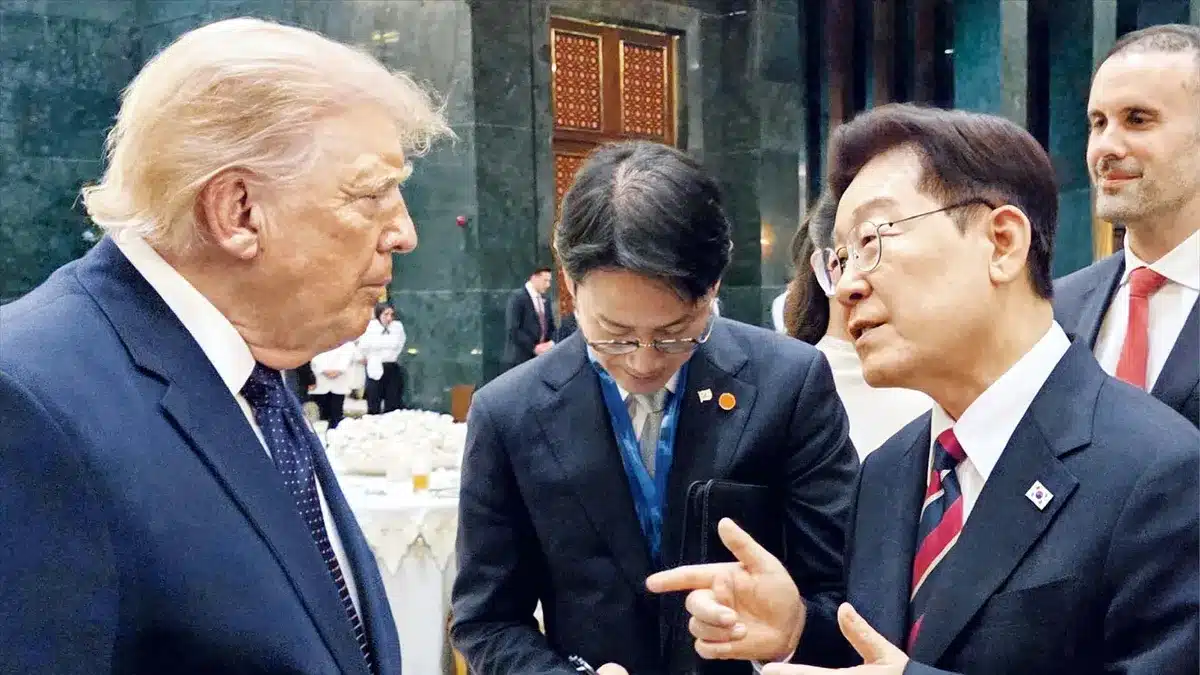
South Korean President Lee Jae-myung expressed his appreciation and support for U.S. President Donald Trump’s decision to significantly scale back joint military exercises with South Korea. Lee stated on the 19th that he “sympathizes with President Trump’s will and efforts to foster conditions for dialogue aimed at establishing a peace regime on the Korean Peninsula and expresses his respect for the outcome.”
In a post on X, formerly Twitter, Lee elaborated, “I anticipate that President Trump’s decision will lead to the building of trust between North and South Korea, facilitate the resumption of dialogue, and ultimately contribute to the establishment of a stable peace regime on the Korean Peninsula.” This statement comes just three days after President Trump strongly advocated for a substantial reduction in the joint military drills, which are central to the South Korea-U.S. alliance.
President Lee also conveyed his eagerness for a future meeting with President Trump, stating, “I look forward to meeting President Trump in the United States soon.” He further commented on recent social media messages and photos shared by President Trump, interpreting them as a “big decision filled with the earnest intention to create peace beyond confrontation and conflict on the Korean Peninsula.”
South Korea’s Defense Capabilities and Shared Responsibility
Lee’s remarks also touched upon South Korea’s growing defense capabilities, noting that the nation is recognized as the world’s fifth-largest military power. He affirmed his full agreement with President Trump’s stance that “while South Korea possesses sufficient capabilities to increasingly shoulder its own defense, security on the Korean Peninsula must ultimately be the responsibility of South Korea itself.” This aligns with the U.S. administration’s push for allies to take greater ownership of their defense, suggesting a mutual agreement on increasing defense spending to reach 3.5% of GDP, as per bilateral discussions.
President Lee reiterated his hope that President Trump’s decision would pave the way for trust-building and dialogue between North and South Korea, leading to a lasting peace regime. He pledged his full commitment to supporting President Trump’s peace-making efforts, stating, “As already indicated, I will do my utmost in the role of a peace-maker, encouraging and contributing to President Trump’s peace-making activities.”
Cooperation on Hormuz Peace Initiative
Addressing the issue of freedom of navigation in the Strait of Hormuz, President Lee confirmed South Korea’s commitment to international efforts. “The South Korean government has stated on various occasions its active participation in the international community’s efforts, including those of the United States, to restore freedom of navigation in the Strait of Hormuz,” Lee said.
He further explained the government’s approach, stating, “To this end, our government will continue to maintain close consultations with the United States, as we have done thus far, on practical measures for contribution within the scope permissible under South Korean law and basic policy.” This statement appears to be a response to President Trump’s previous public expressions of dissatisfaction regarding South Korea’s perceived lack of participation in U.S.-led denuclearization efforts. Lee’s remarks suggest a proactive engagement strategy, aiming to align with U.S. objectives while adhering to national legal and policy frameworks.
Context of Reduced Joint Drills
The decision to reduce joint military drills between the U.S. and South Korea is a significant development in the ongoing diplomatic efforts surrounding the Korean Peninsula. These exercises have historically been a point of contention with North Korea, which views them as provocative and a rehearsal for invasion. By scaling back these drills, the Trump administration signaled a potential shift in strategy, aiming to create a more conducive atmosphere for negotiations with Pyongyang.
President Trump’s approach has often emphasized a transactional style of diplomacy, seeking direct engagement with adversaries and prioritizing outcomes that he believes serve American interests. His focus on reducing military exercises is consistent with this approach, potentially aiming to leverage perceived concessions from North Korea in exchange for eased military pressure from the U.S. and South Korea. This move also reflects a broader U.S. foreign policy objective of encouraging allies to assume greater responsibility for regional security.
President Lee’s supportive response underscores a willingness within the South Korean government to explore diplomatic avenues and potentially de-escalate tensions. By framing the reduced drills as an opportunity to build trust and foster dialogue, Lee aligns his administration with President Trump’s stated goals, while also signaling a commitment to South Korea’s own defense capabilities and its role in ensuring regional stability.
Future Prospects for Peace
The implications of this shift in military posture are far-reaching. A reduction in joint military exercises could potentially lower the threshold for dialogue and reduce the risk of miscalculation or escalation on the Korean Peninsula. However, it also raises questions about maintaining deterrence and ensuring readiness in the face of potential North Korean provocations. The effectiveness of this strategy will likely depend on reciprocal actions from North Korea and the continued close coordination between Seoul and Washington.
President Lee’s commitment to acting as a “peace-maker” suggests a proactive engagement strategy aimed at capitalizing on the current diplomatic window. His emphasis on South Korea’s growing defense capabilities also signals a desire to balance the pursuit of peace with the imperative of national security. The ongoing consultations regarding the Hormuz Strait initiative further indicate a broader alignment on international security issues, despite potential differences in approach.
Ultimately, the success of President Trump’s initiative and President Lee’s supportive stance will be measured by their ability to translate these military adjustments into tangible progress toward denuclearization and lasting peace on the Korean Peninsula. The coming months will be crucial in observing whether this diplomatic opening leads to sustained engagement and a de-escalation of tensions, or if it merely represents a temporary pause in a long-standing standoff.
