

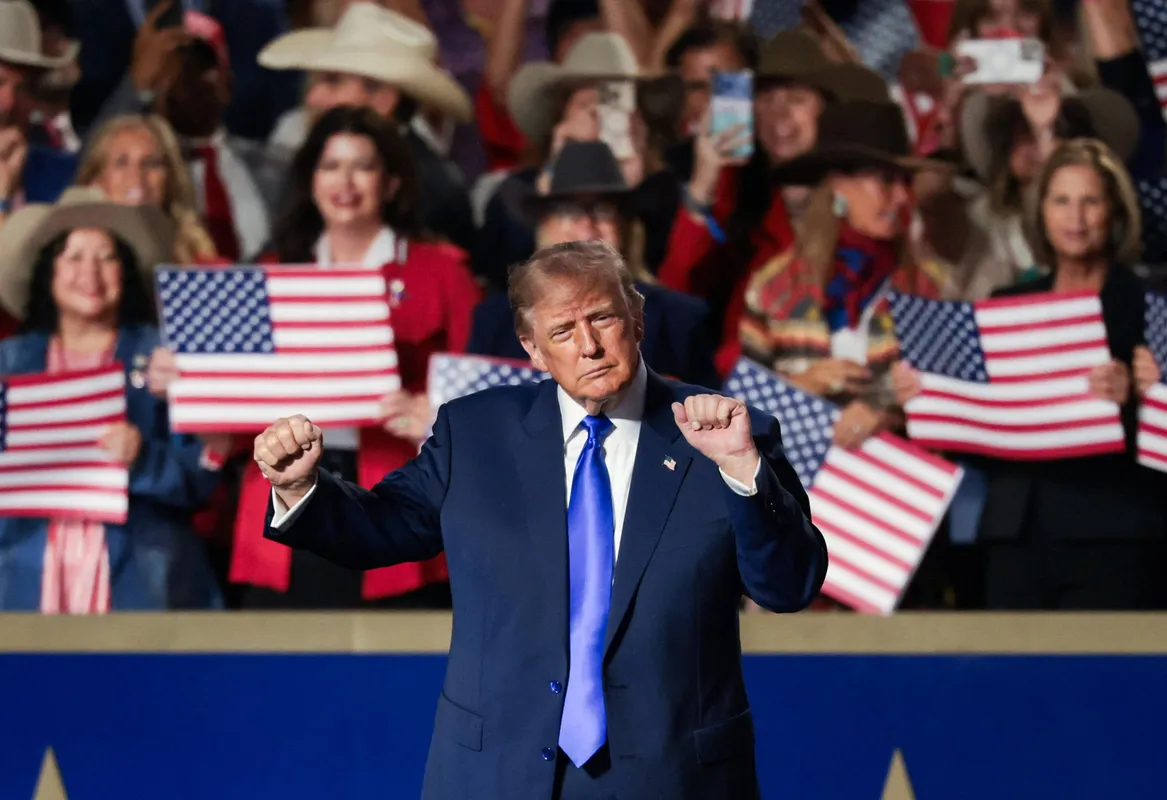
Dallas, TX – In a move unprecedented for a midterm election, former President Donald Trump addressed a Republican Party rally in Dallas, Texas, on September 9th. The event, held at the American Airlines Center, was intended to galvanize support for the upcoming November 3rd midterm elections. During his speech, Trump announced a bold, albeit controversial, pledge: if Republicans win control of both the House and Senate, every adult American citizen would receive $5,000. He dubbed this proposal the ‘Trump Dividend,’ specifying it would be usable only within the United States.
This ambitious cash distribution plan, estimated by Reuters to cost approximately $1.35 trillion based on an adult population of 270 million, comes at a time when Trump’s approval ratings have reportedly dipped to a low of 33%. The proposal, made without a clear outline of how it would be funded, was seen by some as a desperate attempt to boost his standing amidst a prolonged war and high gas prices impacting his second term. Democrats immediately criticized the offer, labeling it an attempt to ‘buy votes with money.’
A ‘Trump Show’ with Notable Empty Seats
The rally in Texas, a traditional Republican stronghold, was billed as a ‘Trump Show’ for the midterm elections from its inception. Trump’s image adorned the venue’s banners and elevators, and even ticket checks featured his likeness. However, despite the elaborate setup, the arena, which has a capacity of 20,000, still had numerous empty seats more than three hours after the event began at 6:00 PM. When Trump finally took the stage around 8:00 PM, a significant portion of the upper seating area remained vacant, though some sections filled as his speech progressed.
Trump, seemingly acknowledging the sparse attendance, claimed the arena was ‘packed’ and that an equal number of people were outside. However, as his nearly two-hour speech continued, some attendees began to leave. This starkly contrasted with previous rallies held by Trump. For instance, a rally in September of the previous year in Arizona, marking Trump’s return to the campaign trail, filled a 70,000-seat stadium with no empty seats. Supporters had begun queuing as early as 2-3 AM for that event, and thousands were reportedly turned away.
Underlying Urgency: The Iran War and Election Stakes
The decision to host an unprecedented midterm election rally stemmed from a palpable sense of urgency. Beyond the historically low approval ratings, election forecasters predict that Democrats might reclaim the House in the upcoming elections. Such a loss could expose Trump to numerous investigations led by the Democratic-controlled House during the latter half of his term, potentially weakening his grip on national affairs.
Trump’s ‘all adult citizens receive $5,000’ pledge, which faces skepticism regarding its feasibility, appears to be a strategic move in this high-stakes environment. He repeatedly urged the audience to consider him as if he were still on the ballot, stating, ‘When I was on the ballot, the Republican Party always did well. Think of it this way: I am on the ballot this time.’ He also asserted that Republicans would win all Senate and House races.
The strategy appears aimed at mobilizing the ‘MAGA’ (Make America Great Again) base, a core constituency that believes Trump’s leadership is essential for the party’s success. However, this approach might alienate undecided voters in the crucial middle class, who are reportedly burdened by the ongoing war and rising costs.
The Iran War’s Shadow Over the Midterms
A significant factor influencing the midterm elections is the ongoing war in Iran, now in its seventh month. Trump expressed his belief that the conflict would conclude swiftly after the November 3rd election, leading to a sharp decline in oil prices. He suggested that Iran might be prolonging the war in anticipation of a Republican defeat, predicting they would ‘give up or move out’ if the election results were unfavorable to Democrats. This implies that a resolution to the war and a drop in oil prices might be unlikely before the midterms.
This projection contrasts with an initial strategy that likely aimed to leverage a swift resolution to the Iran conflict and the removal of nuclear threats as a campaign success. Instead, the continued war presents a challenge, potentially impacting election outcomes. The conflict escalated on the day of the rally, with reports of the U.S. attacking five Iranian-linked vessels and Iran claiming to have attacked ten vessels near the Strait of Hormuz. International oil prices surged past $100 per barrel for the first time in two months on the same day.
Addressing concerns about high oil prices, Trump remarked, ‘If you ask people if Iran should have nuclear weapons, everyone says ‘absolutely not.’ So, I was right, and I won.’ He also alluded to activity detected at ‘Pickaxe Mountain’ near Iran’s Natanz nuclear facility, warning Iran against ‘playing games’ and suggesting the possibility of a forceful strike.
Midterm Candidates’ Stance and Trump’s Messaging
Notably, most Republican candidates running in the midterms did not explicitly mention the Iran war during the rally. Some, like Senate candidate Colin Allred of Texas and Senate candidate Dan Sullivan of Alaska, did not attend the event. This decision may stem from concerns that aligning too closely with Trump could energize his base but might also alienate undecided voters troubled by the war and high fuel costs.
Trump, meanwhile, continued his pattern of attacking Democrats as ‘radical leftists’ and ‘communists.’ He focused heavily on cultural issues such as illegal immigration, crime, and the participation of transgender women in women’s sports. This strategy appears designed to broaden the election’s scope beyond the economy and the war, appealing to voters on social and cultural grounds.
Texas: A Shifting Political Landscape?
Texas has traditionally been a bedrock of conservative support. Since 1988, Democrats have not won a single statewide Senate race in the state. However, recent trends suggest a potential shift. In the closely contested Texas gubernatorial race, Republican Ken Paxton, endorsed by Trump, faces Democrat Beto O’Rourke. Furthermore, Hispanic voters in Texas, who were crucial to Trump’s 2020 presidential victory, are showing signs of wavering.
A public opinion poll released on the day of the rally indicated that 63% of Hispanic voters in Texas support O’Rourke, while only 30% back Paxton. Despite Trump’s plea for voters to support Paxton, urging him to return to Texas multiple times if necessary, the rally’s low attendance suggested his influence might be waning, even beyond the arena walls.
Carlos, a Dallas resident interviewed at the event, expressed frustration. ‘The price of gas in Dallas was just over $2 a gallon before the war, and now it’s nearly $4,’ he stated. ‘Trump called the Iran war ‘small potatoes,’ but what kind of leader says that? Texas is starting to turn its back on Trump.'”
