

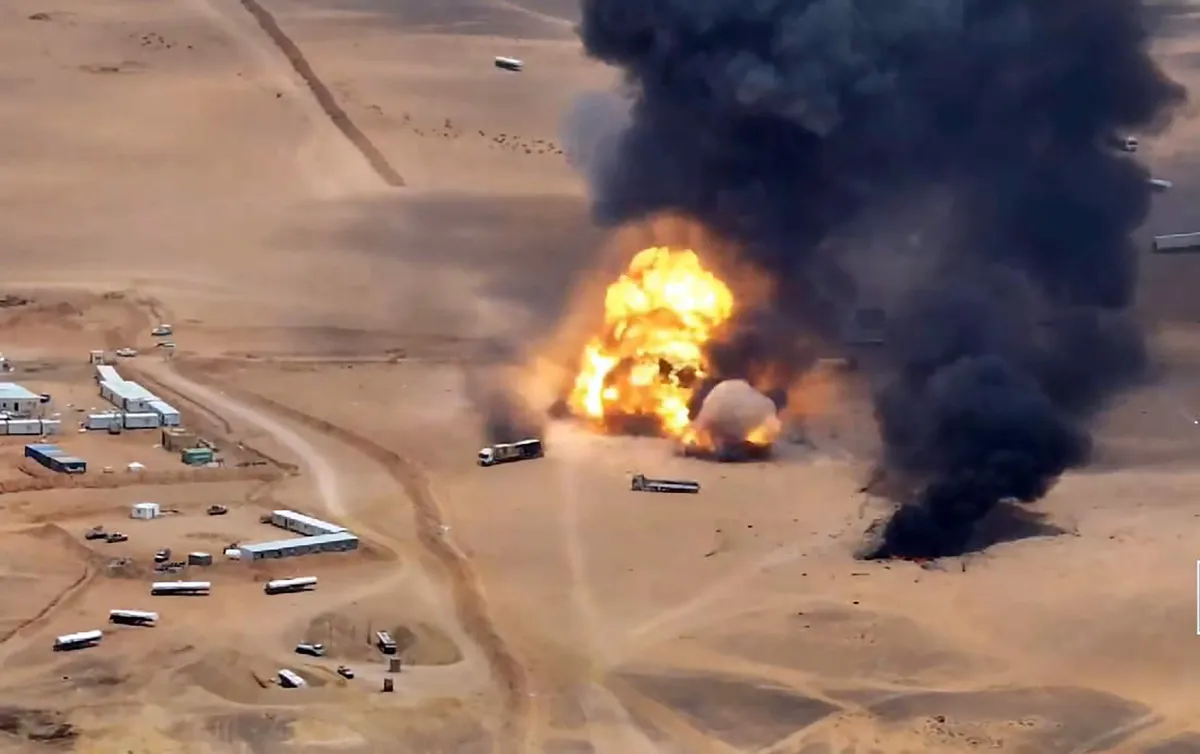
The Middle East is witnessing a dangerous escalation of conflict, with simultaneous military confrontations erupting in the Strait of Hormuz and the Red Sea. In the Strait of Hormuz, the U.S. and Iran are engaged in naval skirmishes, while in the Red Sea, Saudi Arabia and pro-Iranian Houthi rebels are clashing. The situation has further intensified with Israel resuming strikes against Hezbollah, a pro-Iranian militant group based in Lebanon. This complex web of alliances and hostilities pits the U.S., Saudi Arabia, and Israel against Iran, the Houthis, and Hezbollah, expanding the conflict zones across two vital maritime choke points in the region.
U.S. Strikes Iranian Oil Facilities in Retaliation
In a significant retaliatory move, the U.S. military announced it had destroyed five Iranian oil tankers. These strikes were a direct response to an alleged attack by Iran’s Islamic Revolutionary Guard Corps (IRGC) on U.S. interests. Four of the targeted tankers were reportedly located in the Persian Gulf, while one was struck near the Strait of Hormuz, a critical oil export hub. In response, Iran has also launched retaliatory strikes, targeting U.S. military bases, naval facilities, and commercial vessels. Iran claims to have hit over ten targets, including two facilities used for storing U.S. military equipment near Kuwait and Bahrain, as well as oil tankers. Reports also indicate that Iran fired missiles at U.S. military installations in Jordan and Qatar.
Red Sea Conflict Intensifies Between Saudi Arabia and Houthis
The Red Sea, mirroring the tensions in the Strait of Hormuz, has become another major flashpoint. The conflict between Saudi Arabia and the Houthi rebels, an Iranian-backed group operating within Yemen, has escalated to full-blown warfare. Over the past week, more than 500 casualties have been reported on both sides, with over 18,500 civilians displaced in the last four days alone, according to external reports. The Houthis have launched drone and missile attacks targeting four Saudi cities in the south, including key infrastructure such as military bases and vital facilities belonging to Saudi Aramco, the state-owned oil company. In response, Saudi forces have unleashed a barrage of missiles on Sana’a, the Houthi-controlled capital of Yemen, as well as Marib, Al Jawf, Saada, and Taiz in central and northern Yemen.
Houthi Attacks on Saudi Infrastructure
The Houthi attacks have specifically targeted Saudi Arabia’s economic lifeline and military infrastructure. Critical oil storage facilities and energy infrastructure belonging to Saudi Aramco have been hit, signaling a direct assault on the kingdom’s economic stability. The Houthis’ stated aim is to disrupt Saudi oil exports, which are crucial for the kingdom’s economy, especially as they rely on the Bab el-Mandeb strait in the Red Sea as an alternative route for oil transport, bypassing the Strait of Hormuz.
Saudi Retaliation in Yemen
Saudi Arabia has responded with extensive retaliatory strikes against Houthi-controlled territories in Yemen. The Saudi military has targeted Houthi strongholds, including Sana’a, Marib, Al Jawf, Saada, and Taiz, employing a significant volume of missile and aerial bombardments. This response underscores Saudi Arabia’s determination to protect its national interests and secure the vital shipping lanes in the Red Sea.
U.S. Senator Marco Rubio commented on the escalating conflict between Saudi Arabia and the Houthis, stating, “There is undoubtedly Iran’s hand behind the scenes in the escalation of the situation.”
Iran’s Strategy: Economic Blockade and Military Pressure
The New York Times has characterized the current situation as a critical juncture in the ongoing conflict, noting that both the U.S. and Iran are pushing each other’s red lines. The U.S. is seeking to tighten its economic blockade on Iran, now employing military force to enforce it. Conversely, Iran, facing severe economic hardship, appears to be using strong military responses to destabilize the situation. The Times further suggests that Iran is attempting to regain momentum by escalating its military actions, possessing the capability to precisely target U.S. military bases.
Within the U.S., the surge in oil prices and deteriorating public opinion are reportedly placing significant political pressure on the Trump administration as the midterm elections approach. Hardliners within Iran are allegedly advocating for escalating the conflict, regardless of the U.S. presidential election outcome, with a strategic aim to strengthen their negotiating position through maximum pressure on the U.S. Mohamad Bagher Ghalibaf, Speaker of the Iranian Parliament, had previously warned of “faster and more painful” retaliatory attacks against the U.S., a threat that now appears to be materializing.
Iran has also declared its intention to control not only the Strait of Hormuz but also the Gulf of Oman and the Arabian Sea, signaling a broader strategic objective to assert dominance over key maritime routes.
U.S. Strikes Target Iranian Oil Tankers Linked to Funding
On August 8th, the U.S. military confirmed the destruction of five Iranian oil tankers, stating it was in retaliation for Iran’s attacks on U.S. naval facilities over the preceding two weeks. U.S. officials asserted that these tankers were utilized by the IRGC and regional proxy forces to fund their operations through illicit oil sales, forming part of a network that facilitates financial support for militant activities. The U.S. Central Command had previously reported striking three tankers near the Kharg Island oil terminal on August 5th, rendering them inoperable.
In response, Iran claimed to have targeted a U.S. military base in Al-Azrak, Jordan, with missiles. Additionally, Iran stated it had retaliated against U.S. facilities in Kuwait, Bahrain, and Qatar, as well as oil tankers. Iran had also attacked U.S. naval facilities on July 7th. The Wall Street Journal, citing individuals close to the Iranian government, reported growing concerns about Iran potentially receiving assistance from China and Russia in identifying and targeting U.S. military positions. This concern stems from Iran’s continued ability to conduct sophisticated surveillance and targeting operations, despite U.S. claims of having degraded its radar capabilities in the Strait of Hormuz.
Prior to these strikes, Iran had claimed to have intercepted a U.S. drone in the Strait of Hormuz. A U.S. Central Command spokesperson, Tim Hawkins, denied these claims, stating that the U.S. military had not collected sensitive data or carried classified equipment on any drones in the area. Iran also alleged that it had targeted two U.S. warships, the DDG-119 and DDG-53, which are equipped with advanced missile and naval combat systems.
Saudi Arabia and Houthis in Full-Scale Red Sea Confrontation
The clashes between Saudi Arabia and the Houthis have escalated into a full-scale war at the Bab el-Mandeb Strait, a crucial chokepoint in the Red Sea. This escalation is seen as a direct consequence of the blockade imposed by the U.S. in the Strait of Hormuz. The Houthis launched attacks on four southern Saudi cities—Mushait, Abha, Najran, and Jizan—on August 8th. These attacks specifically targeted critical Saudi infrastructure, including military bases and key oil facilities of Saudi Aramco. This marks the largest-scale attack on Saudi territory since the beginning of the Iran conflict, resulting in at least 73 casualties, including women and children.
Saudi Arabia has responded with extensive retaliatory strikes against Houthi-controlled areas in Yemen. The kingdom is heavily reliant on the Bab el-Mandeb strait for its oil exports, as it provides an alternative route to the Persian Gulf, bypassing the Strait of Hormuz. The Houthi control over this strait poses an existential threat to Saudi Arabia’s economy and national security. Consequently, Saudi Arabia is determined to maintain control over this vital waterway.
Faisal bin Farhan, the Saudi Minister of Foreign Affairs, stated that the kingdom would not hesitate to take measures to protect its territory, safeguard its interests, and ensure the security and stability of its brotherly nation, Yemen. The Houthis, seizing this opportunity, are intensifying their offensive to gain control of the Bab el-Mandeb Strait and cripple the Yemeni government. Saudi Arabia and the Yemeni government are facing a critical situation where their survival is at stake, with oil supply routes threatened.
Broader Regional Implications
The conflict has also spilled over into the Lebanese border, where Israel has resumed strikes against Hezbollah, resulting in nearly 20 deaths, including children and medical personnel. The current situation, characterized by the spillover of U.S.-Iran tensions across the Middle East, is seen by analysts as a direct result of Iran’s decision to resort to proxy warfare amidst severe economic crises and internal instability. This strategy aims to counter U.S. pressure and assert regional influence.
