

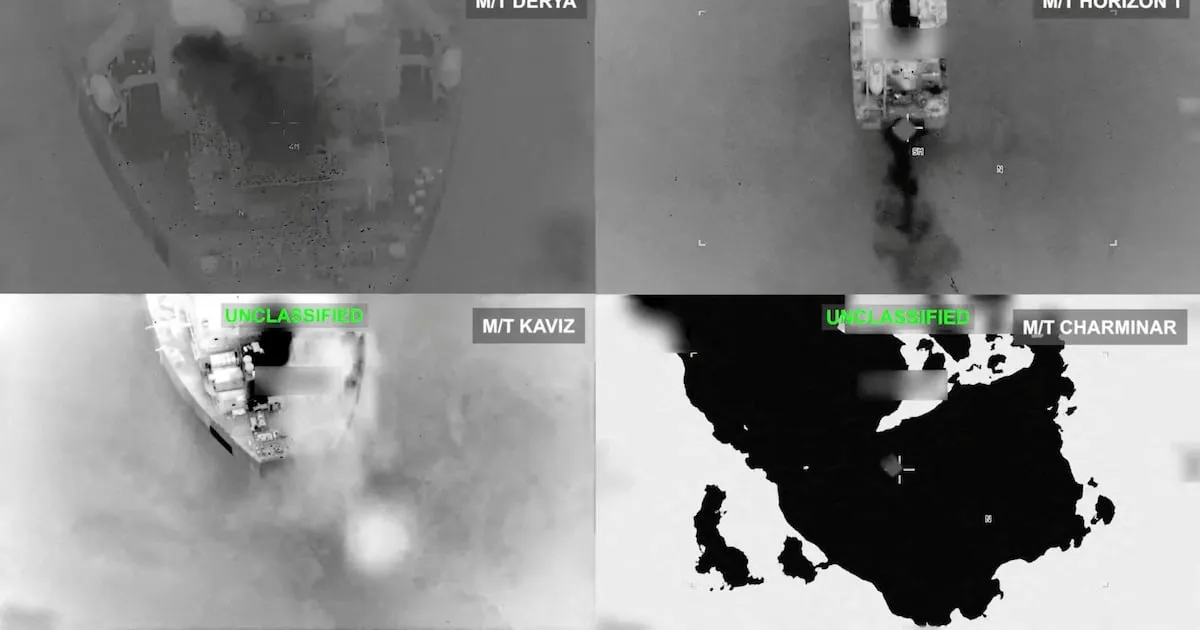
The U.S. military has destroyed five Iranian oil tankers in a retaliatory strike following recent Iranian missile attacks on U.S. Navy vessels. This action marks a significant escalation in the ongoing tensions between the two nations in the Persian Gulf.
U.S. Military Confirms Strike on Iranian Assets
U.S. Central Command announced on the 8th that its forces successfully targeted and destroyed five oil tankers belonging to Iran’s Islamic Revolutionary Guard Corps (IRGC). The operation was a direct response to two separate instances in the past two weeks where Iranian forces launched missiles at U.S. Navy ships. The command stated that the U.S. Navy ships successfully evaded the Iranian attacks and continued their patrols in the region, with no U.S. personnel casualties reported.
The strikes occurred in two key locations. Four of the targeted tankers were located off the coast of Oman, while the fifth was near the Strait of Hormuz, a critical chokepoint for global oil shipments. Central Command also released the names of the vessels that were attacked.
Details of the Operation
U.S. military officials explained that before engaging the tankers, the crews were warned and given an opportunity to disembark, ensuring their safety. The primary objective was to render the vessels inoperable and prevent them from continuing their voyages. This action was taken because, according to U.S. military intelligence, these oil tankers were being utilized by the IRGC and its regional proxies to fund their operations. The U.S. asserts that Iran has used these tankers as a source of revenue for a vast network of shadow companies, which in turn finance the IRGC and its proxy forces across the Middle East.
The U.S. military emphasized that Iran lacks any effective means to defend these particular tankers, making them vulnerable targets. This latest operation follows a similar strike on July 5th, when U.S. forces destroyed two oil tankers near the Strait of Hormuz and one near Oman, also rendering them unable to navigate.
Escalation in the Persian Gulf
The destruction of the five Iranian oil tankers represents a significant development in the maritime security landscape of the Persian Gulf. The region has been a focal point of geopolitical tension, with frequent incidents involving naval forces and commercial shipping. The U.S. military’s decision to directly strike Iranian assets underscores a hardening stance in response to perceived threats to its naval operations and regional stability.
The IRGC plays a crucial role in Iran’s defense strategy and is designated as a foreign terrorist organization by the United States. Its involvement in regional conflicts through proxy forces has been a persistent concern for the U.S. and its allies. The assertion that the oil tankers were funding these activities provides a strategic justification for the U.S. military’s actions, aiming to disrupt the financial lifelines of these groups.
Background of Recent Incidents
The recent missile launches from Iran targeting U.S. Navy vessels have been a direct catalyst for this retaliatory action. While the U.S. Navy successfully defended against these attacks, the repeated nature of the launches indicated a deliberate escalation by Iranian forces. The U.S. military’s response, while aimed at disabling the assets, also serves as a clear signal of deterrence against future aggression.
The Strait of Hormuz, where one of the tankers was destroyed, is a vital artery for global energy supplies. Approximately 20% of the world’s oil passes through this narrow waterway daily. Any disruption or threat to shipping in this region can have significant repercussions on global energy markets and international trade. The U.S. Navy maintains a significant presence in the Gulf to ensure freedom of navigation and deter hostile actions.
Strategic Implications and Future Outlook
The destruction of Iranian oil tankers is likely to provoke a strong reaction from Iran and could lead to further escalations. Iran has previously threatened to retaliate against U.S. interests in the region in response to perceived provocations. The U.S. military, however, appears prepared for such a scenario, emphasizing its readiness to defend its assets and allies.
The U.S. strategy appears to be focused on degrading Iran’s ability to project power and fund its proxy networks through illicit means, such as the alleged use of oil tankers. By targeting these financial conduits, the U.S. aims to impose economic pressure and limit Iran’s capacity for regional destabilization. The effectiveness of this strategy in de-escalating tensions remains to be seen, as it carries the inherent risk of further conflict.
International reaction to these events will be closely watched. Allies of the U.S. in the region, as well as global powers, will be assessing the implications for maritime security and the broader geopolitical stability of the Middle East. The ongoing cycle of action and reaction highlights the precarious nature of security in the Persian Gulf and the challenges in managing the complex relationship between the U.S. and Iran.
