

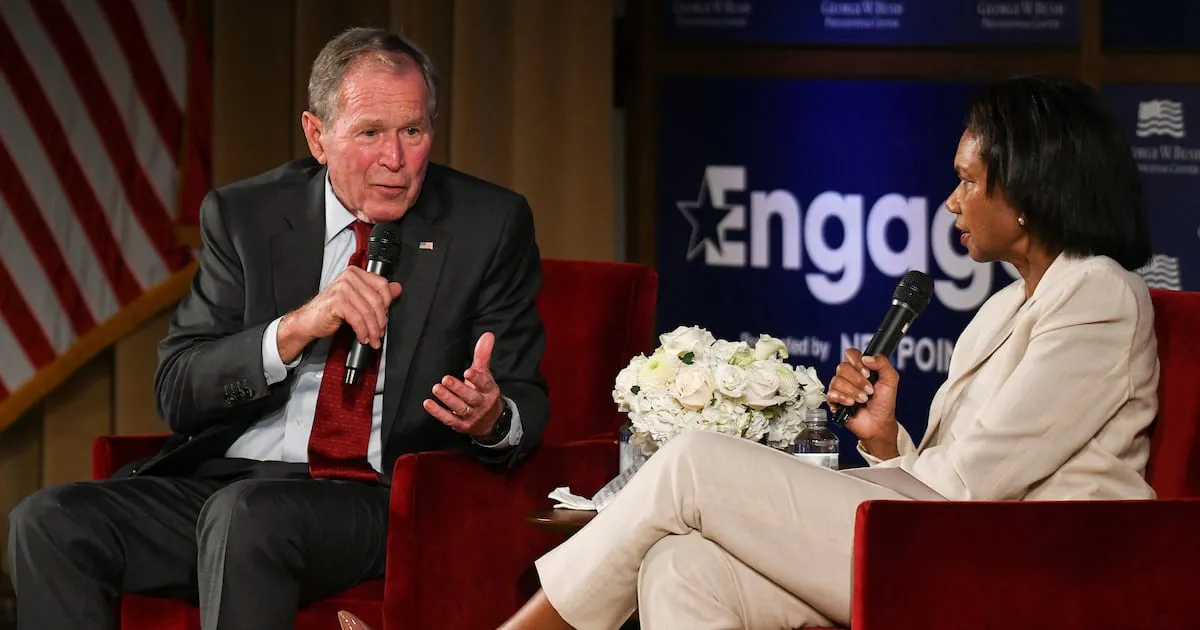
Former U.S. President George W. Bush recounted a pivotal phone call from then-Japanese Prime Minister Junichiro Koizumi on the morning after the September 11th terrorist attacks, describing it as a crucial moment that solidified his belief in the cooperation of free societies. Speaking at the George W. Bush Presidential Center at Southern Methodist University in Dallas, Texas, Bush shared this memory during a discussion with former Secretary of State Condoleezza Rice, just two days before the 25th anniversary of the devastating attacks.
The Significance of Koizumi’s Call
Bush emphasized that Koizumi’s call, received on the morning of September 12, 2001, was the first from a world leader following the tragedy. “The call from Koizumi gave me confidence that free societies could work together,” Bush stated. He reflected on the irony of the call, considering the historical conflicts between the United States and Japan during his father’s generation. “It was an ironic call, thinking about the conflicts our fathers’ generations fought,” he said. “But he called, and we discussed how both nations could defend each other’s freedoms through mutual defense treaties.”
The personal connection between Bush and Koizumi, forged in the aftermath of the attacks, is seen by many as a catalyst for the strengthening of U.S.-Japan relations in the early to mid-2000s. This period saw a significant deepening of their alliance, moving beyond mere formality to a more robust partnership.
Recollections from the Day of the Attacks
During the same event, Bush and Rice shared further details about the events of September 11th. Bush recalled his immediate reaction upon returning to the White House after visiting a Florida school that day. His first question to Rice was about the safety of his wife, Laura. Rice described the moment as feeling “truly familial,” highlighting the human element amidst the unfolding crisis.
Both Bush and Rice admitted that in the initial hours, they believed the incidents were merely airplane accidents. However, as the situation became clear, Bush’s focus shifted. “The perpetrators were identified fairly early on, and my main concern was to serve as the ‘Comforter in Chief’ for the grieving families and the nation,” he explained. He recounted his visit to Ground Zero in New York, the site of the World Trade Center’s collapse, where he witnessed firsthand the sacrifices and bravery of firefighters and police officers.
The September 11th attacks resulted in the deaths of 2,977 people across multiple locations, including the World Trade Center in New York, the Pentagon in Washington D.C., and a field near Shanksville, Pennsylvania. Bush spoke about the profound sadness he felt meeting those who had lost loved ones, particularly the difficulty of interacting with children affected by the tragedy. “The only thing I could do was hug them and tell them I cared,” he shared.
The Spirit of American Resilience
Bush also noted the surge of volunteers eager to join the military in the wake of the attacks. “When America is in crisis, Americans step up,” he observed. “I witnessed that firsthand, and it showed me what an incredible country America is.” This sentiment was powerfully symbolized by Bush’s appearance at Game 3 of the World Series at Yankee Stadium on October 30, 2001, where he threw out the ceremonial first pitch wearing a bulletproof vest. This moment remains an iconic image of America’s resolve in overcoming the 9/11 attacks.
Addressing the numerous conspiracy theories surrounding 9/11, Bush expressed his intent to disregard such notions. “I try not to pay attention to those nuts,” he remarked.
Reflections from Military Personnel
The event also included remarks from then-Brigadier General Dan K. McNeill, who was stationed at Andrews Air Force Base near Washington D.C. at the time. McNeill recounted his experience leading F-16 fighter jets in defense of the capital. He recalled a critical moment when he requested authorization to shoot down a hijacked airliner, a decision that remained with him for 25 years. He also remembered the leadership of then-Major General David W. P. Powers, commander of the D.C. Air National Guard, who assured him, “I don’t know what you’re going to face, and it’s going to be incredibly difficult, but I will protect you.”
McNeill reflected on the dual nature of that day: “2,977 people died, but it was also a day of extraordinary courage.” He concluded by stating, “Americans, even when they are bumping into each other and making noise, when the nation is in trouble, they come together. That’s the American identity.”
