

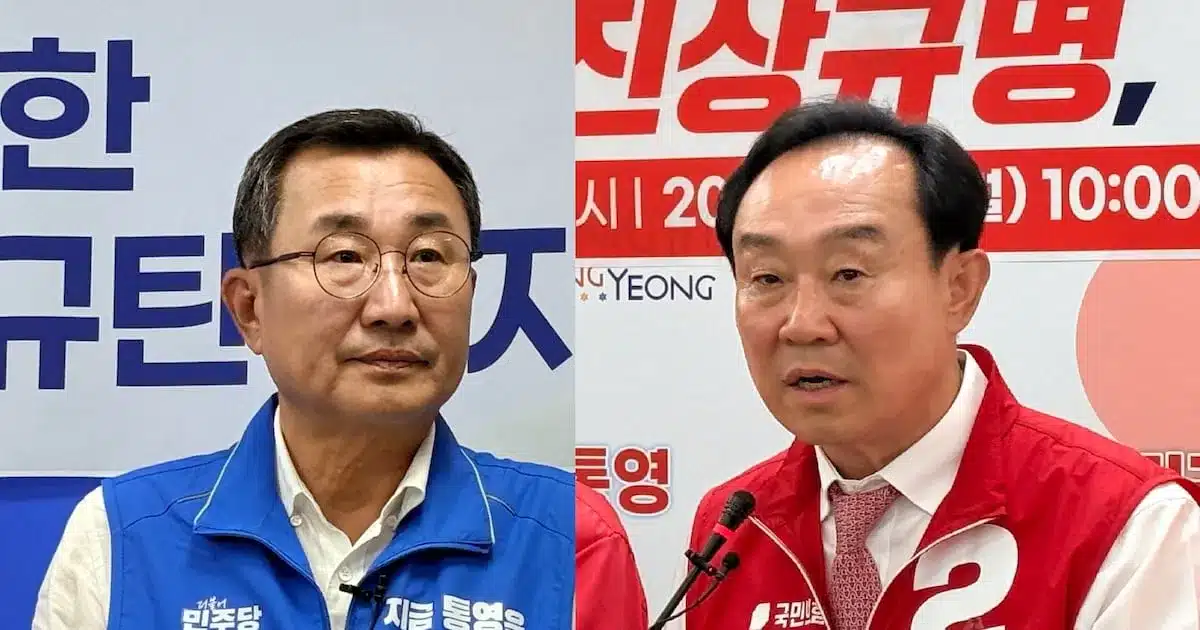
A meticulous recount of the Tongyeong mayoral election ballots, spanning nearly 12 hours, has reaffirmed the initial outcome, confirming Kang Seok-ju of the Democratic Party as the victor. While the final margin of victory narrowed slightly, the election result remained unchanged. The Gyeongnam Provincial Election Commission announced on July 28th that Kang Seok-ju secured a win over Cheon Young-ki of the People Power Party by a final difference of 38 votes.
Recount Details and Margin Shift
The Gyeongnam Provincial Election Commission conducted the ballot recount at the convention hall on the 6th floor of the Provincial Election Commission building in Seongsan-gu, Changwon City. The recount revealed that Kang Seok-ju received 33,626 valid votes, while Cheon Young-ki garnered 33,588 votes. A total of 1,024 ballots were deemed invalid. Initially, after the first count on June 3rd, the difference between the two candidates was 44 votes. However, the recount reduced this margin to 38 votes.
The slight reduction in the vote difference is attributed to a re-evaluation of previously invalidated ballots. While Kang Seok-ju’s vote count remained consistent, six ballots that were initially classified as invalid (totaling 1,030) were re-examined. Of these, six were deemed valid for Cheon Young-ki, altering his total vote count and narrowing the gap. Despite this adjustment, the overall election outcome was not affected.
Background of the Recount Request
The demand for a recount was initiated by Cheon Young-ki, the defeated candidate, who filed an appeal with the Provincial Election Commission on July 17th. Cheon’s appeal argued that there were potential errors in the ballot sorting and counting process, specifically concerning the automatic sorting system used during the initial count, and therefore, a recount was necessary to ensure accuracy. The recount process encompassed all 69,693 cast ballots.
The Recount Process: Challenges and Delays
The manual recount involved approximately 24 observers from both campaigns (12 from each side), along with election commission officials. The process began with election officials manually verifying each ballot. However, the recount, initially scheduled to commence around 2 PM, was delayed until approximately 3:25 PM due to objections raised by Cheon’s campaign team.
A key point of contention arose when observers from Cheon’s side questioned the integrity of the seals on the boxes containing the ballots. Jeon Han-gil, a history teacher and YouTuber observing on behalf of Cheon, argued that while hand-stamped ballots typically show an ink mark on the reverse side, the absence of such a mark on the back of some ballots suggested they might not have been properly stamped. Jeon stated that his participation was to ensure the counting process was conducted correctly and transparently, thereby informing the public about any potential irregularities.
Further complicating the process, Cheon’s team requested video recording of the proceedings or direct access to the video footage. These procedural disputes and objections led to significant delays. Consequently, the results, which were initially expected around 8-9 PM on July 27th, were not finalized until approximately 3 AM on July 28th, pushing the announcement well past midnight.
Throughout the extended counting period, observers from both campaigns closely monitored the three counting stations, meticulously checking each ballot for proper stamping and validity. The manual verification process was exhaustive, with officials and observers scrutinizing every detail to ensure fairness and accuracy.
Next Steps and Cost Implications
Following the recount, the Gyeongnam Provincial Election Commission is scheduled to make a decision by August 18th regarding the acceptance, rejection, or postponement of the recount results. The cost of the recount, estimated at approximately 19.22 million won, will initially be borne entirely by Cheon Young-ki, the candidate who requested the recount. However, if his appeal is ultimately deemed valid, the costs will be reimbursed.
It is widely anticipated that the Provincial Election Commission will rule to dismiss Cheon Young-ki’s appeal, meaning the recount results will likely be upheld, and his original challenge will be rejected. This would solidify Kang Seok-ju’s position as the duly elected mayor of Tongyeong.
Conclusion
The extensive recount process, marked by delays and close scrutiny, ultimately confirmed the initial election outcome for the Tongyeong mayoral race. While the vote difference between the two leading candidates was slightly reduced, Kang Seok-ju’s victory was reaffirmed. The process underscored the importance of transparency and meticulousness in electoral procedures, even as it highlighted the potential for procedural disputes to extend the timeline of election verification.
