

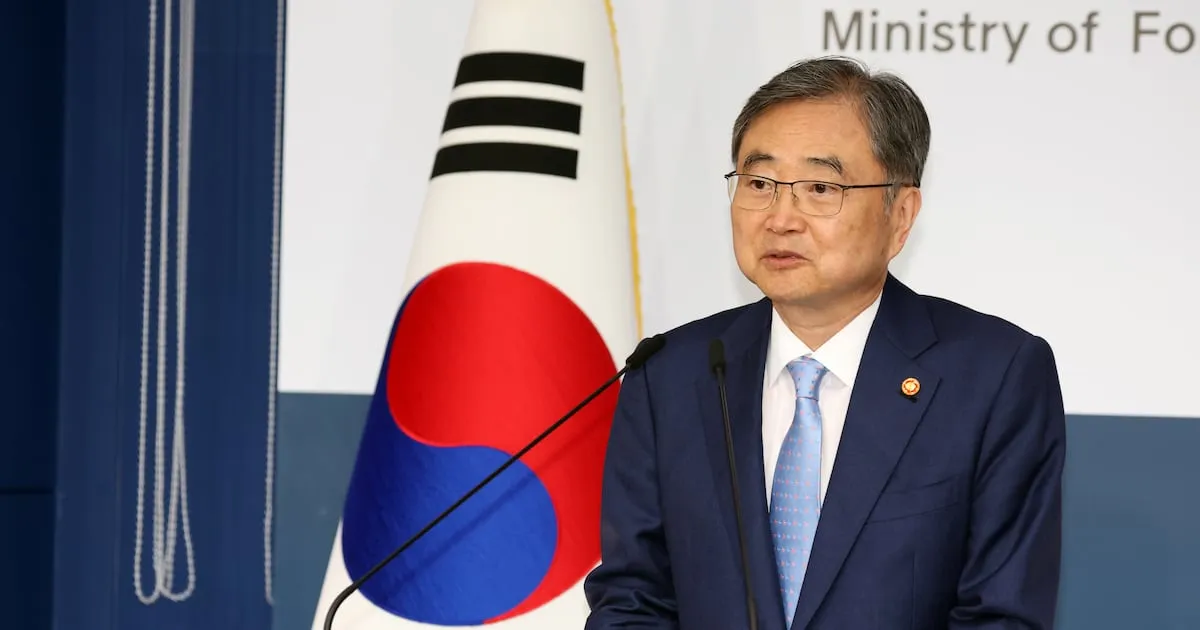
South Korean Foreign Minister Cho Tae-yul indicated on September 5th that a significant agreement on defense cooperation between South Korea and the United States is imminent, stating that a deal is expected at the high-level official level in the near future. While formal signing ceremonies have not yet occurred, Cho emphasized that substantive negotiations have been consistently progressing.
Defense Pact Negotiations Progressing
The ongoing defense pact talks, aimed at discussing follow-up measures after the South Korea-US summit, have seen their second round of meetings delayed since the initial session in June. Minister Cho identified several key opportunities for advancing these high-level discussions. These include the upcoming UN General Assembly’s high-level meeting in September and potential encounters during the APEC (Asia-Pacific Economic Cooperation) summit, where US Secretary of Defense Lloyd Austin is expected to attend. Cho suggested that further meetings could be arranged before these major events.
Addressing concerns about potential delays in the negotiations, Cho stated that the timeline is not necessarily lagging. He acknowledged that global events, such as the conflict in the Middle East, have contributed to some delays. However, he stressed that while investment from South Korea into the US is not seen as a bottleneck, the pace of such investments is crucial and requires swift progress.
Addressing Bilateral Trade Issues
Beyond the defense pact, Minister Cho highlighted efforts to resolve other bilateral issues that could impact the robust relationship between South Korea and the US. He specifically mentioned trade disputes, such as those involving Coupang, a major e-commerce platform. Cho stated that his ministry is actively working to expedite resolutions for these matters to ensure the continued development of the strong alliance. He noted that while these trade issues may not directly influence the defense negotiations, they are part of a broader effort to strengthen the overall bilateral relationship.
In relation to the Coupang issue, the Ministry of Foreign Affairs had previously instructed Ambassador Kang Sang-wook to return to Seoul temporarily in mid-August. This measure was taken to facilitate discussions and formulate comprehensive countermeasures with relevant domestic agencies. Cho clarified the term used for the ambassador’s return, explaining that it was an “expedited return for work consultation” rather than a formal “recall” or “protest.” He elaborated that “expedited return” is the appropriate term when a country’s ambassador in a foreign nation is summoned back to the capital to convey a particular stance or discuss urgent matters.
Diplomatic Engagements and Personal Anecdotes
Minister Cho also shared details of his recent meeting with US Ambassador to South Korea, Sung Kim, on the previous day. He recounted a lighthearted exchange where Ambassador Kim’s spouse mentioned their 45-year marriage without divorce, to which Cho humorously replied that his own situation was similar. Sung Kim’s husband, Sean Steel, is a prominent figure in California Republican politics and had accompanied the ambassador during her previous visit to the Ministry of Foreign Affairs to submit her credentials and meet with Minister Cho.
Cho recounted a playful remark he made to Steel, referencing the concept of “Buy one, get one free” to signify a “1+1” situation. He shared that he told Steel, “Welcome. If you are needed in US politics in the future, our government will utilize you well.” In response, Steel reportedly said, “I will work hard with pleasure.” This anecdote underscores the friendly and collaborative atmosphere that often characterizes high-level diplomatic interactions.
The minister’s remarks suggest a dynamic diplomatic environment where defense cooperation is a primary focus, but attention is also given to resolving trade friction and maintaining strong personal relationships between officials and their families. The anticipation of a high-level defense agreement signals a deepening of the security alliance between the two nations, even amidst complex geopolitical challenges and ongoing trade discussions.
