

A controversy over the alleged plagiarism, or ‘copy-pasting,’ of student academic records has erupted in South Korea, highlighting deep-seated issues within the university admissions process and the pressures placed on educators. The scandal centers on the ‘Se-taek,’ a detailed section within the student record book (haksaengbu) where teachers describe students’ specific abilities and characteristics. Recent audits have revealed widespread instances where teachers have used identical descriptions for multiple students, raising questions about fairness and the integrity of the evaluation system.
Widespread ‘Copy-Pasting’ Revealed
An audit by the Board of Audit and Inspection (BAI) found that out of 15,377 subject teachers in Seoul high schools between 2021 and 2024, a significant number had used identical descriptions for multiple students in the ‘Se-taek’ section. Specifically, 803 teachers reportedly copied and pasted the same content for over 50 students each. This practice was observed across 239 out of 315 high schools in Seoul, spanning various school types including general, autonomous, foreign language, international, and science high schools.
The issue extends to the ‘Comprehensive Opinion’ section as well. In 236 high schools, 1,604 homeroom teachers were found to have used the same descriptions for two or more students. The audit further detailed that 76 teachers created two to five standardized descriptions and applied them arbitrarily to the majority of their students, reserving truly individualized comments for only one or two students. In some cases, three homeroom teachers even applied identical comprehensive opinions to all students in their charge.
Teachers Cite Systemic Pressures
Educators on the ground argue that these practices are not merely a matter of individual teachers’ laziness or lack of integrity, but rather a symptom of a flawed system. A technology teacher, identified as Mr. A, acknowledged that copying student records is not ideal but pointed out that students aiming for early admission or those interested in higher education often have numerous extracurricular activities. This abundance of activity provides ample material for detailed records, he explained.
However, for students with fewer activities, teachers struggle to find enough content to fill the record meaningfully. “Even if we try to write something for students with limited activities, there’s simply not enough material,” Mr. A stated. “When students take the same class and engage in similar activities, the written descriptions inevitably become similar. It’s a constant dilemma for us on the ground.”
Another teacher, Mr. B, from a private high school in Seoul, noted that teachers who excel at writing student records sometimes receive commendations from the school. “Ultimately, it seems directly tied to college admission results,” he commented. In private schools, university admission outcomes for graduating students are often used as a metric to gauge the school’s standing and attract future students. Consequently, the task of writing student records becomes a source of pressure and a motivator for teachers.
Mr. B further elaborated on the practical challenges: “We are responsible for nearly 30 students in a single class, and with the introduction of the High School Credit System, student compositions change every period. Recording the growth process of each individual student with distinct descriptions is practically very difficult.” He added that after about a decade of teaching, the burden on teachers for writing student records has become excessively heavy, largely because these records are used as crucial college admission materials.
The Evolving Role of the Student Record Book
The student record book (haksaengbu), originally intended as a comprehensive record of a student’s school life, has increasingly become a critical component of university admissions. The ‘Se-taek’ section, in particular, has gained prominence as a key evaluation tool, especially with the rise of the ‘Su-si’ (early admission) track, which emphasizes factors beyond standardized test scores.
Since the introduction of the college admissions system in 2007, the student record book has evolved from a simple log to a vital college application document. The systematic expansion of the ‘Comprehensive Student Record’ in 2014 solidified the importance of narrative-style entries like the ‘Se-taek’ in evaluating students. Universities view these sections as essential for understanding a student’s specific academic interests, exploration efforts, and potential career alignment, going beyond mere grades.
Mr. B explained his approach to the ‘Se-taek’: “I believe the ‘Se-taek’ section, more than other individual categories, can reveal a student’s capabilities by subject. I put effort into writing it well to match the student’s interests or the career they are aiming for.” This perspective underscores the pressure teachers feel to craft individualized narratives within limited space, aiming to showcase a student’s academic attitude, career suitability, and growth potential.
The emphasis on the student record book has transformed the task from documenting a student’s educational journey into creating ‘differentiated text’ for admissions. This pressure also influences teaching methods, with some suggesting that classes are increasingly taught with evaluation in mind. Professor Park Ju-hyung of Kyungin National University stated, “The problem with student record entries lies not in the teachers’ effort but in the system’s design.”
Professor Park elaborated, “In the past, the focus was on preparing student records for a few students applying for early admission. Now, the trend has shifted to ‘recording all students fairly.’ As evaluations reflect student growth, teachers spend considerable time on performance assessments and presentations, then documenting these in the student records.”
Systemic Flaws and the High School Credit System
Criticism of student record entries often points to the expanded early admission process over the past decade, particularly the ‘Comprehensive Student Record.’ The High School Credit System, implemented for second-year high school students, allows them to choose courses aligned with their career paths. While intended to foster student choice and move away from standardized education, it creates challenges for teachers.
With students selecting diverse courses, teachers now meet different students in various subjects each period, making continuous, individualized observation and record-keeping more difficult. This complexity is compounded by recent changes that have limited the content and length of student record entries. While intended to enhance fairness, these restrictions reduce the information available for university evaluation, placing greater weight on remaining elements like grades and the ‘Se-taek.’
The ‘Joo Guk incident’ in 2019 further intensified scrutiny on university admissions, leading to the government restricting categories that could be included in student records or considered for admissions. Activities like awards, volunteer work outside school, personal volunteer hours, and reading logs were excluded. The Ministry of Education stated this was to reduce the influence of private education and parental influence, but critics argue it has concentrated evaluation weight onto fewer categories, such as academic performance and the ‘Se-taek.’
Professor Yang Jung-ho of Sungkyunkwan University commented, “After the ‘Joo Guk incident,’ the student record book became a mess.” He added, “When the content that high schools can record is reduced, and universities are asked to evaluate, they can only rely on limited content like the ‘Se-taek.'” This situation, he explained, leads to students and parents demanding that their desired content be included, placing further demands on teachers.
Teacher Unions Demand Reform
In response to the BAI’s audit findings, teacher unions have voiced strong opposition. On July 24, the Korean Federation of Teachers’ Associations and the Seoul Teachers’ Union held a press conference criticizing the BAI’s “mechanical auditing that evaluates teachers solely on whether sentences match, disregarding the educational context of student records.” They demanded a review of the audit results and an apology for the “collective defamation” of teachers.
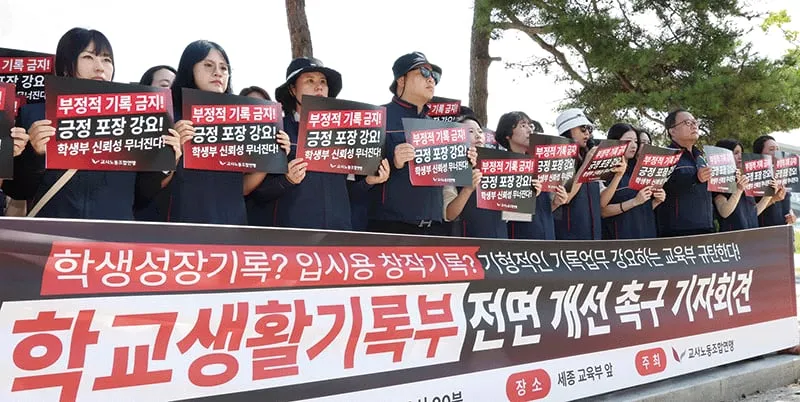
The unions are calling for a fundamental reform of the student record system. The Korean Teachers and Education Workers Union stated on July 31 that the student record book has “effectively become a ‘creation for admissions” and called for a re-evaluation of its role in university admissions. They specifically highlighted that the High School Credit System has increased the number of courses students take and the records teachers must manage, but teacher allocation and the admissions system have not kept pace.
The unions are advocating for a reduction in the admissions evaluation function of student records, differentiated record-keeping systems by grade level, and a re-examination of the current narrative-style reporting methods. The core issue, they argue, is the systemic pressure to create ‘differentiated’ records for admissions, which conflicts with the original purpose of documenting a student’s genuine educational progress.
Student and Parent Perspectives
The pressure extends to students and parents, who are also affected by the ambiguity and perceived unfairness. Students, unable to write or ultimately revise their own records, feel anxious about their college prospects being determined by the quality of their teachers’ writing. Some students have resorted to writing their own activity descriptions or requests for specific content to be included in their records.
Kim, a freshman at a women’s university in Seoul, shared, “In some classrooms, students directly wrote their ‘Se-taek’ or ‘Hae-taek’ (Behavioral Characteristics and Development Opinions) and submitted them.” She added, “Some teachers even asked us to write them by subject.” This practice of students proactively organizing and submitting their achievements or requesting specific career-related content to be reflected in their records is not uncommon.
A student from a high school in Dongjak-gu, Seoul, named Ahn, stated, “I decided to major in police administration and told my homeroom teacher and subject teachers. My friends are doing the same. Since teachers write what we ask them to, we try to request descriptions that are as similar as possible [to our desired field].” This situation represents a shift from teachers observing and recording student life to students creating the ‘material’ for their records and presenting it to teachers.
The introduction of the High School Credit System is expected to exacerbate these issues. While the system aims to broaden student choice and cater to individual career paths, it complicates the teacher’s role. Teachers now face students in various subjects daily, making continuous observation and detailed record-keeping for each student increasingly challenging. The tension between the need for individualized records reflecting student choice and the practical difficulties faced by teachers under the current system remains a significant concern.
The debate over student records underscores a fundamental conflict: the original intent of documenting holistic student development versus the current reality of using these records as a primary tool for competitive university admissions. Addressing this requires a systemic overhaul that alleviates pressure on educators and ensures a fairer evaluation process for all students.
