

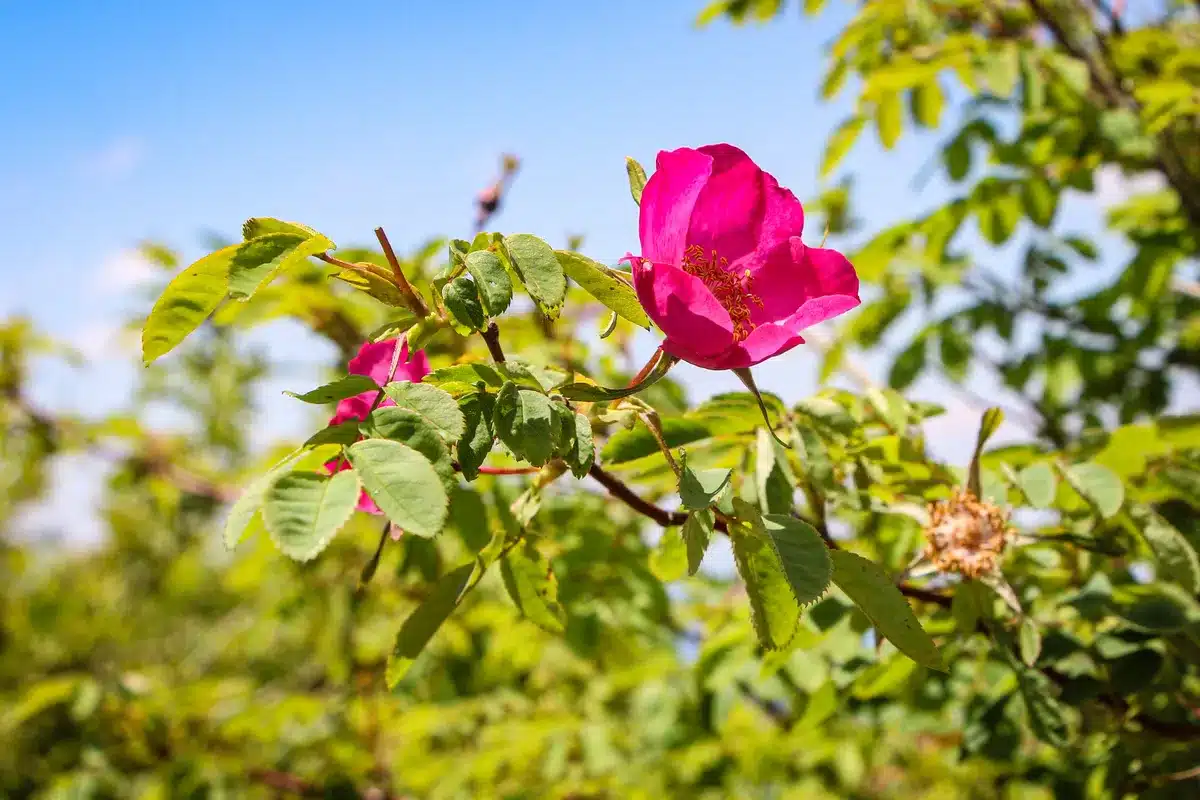
During a recent four-day trip from June 11th to 14th, I explored the mountainous regions of Japan’s Shikoku island, visiting locations like Makino Botanical Garden, Mount Ishizuchi (1982m), Mount Tsurugi (1955m), and Kurozo Marsh. Amidst the stunning scenery, I encountered numerous plant species, many of which are facing endangerment or are rare in Korea. This report highlights twelve such species found thriving in Japan’s highlands.
Alpine Blooms of Shikoku
One of the most striking flowers I observed near the summit of Mount Tsurugi was the Ingamok. Resembling the common Rhododendron (Haedanghwa), the Ingamok differentiates itself by its habitat. While Rhododendrons typically grow near the coast or on lower mountain slopes, Ingamok prefers high altitudes. Furthermore, Rhododendron leaves are thicker with deeper veins and broader leaves, whereas Ingamok leaves are less veined, have deeper serrations, and a rougher, irregular texture.
The common Rhododendron, often referred to as Chamkkot (edible flower), can be eaten, while Cheoljjuk, a type of Rhododendron, is known as Gaekkot (dog flower) because it is inedible. However, distinct from the common Rhododendron, there is a species called Chamkkotnamu (true flower tree) found on Jeju Island. This particular tree was abundant on the mountains of Shikoku. Chamkkotnamu is a deciduous shrub, with Jeju Island being its sole natural habitat in Korea. Its vibrant flowers bloom alongside its leaves in May and June, offering a striking splash of color. This tree is considered a symbolic flower of Jeju Island, known as the Dohwa (island flower). The three leaves that cluster at the end of each branch are thought to represent Jeju’s ‘three abundances’ (wind, stone, and sea) and ‘three nones’ (beggars, thieves, and fires).
A white-flowered variant, Huin chamkkotnamu, shares the same genus as the common Rhododendron. In Korea, it is a rare plant found in the high-altitude regions of southern mountains like Deogyusan, Jirisan, and Gayasan. Its white flowers are small and difficult to spot. I was able to find this rare white Rhododendron in the alpine zone of Mount Ishizuchi.
The Gisaengkkot (parasitic flower) is another rare plant found in the high altitudes of mountains from Jirisan to Taebaeksan and Seoraksan, and even on Baekdusan. Its white petals, adorned with golden stamens like a crown, make it a beautiful sight. Classified as Endangered Wild Species Class II, this flower is rarely seen. Yet, it was commonly found on Mount Tsurugi.
This flower is a temperate plant that descended to the Korean peninsula during glacial periods but struggled to survive as temperatures rose. It now persists precariously in the cooler alpine zones. The name Gisaengkkot is said to derive from its resemblance to the ornamental hairpins worn by women, or from its stunning beauty, likened to that of a courtesan.
Mount Tsurugi’s peak was covered in Heoldeokipul, a type of Geranium. Its long flower stalks were adorned with numerous small white flowers. This plant, belonging to the Geranium family, is found in Korea, Ulleungdo, Japan, Taiwan, China, and the Himalayas. It is known for its efficacy in treating coughs and fevers, hence its name. The name Heoldeokipul literally translates to ‘lung-supporting herb’.
Durumikkot, another Geranium species, was also common in the alpine regions of Shikoku. In Korea, it is typically found in forests above 1000 meters on mountains like Sobaeksan, Taebaeksan, Seoraksan, and Deogyusan. It is a perennial herb of the Geranium family, with horizontal leaves resembling the wings of a dragonfly. Its white flowers, along with its long stems, are said to resemble a crane’s long neck and head. Found in damp, open areas of high mountains and wetlands in May and June, its leaves emerge in clusters of two or three from the stem. They are heart-shaped, pointed, and have hairs on the underside.
Seongneolsuguk was also remarkably abundant on the higher elevations of Mount Ishizuchi. This perennial plant, related to the Geranium family, was first discovered in Seongnal Oreum, Jeju Island, in 2003, leading to its name. Prior to this, it was believed to be endemic to Japan. Currently, Seongnal Oreum is its only known natural habitat in Korea. It grows to about 1.5 meters tall, with white or pale red flowers blooming in June and July. It shares a similar morphology with related species like Samsuguk, Deungsuguk, and Bawisuguk.
Sujeongnanpul is an epiphyte belonging to the Geranium family. It can be found occasionally in mountainous areas across Korea, growing on rocks as it lacks roots and obtains nutrients from its host. Direct sunlight causes it to wither, so it thrives in shaded or humid environments. I encountered it several times in the alpine regions of Shikoku.
Flora of Kurozo Marsh and Makino Botanical Garden
In Kurozo Marsh, the Kkeunkkeunijugeok stood out as a representative species of carnivorous plants. While it naturally grows in sunny, damp areas in Korea, development projects have led to its habitat loss, making it increasingly rare. Children often find this plant fascinating. Its root-like leaves store dew, and its red, moving tendrils, when exposed to sunlight, appear like morning dew. Beautiful flowers were also in bloom.
The marsh was also home to the Keunbangulsaraen, a perennial herb of the Orchid family that prefers sunny, damp environments. It stands about 15-30cm tall, with long, lanceolate leaves that have smooth margins and taper towards the base, resembling wings along the stem. Its reddish-purple flowers bloom in clusters at the end of the stem in June and July. This plant can be found throughout Korea.
I also encountered the rare Eureumnancho in Kurozo Marsh. As a parasitic plant, it lacks any green coloration. The name Eureumnancho is derived from the appearance of its fruit, which resembles the seed pods of the elm tree. In Korea, it is found in limited areas like Anmyeon-do and is protected as an Endangered Wild Species Class II. It grows to about 1.5 meters tall, with white or pale red flowers blooming in June and July. It shares a similar morphology with related species like Samsuguk, Deungsuguk, and Bawisuguk.
Makino Botanical Garden was established in Kochi Prefecture, Japan, to honor the work of Japanese botanist Dr. Tomitaro Makino. His name is frequently associated with Korean plant species, including the Gakjisebikkot. Here, I found Mannyun-kong, a precious plant with only five to six known individuals in Korea, making it an Endangered Wild Species Class I. China and Japan also designate it as an endangered species. The only known natural habitat in Korea is the Donnaeko stream valley in Jeju.
Mannyun-kong is unique among Korean legumes as it is the only species that remains green throughout the four seasons. It grows to a height of 30-60cm, with stems spreading close to the ground. Its leaves are composed of three small leaflets, forming compound leaves, and have white hairs on the underside. White flowers bloom at the end of the stems in June and July, followed by dark blue pods from September to November. Unlike other legumes, its pod is fleshy and contains a single seed. Other rare Korean native plants I observed include Bunhongnorubal, Hongnodoraji, Wando-sullkkotnamu, Sanaengdonamu, Jeonggeumnamu, and Heuksamneung. Seeing these plants, which are also found on Baekdusan, Hallasan, and Ulleungdo, felt like visiting all three locations at once. Naturally, I also saw many other impressive flowers endemic to Japan, such as Norangchamnari, Danpungcheoljjuk, and Bindori.
