

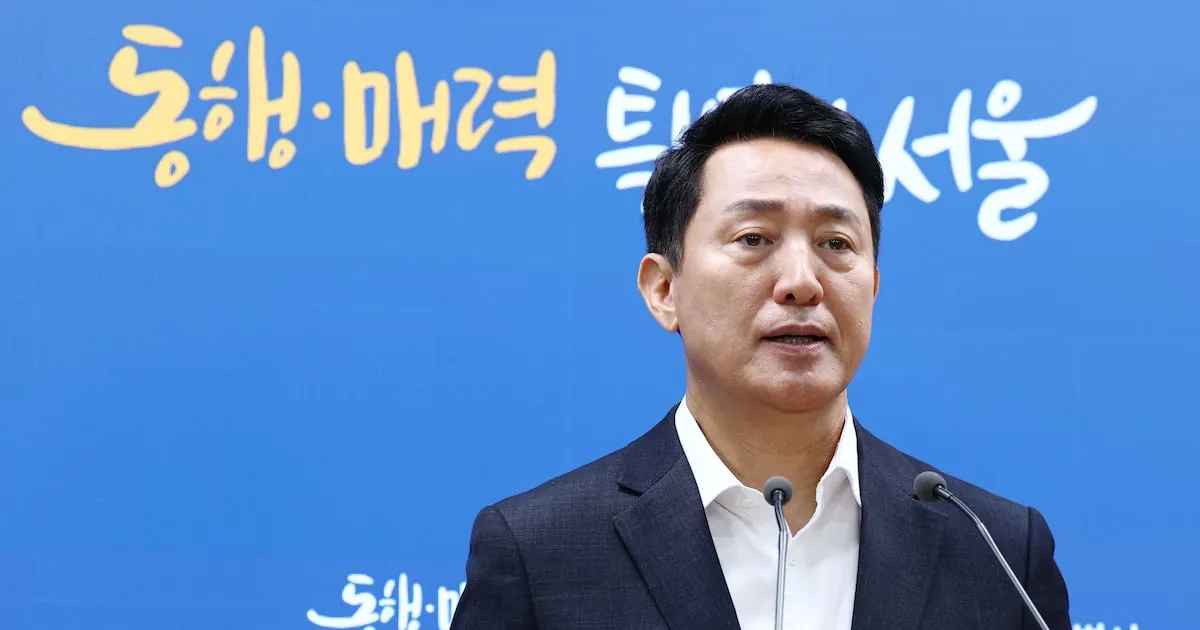
Seoul Mayor Oh Se-hoon has strongly criticized a statement made by Kim Min-seok, a leader of the Democratic Party, who predicted a 99.9% chance of the mayor’s re-election next year. Oh characterized Kim’s remarks as an attempt to exert undue influence on the judiciary, pressuring it to deliver a specific outcome in an ongoing legal process.
Mayor Oh’s Office Denounces ‘Anticipatory Judgment’
Lee Jong-hyun, Seoul Metropolitan Government’s Special Commissioner for Public Relations and Communication, issued a statement on the 10th questioning the Democratic Party’s stance on the separation of powers. The statement, titled “Does the Democratic Party Recognize the Judiciary as a Pillar of the Three Branches of Government?”, highlighted Kim Min-seok’s recent comments as a disregard for judicial independence, following earlier controversial remarks regarding a public official named Jo Hee-dae.
The special commissioner pointed out that the appeal process for the Seoul mayoral election has just begun. “To claim a 99.99% chance of re-election is to pre-emptively determine the outcome of the trial,” Lee stated. “This is effectively instructing the judiciary, which is currently deliberating the case, on what conclusion to reach.”
Questioning Judicial Independence and Party Authority
The statement further probed the Democratic Party’s fundamental respect for the judicial system. “Does this mean the Democratic Party does not recognize the judiciary as a pillar of the three branches of government?” Lee asked. “Or does the party believe it stands above the three branches and can exercise authority over them?” These questions underscore a significant concern about potential political interference in legal proceedings.
The special commissioner emphasized the gravity of the situation, especially given the current economic uncertainties and the difficulties faced by citizens. “In a situation where real estate market instability and public hardships persist, using the Seoul mayoral re-election to create a fait accompli and destabilize the city administration is an irresponsible act for a party leader,” Lee asserted.
He added, “The solemn position of Seoul Mayor, responsible for the lives of ten million citizens, is not something that can be swayed by the election strategies of the Democratic Party.” This highlights the mayor’s office’s view that the mayoral role is too critical to be subjected to political maneuvering.
Focus on Governance and Citizen Welfare
The mayor’s office stressed that the current Seoul Mayor is dedicated to addressing the daily lives of citizens and navigating the complexities of the city’s market. “Seoul City officials are also working without wavering to serve the citizens,” the statement affirmed, indicating a unified effort within the administration.
Concluding his remarks, the special commissioner reiterated that the position of Seoul Mayor is not determined by the political calculations of the Democratic Party leader. “The Seoul Mayor’s office is not a position decided by the number of votes calculated by the Democratic Party leader,” he stated. This reinforces the mayor’s commitment to his duties and his belief that the office’s legitimacy stems from public service and judicial process, not political predictions.
Broader Implications for Political Discourse
Kim Min-seok’s comments, and the subsequent response from Mayor Oh’s office, highlight a recurring tension in South Korean politics regarding the relationship between political parties, the judiciary, and elected officials. The principle of judicial independence is a cornerstone of democratic governance, ensuring that legal decisions are made impartially, free from external pressure. When political figures make statements that appear to pre-judge legal outcomes or pressure judicial bodies, it can erode public trust in the fairness of the legal system.
The Democratic Party, as a major political force, faces scrutiny over its adherence to democratic norms, including respect for the separation of powers. The opposition’s role often involves holding the government accountable, but this must be balanced with a commitment to upholding the integrity of all branches of government. Mayor Oh’s strong reaction suggests that he perceives Kim’s remarks as crossing a line, potentially undermining not only his personal political standing but also the stability of the city’s governance.
Furthermore, the timing of these remarks is significant. With an appeal process underway, any public statement that could be interpreted as influencing the court’s decision is particularly sensitive. The Seoul mayoral election itself was a closely watched event, and the subsequent legal challenges continue to draw public attention. The mayor’s office’s defense emphasizes the importance of allowing the legal process to unfold without perceived political interference, focusing instead on the administrative duties and the welfare of Seoul’s residents.
The debate also touches upon the nature of political campaigning and public discourse. While predicting election outcomes is common in politics, doing so with such a high degree of certainty, especially when legal challenges are involved, can be seen as a strategic move to shape public perception or to demoralize opponents. The Seoul Metropolitan Government’s response frames this as an attempt to exert political pressure, rather than a genuine assessment of electoral prospects.
Conclusion: Upholding Democratic Principles
The exchange between Mayor Oh Se-hoon and Kim Min-seok underscores the critical importance of maintaining the independence of the judiciary and respecting the separation of powers. While political parties naturally engage in strategic communication and electoral forecasting, statements that appear to pressure or pre-empt judicial decisions can be detrimental to democratic institutions. The Seoul Metropolitan Government’s firm response emphasizes its commitment to governance based on due process and public service, asserting that the responsibilities of elected office are not subject to political manipulation or predetermined outcomes.
