

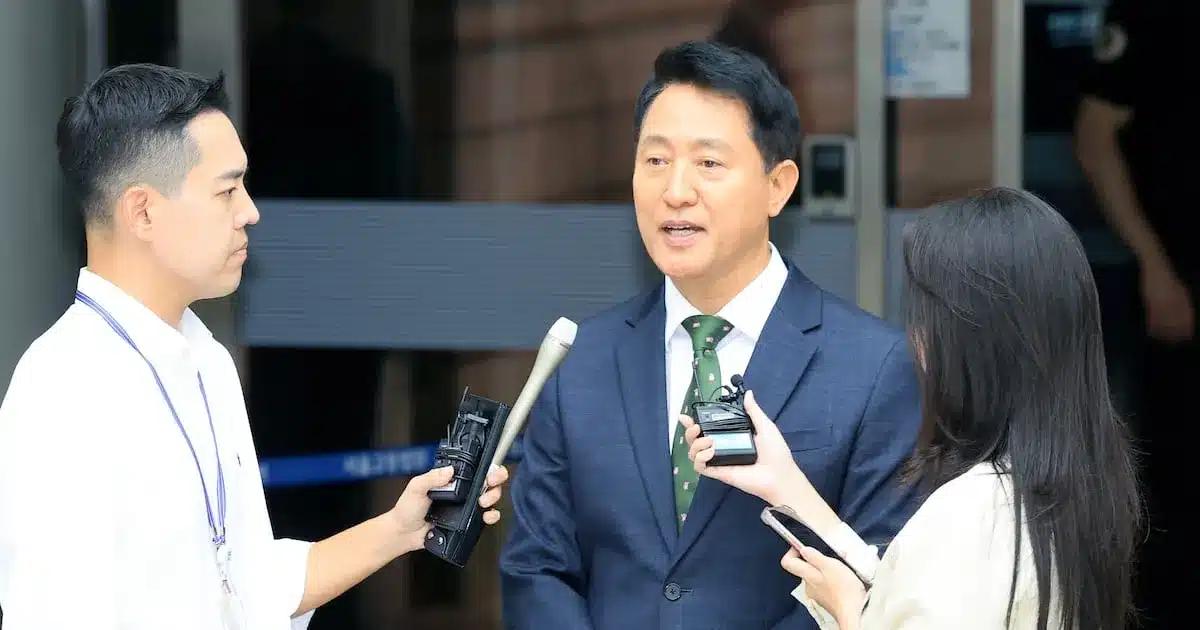
Seoul Mayor Oh Se-hoon’s office has announced plans to appeal a recent court ruling that imposed a fine of 10 million Korean won (approximately $7,200 USD) on the mayor, citing alleged involvement in rigging opinion polls. The mayor’s team contends that the ruling was made based on mere possibility rather than concrete evidence.
Court Ruling and Mayor’s Response
The initial ruling, handed down by the Seoul Central District Court, found Mayor Oh liable for his alleged role in manipulating public opinion surveys. However, Lee Jong-hyun, a spokesperson for the Seoul Metropolitan Government, stated on [Date of original report, e.g., October 22nd] that the court’s decision lacked sufficient direct evidence of the mayor’s involvement or instructions related to the alleged rigging of opinion polls. Instead, the spokesperson argued, the court relied heavily on the unilateral statements of an individual named Myung Tae-gyun and circumstantial evidence.
Lee Jong-hyun emphasized that the ruling deviates from fundamental principles of criminal justice, particularly the requirement for proof beyond a reasonable doubt. “The court’s decision is difficult to accept,” Lee stated, adding that “there was no direct evidence presented to prove direct instruction or involvement in the opinion poll manipulation.” The spokesperson further elaborated that the court’s conclusion, drawn from Myung Tae-gyun’s exaggerated statements and various circumstances, was problematic.
Key Points of Contention
The mayor’s office raised several critical points challenging the validity of the court’s decision:
- Lack of Direct Evidence: The primary argument is the absence of concrete proof directly linking Mayor Oh to any instructions or actions aimed at manipulating the opinion polls.
- Reliance on Circumstantial Evidence: The court’s reliance on indirect evidence and the testimony of a single individual, Myung Tae-gyun, is seen as a weak foundation for the ruling.
- Pre-existing Documents: The spokesperson pointed to the existence of written documents allegedly drafted before the supposed receipt of instructions, questioning the timeline and the nature of the alleged events.
- Alleged Covert Exchange: Claims of covertly exchanging materials without being detected raised further doubts about the evidence presented.
Given these concerns, the mayor’s office believes that all ten charges related to this case should be dismissed. “Considering the existence of such issues, such as documents allegedly being written before the alleged receipt of instructions and the claim of covert exchanges of materials, it is only right that all ten charges in this case be overturned as not guilty,” Lee Jong-hyun asserted.
Mayor’s Determination to Appeal
Mayor Oh Se-hoon expressed his firm rejection of the court’s verdict. “Mayor Oh Se-hoon cannot accept this ruling,” the spokesperson declared. The city government intends to file an immediate appeal to present the facts and legal arguments more thoroughly. The appeal aims to seek a fair judgment based on evidence and legal principles.
The spokesperson conveyed confidence in the appellate process: “We will faithfully present the facts and the law again in the appeal. We are confident that a fair judgment based on evidence and the law will be made in the appellate court.” This legal battle underscores the complexities of proving intent and involvement in cases involving alleged manipulation of public opinion data.
Background on Opinion Polls and Legal Scrutiny
Opinion polls play a crucial role in shaping public perception and informing policy decisions. However, their integrity can be compromised through various forms of manipulation, leading to legal scrutiny. Cases involving alleged rigging often hinge on proving direct intent and action, which can be challenging when relying on circumstantial evidence or the testimony of individuals.
The legal standard in such cases typically requires a high burden of proof. For a conviction, prosecutors must demonstrate that the accused acted with a specific intent to deceive or manipulate, and that their actions had a tangible effect or were intended to have one. The principle of “proof beyond a reasonable doubt” is a cornerstone of justice systems, ensuring that individuals are not convicted based on mere suspicion or probability.
The Seoul Metropolitan Government’s stance highlights the importance of rigorous evidence in legal proceedings. By emphasizing the lack of direct evidence and questioning the reliance on circumstantial factors, the mayor’s office is signaling its intent to challenge the foundation of the court’s initial decision. The upcoming appeal will likely focus on dissecting the evidence presented and arguing for a different interpretation based on established legal precedents and the principle of reasonable doubt.
Moving Forward: The Appeal Process
The appeal process will involve presenting the case again before a higher court. This typically entails reviewing the evidence and arguments from the initial trial, as well as potentially introducing new evidence or legal arguments. The appellate court will examine whether the lower court made any errors in its application of the law or its assessment of the facts.
The outcome of this appeal could have significant implications, not only for Mayor Oh Se-hoon personally but also for the broader public discourse surrounding the reliability and regulation of opinion polls in South Korea. The city’s determination to fight the ruling suggests a strong belief in the mayor’s innocence and a commitment to upholding what they perceive as justice and legal accuracy.
As the legal proceedings continue, stakeholders will be closely watching to see how the appellate court weighs the evidence and applies legal principles to this complex case. The focus remains on whether the prosecution can provide sufficient proof to overcome the presumption of innocence and establish guilt beyond a reasonable doubt.
