

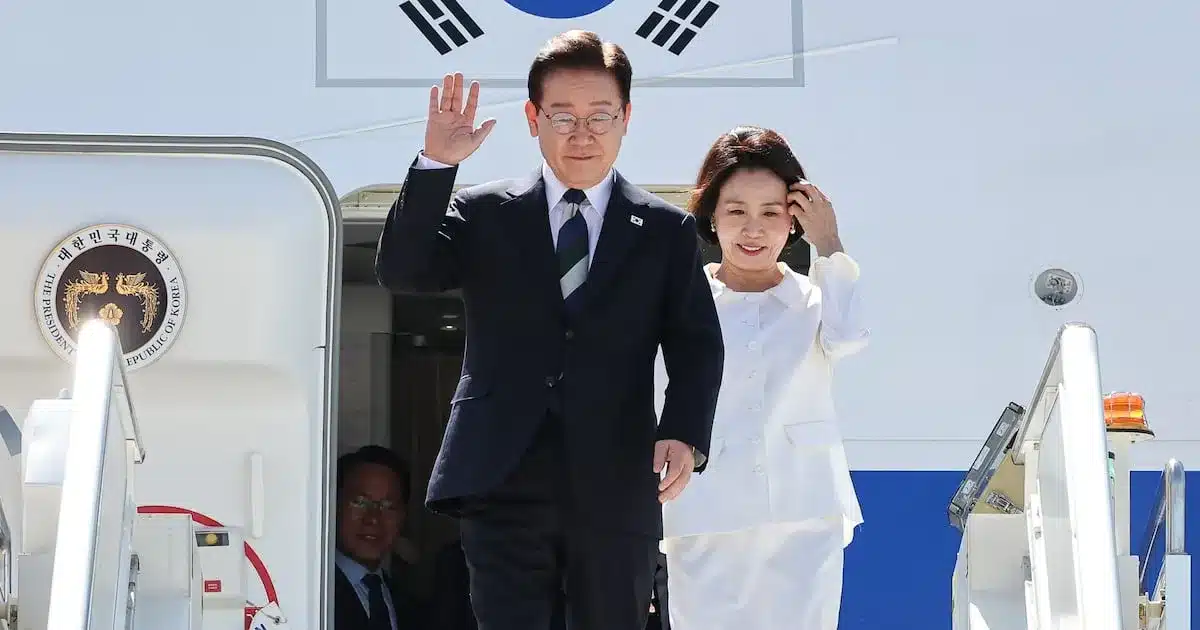
The approval rating for the current President has declined for the second consecutive week, reaching 46.3%, according to a poll released on the 27th. The survey, conducted by Realmeter and commissioned by Energy Economy Shinmun, also indicated that 49.5% of respondents disapproved of the President’s performance in handling state affairs, an increase from the previous week’s 48.4%.
Presidential Approval Rating Declines
The latest Realmeter poll, conducted between the 20th and 24th, found that 46.3% of participants positively evaluated the President’s state administration. This figure represents a 2.1 percentage point decrease from the prior week’s 48.4%. Conversely, negative evaluations rose to 49.5%, a 1.5 percentage point increase. Those who responded “don’t know” accounted for 4.2% of participants.
Regional and Age-Based Trends
Examining the data by region, the President’s approval rating saw significant drops in Daegu and North Gyeongsang Province, falling by 16.8 percentage points compared to the previous week. South Jeolla Province, Gwangju, and North Jeolla Province also experienced a decline of 5.1 percentage points, while Incheon and Gyeonggi Province saw a decrease of 2.4 percentage points.
In terms of age demographics, respondents aged 70 and above showed the most substantial drop in approval, decreasing by 10.3 percentage points. The 40s age group saw a decline of 4.3 percentage points, and those in their 20s registered a 2.7 percentage point decrease.
Factors Influencing the Decline
Realmeter attributed the sustained downward trend to a confluence of economic and social issues. The firm cited public dissatisfaction stemming from real estate market concerns, including debates over “contract cancellations” for apartments and discussions about strengthening property taxes. Additionally, policy shifts related to leveraged Exchange Traded Funds (ETFs) and the ongoing investigation into the supplementary pension system were noted as contributing factors to the public’s unease.
Political Party Support Ratings
In a separate survey conducted by Realmeter on the 23rd and 24th regarding party support, the Democratic Party garnered the highest level of backing, with 41.3% of respondents indicating their support. However, this represents a 1.8 percentage point decrease from the previous week’s 43.1%.
The People Power Party followed closely, with 40.6% support, a slight increase of 0.6 percentage points from the week before. Other parties garnered lower support: the Justice Party at 3.3%, the Progressive Party at 2.2%, and the Jinbo Party at 1.0%. Those who supported other parties constituted 2.0%, while 9.6% identified as unaffiliated or undecided.
Party Support: Regional and Age Analysis
Analyzing party support by region, the Democratic Party saw a notable decrease in Daegu and North Gyeongsang Province, down by 15.2 percentage points, and in South Jeolla Province, Gwangju, and North Jeolla Province, down by 7.1 percentage points. Conversely, support for the Democratic Party increased in Daejeon, Sejong, and the Chungcheong region by 4.6 percentage points, and in Seoul by 3.3 percentage points.
The People Power Party experienced an increase in support in Daegu and North Gyeongsang Province by 12.6 percentage points, and in South Jeolla Province, Gwangju, and North Jeolla Province by 1.9 percentage points. However, their support dipped in Seoul by 2.0 percentage points and in Busan, Ulsan, and South Gyeongsang Province by 1.6 percentage points.
In terms of age demographics, the Democratic Party’s support declined among those aged 70 and above by 12.6 percentage points and among those in their 20s by 7.9 percentage points. Support increased, however, among those in their 50s by 5.8 percentage points and in their 60s by 2.9 percentage points.
The People Power Party saw a significant rise in support among those aged 70 and above, increasing by 15.2 percentage points, and among those in their 20s, up by 8.7 percentage points. Conversely, support decreased among those in their 30s by 8.1 percentage points and in their 60s by 5.1 percentage points.
Party Dynamics and Explanations
Realmeter offered insights into the shifts in party support. For the Democratic Party, internal disputes, including controversies surrounding convention delegate deposits and the reopening of the Shincheonji temple, were cited as reasons for the decline. The party’s push to abolish the supplementary pension system also reportedly added to the pressure, contributing to the drop in their approval ratings.
Regarding the People Power Party, the analysis suggested they benefited from internal conflicts and policy confusion within the Democratic Party. Furthermore, the People Power Party strengthened its public engagement by focusing on issues such as the supplementary pension and real estate special measures. This strategic focus, combined with the consolidation of support from key demographics like older voters in Daegu and North Gyeongsang Province, and younger voters in their 20s, is believed to have contributed to their rise in the polls.
Survey Methodology
The survey on the President’s state administration performance was conducted from May 20th to 24th, targeting 2,505 individuals aged 18 and above nationwide. The methodology involved wireless and landline random digit dialing (RDD) using an automated response system (ARS). The response rate was 3.6%, with a margin of error of ±2.0 percentage points at a 95% confidence level.
The party support poll was conducted over two days, May 23rd and 24th, with 1,001 individuals aged 18 and above nationwide. This survey also utilized wireless and landline RDD via an ARS. The response rate for this poll was 4.3%, with a margin of error of ±3.1 percentage points at a 95% confidence level.
Detailed information regarding these surveys can be found on the National Election Survey Deliberation Commission’s homepage.
