

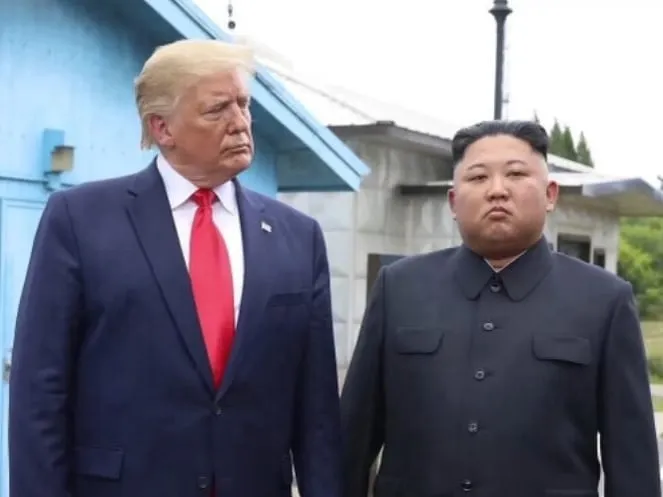
Kim Min-seok, a candidate for the leadership of the Democratic Party, has announced his intention to pursue a visit to the Middle East within the year if he is elected to the top party position. The announcement came as Kim shared a photograph on his social media platform, X, formerly known as Twitter, showing former U.S. President Donald Trump and North Korean National Security Advisor Kim Jong-un at the Demilitarized Zone (DMZ).
Kim Min-seok’s DMZ Photo and Trump Connection
The photograph Kim shared was originally posted the previous day by Donald Trump on his social media, Truth Social. Trump had accompanied the image with a caption stating, “Kim Jong-un and I are getting along very well.”
Kim Min-seok elaborated on the origin of the photo in his post. He explained that he had met with President Trump at the Blue House, South Korea’s presidential office, during a previous visit. At that time, Trump, upon hearing Kim’s explanation of North Korean issues, immediately requested the photo be brought to him so he could show it to Kim, leading to a conversation between the two.
Kim further recounted that Trump had expressed significant interest in his proposal for an “unannounced, unofficial, and unannounced” visit to North Korea. According to Kim, Trump promptly issued related directives at that moment.
Vision for Party Leadership and Foreign Policy
Kim Min-seok articulated his broader vision should he secure the party leadership. “If I become the party leader, I will pursue a visit to the Middle East within the year,” he stated. He also pledged to engage in what he termed “provisional, proper diplomacy,” which he contrasted with the approach taken during the Korean War. This suggests a desire to foster more direct and perhaps unconventional diplomatic channels.
The Significance of a Middle East Visit
While the specifics of the proposed Middle East visit remain to be detailed, the commitment signals a potential shift or intensification of the Democratic Party’s engagement with the region. Such a visit could aim to:
- Strengthen diplomatic ties with key Middle Eastern nations.
- Explore economic cooperation opportunities.
- Address regional security concerns and foster dialogue.
- Understand and potentially influence evolving geopolitical dynamics in the area.
The region is a critical hub for global energy, finance, and politics, making any significant diplomatic outreach a noteworthy development.
Rethinking Diplomacy: “Provisional, Proper Diplomacy”
Kim’s reference to “provisional, proper diplomacy” (초당적 멤버로 초당적 상대를 만나는 초당적 정당 외교) is particularly intriguing. The term “초당적” (chodangjeok) typically translates to “bipartisan” or “transcending party lines.” When applied to diplomacy, especially in the context of meeting “provisional counterparts,” it suggests an approach that seeks common ground and cooperation beyond traditional political or national divisions.
This could imply:
- Seeking Unlikely Alliances: Engaging with parties or individuals who might not typically be considered diplomatic partners.
- Focus on Practical Outcomes: Prioritizing tangible results and cooperation over ideological alignment.
- Direct Engagement: Facilitating direct talks and negotiations, potentially bypassing more formal or protracted diplomatic processes.
- Historical Context: The mention of the Korean War (6.25 전쟁) suggests a desire to learn from past diplomatic failures or missed opportunities and to forge a new path forward.
This approach could be interpreted as a call for more flexible, pragmatic, and perhaps even bold diplomatic initiatives, particularly concerning inter-Korean relations and regional stability.
Broader Implications for Inter-Korean Relations
Kim Min-seok’s emphasis on engaging with North Korea, highlighted by the shared DMZ photo and his comments on Trump’s interest, underscores a continued focus on inter-Korean dialogue. The mention of meeting “provisional counterparts” could be a veiled reference to exploring new avenues for communication with Pyongyang, potentially outside of established frameworks.
The political landscape in South Korea often sees varying approaches to North Korea, ranging from hardline stances to engagement policies. Kim’s proposed diplomatic strategy appears to lean towards the latter, advocating for proactive and unconventional methods to foster peace and cooperation on the Korean Peninsula.
His remarks also touch upon the complex relationship between South Korea, North Korea, and the United States, as evidenced by the reference to his interaction with Donald Trump. Navigating these triangular dynamics is a perennial challenge in regional diplomacy, and Kim’s platform suggests a willingness to engage with all relevant parties to achieve his foreign policy objectives.
Conclusion
Kim Min-seok’s pledge to visit the Middle East and pursue a unique form of diplomacy, if elected as Democratic Party leader, signals an ambitious foreign policy agenda. The strategic use of the DMZ photograph featuring Donald Trump and Kim Jong-un serves to amplify his message, linking his leadership aspirations to high-level international interactions and a forward-looking approach to diplomacy. His focus on “provisional, proper diplomacy” suggests a potential departure from conventional methods, aiming for pragmatic cooperation and direct engagement in both regional and inter-Korean affairs.
