

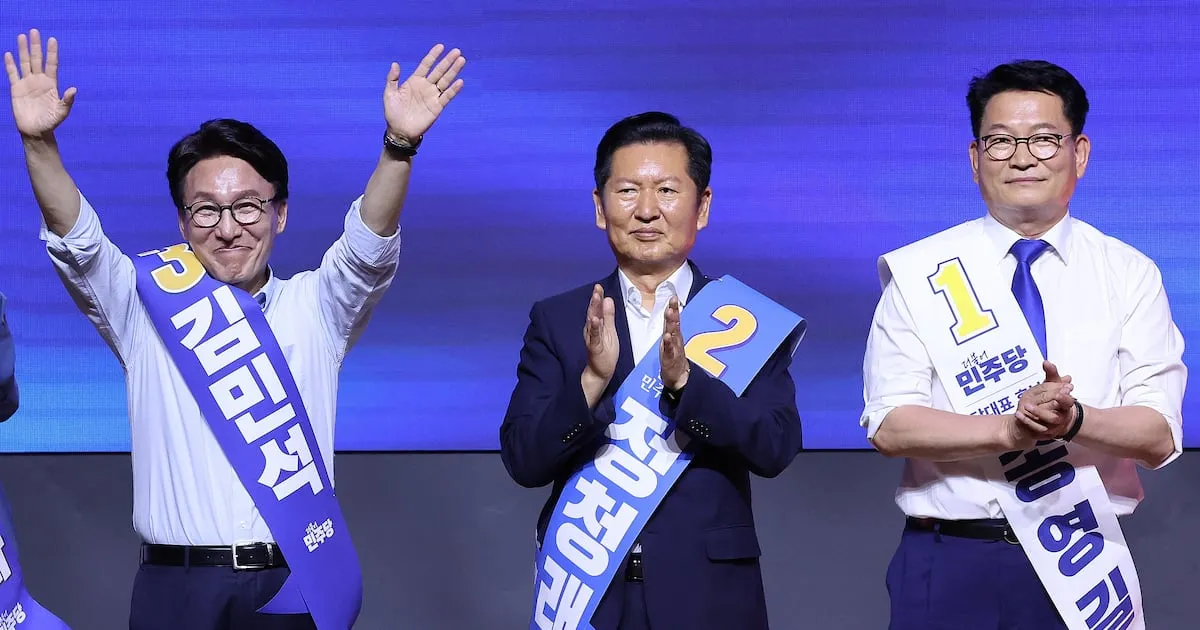
Kim Min-seok has emerged as the frontrunner in the first regional contest for the Democratic Party of Korea’s next leadership, securing 45.08% of the delegate votes in the Chungcheong region. The results, announced following a joint convention for Daejeon, Sejong, and the Chungcheong provinces, place him slightly ahead of rivals Jung Cheong-rae (44.63%) and Song Young-gil (10.34%).
This initial victory for Kim sets a positive tone for his campaign, especially given that the Chungcheong region is the home turf of Jung Cheong-rae. Kim’s narrow margin of victory over Jung, by just 0.45 percentage points, underscores the close competition expected throughout the leadership race.
Understanding the Democratic Party’s Leadership Election Process
The Democratic Party’s selection of its next leader is a multi-faceted process that combines delegate votes, national opinion polls, and votes from the party’s Supreme Council. Delegate and Supreme Council votes account for 70% of the total, while public opinion surveys make up the remaining 30%. Since the introduction of a “one delegate, one vote” system earlier this year, the weight of delegate and Supreme Council votes is equal.
The current leadership election is characterized by a preferential voting system, where party members rank their preferred candidates. However, only the first-choice rankings from the regional contests have been publicly disclosed so far. The final results, incorporating second-choice preferences, the Supreme Council votes, and national polls, will only be revealed after all regional contests are completed and tallied.
The process involves distributing the second-choice votes of delegates who ranked a third-place candidate first to the top two contenders. This intricate system aims to determine the ultimate winner based on a comprehensive assessment of candidate support.
Upcoming Regional Contests and Final Announcement
The Chungcheong region’s results mark the first of several scheduled contests. The election schedule continues with:
- August 2nd: Busan, Ulsan, Gyeongsangnam-do
- August 8th: Jeju, Incheon
- August 9th: Gangwon, Daegu, Gyeongsangbuk-do
- August 15th: Jeollanam-do, Gwangju, Jeollabuk-do
- August 16th: Gyeonggi-do, Seoul
The final, overall results, which will include the Supreme Council votes, are slated to be announced on August 17th.
Candidate Statements and Campaign Themes
Following the announcement of the Chungcheong results, the candidates articulated their campaign messages and visions for the party.
Song Young-gil’s Focus on Livelihood Issues
Song Young-gil, who has been advocating for a June 3rd local election victory, criticized the current leadership. He referenced President Lee Jae-myung’s past apology for election losses, questioning the legitimacy of a leadership that claims success while the President admits fault. Song emphasized a shift in focus towards pressing public concerns, stating, “The prosecution reform is over. Now, it’s about people’s livelihoods.”
Song outlined his policy priorities, including addressing housing supply shortages, revitalizing local construction businesses through eased project financing (PF) rules, constructing 50,000 homes in the Seoul metropolitan area, and implementing financial measures to stabilize the stock market. He also drew an analogy, comparing the President to a GPU (Graphics Processing Unit) and himself to HBM (High Bandwidth Memory), suggesting their combined capabilities would drive South Korea towards becoming an AI powerhouse.
Kim Min-seok’s Emphasis on Reform and Experience
Kim Min-seok countered criticisms regarding past election performance, particularly referencing Jung Cheong-rae’s perceived lack of engagement in key 2022 local elections. Kim questioned Jung’s leadership capabilities, asking, “With this kind of leadership, can you entrust the party to lead the country?”
Kim defended the reformist credentials of the current administration, highlighting its progressive appointments, such as appointing ministers from labor backgrounds and prioritizing worker safety in the National Assembly. He urged party members not to doubt the reformist spirit of President Lee and his government, asserting, “I have the experience and confidence to prepare, strategize, and lead the party to victory.”
Jung Cheong-rae’s Call for Unity and Integrity
Jung Cheong-rae addressed Kim Min-seok’s remarks about past election defeats, stating, “I will not engage in politics that blames Lee Jae-myung four years ago and blames Jung Cheong-rae four years later.” He invoked the concept of conscience, citing the betrayal of Roh Moo-hyun by Chung Mong-joon in 2002 as an example of “the worst self-politics.” Jung stressed the importance of integrity and unity within the party, questioning how they could achieve national victories if they resorted to labeling and dividing members.
Jung also advocated for broader party alliances, including merging with the Open Minjoo Party and the Basic Income Party, and forming a coalition with the former Justice Party. He concluded by urging support for his candidacy, presenting himself as a strong, reform-minded leader capable of making the Democratic Party truly representative of its ideals.
The race remains dynamic, with subsequent regional contests expected to further shape the narrative and influence the final outcome on August 17th.
