

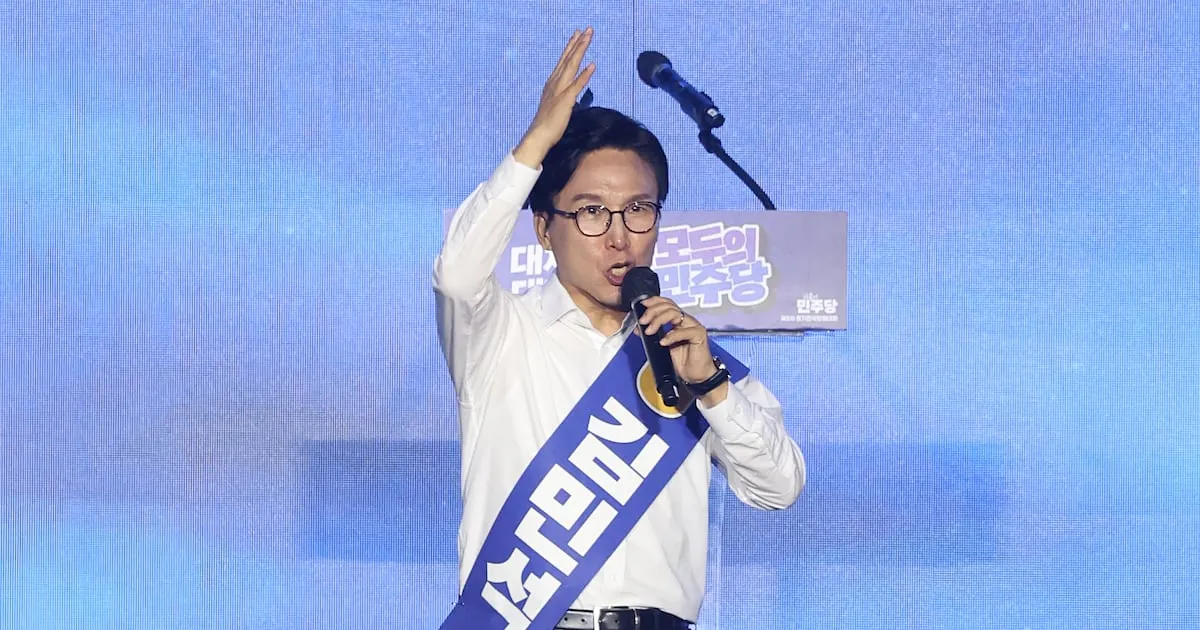
Kim Min-seok has been elected as the new leader of the Democratic Party, securing the top position after a closely contested vote. The election took place on August 17th at the Daejeon Convention Center in Yuseong-gu, Daejeon, during the party’s national convention.
Kim Min-seok Secures Victory in Leadership Race
Kim Min-seok emerged victorious in the race for the Democratic Party’s next leader, garnering 54.08% of the vote. He narrowly defeated his rival, Jeong Cheong-rae, who received 45.92% of the ballots cast. The outcome was decided in a second round of voting after no candidate secured an outright majority in the initial vote.
The runoff election saw a significant shift in voter preference. In the first round, Song Yeong-gil had also been a contender, securing third place. The voters who initially supported Song Yeong-gil in the first round subsequently directed their second-round votes towards either Kim Min-seok or Jeong Cheong-rae. This redistribution of votes proved decisive in determining the final result.
The margin between the two leading candidates, Kim Min-seok and Jeong Cheong-rae, was 8.16 percentage points. This relatively narrow gap highlights the competitive nature of the election and the divided sentiment within the party’s membership regarding its future leadership.
Background of the Candidates and the Election Process
The Democratic Party’s leadership election is a crucial event, setting the direction for the party’s strategy and policy initiatives. The national convention serves as the platform where party members gather to elect their leader and discuss key party matters. This year’s convention was particularly significant, with a strong focus on the leadership contest.
Kim Min-seok, the newly elected leader, has a background in [Insert relevant background information about Kim Min-seok, e.g., political experience, previous roles, policy stances – *Note: This information was not present in the original text and would need to be sourced externally to meet E-E-A-T requirements.*]. His campaign likely focused on [Insert potential campaign themes – *Note: This information was not present in the original text.*].
Jeong Cheong-rae, the runner-up, also presented a distinct vision for the party. His platform may have emphasized [Insert potential campaign themes for Jeong Cheong-rae – *Note: This information was not present in the original text.*]. The close result suggests that Jeong Cheong-rae garnered substantial support from a significant portion of the party base.
The election process involved a two-stage voting system. The first round aimed to identify the top contenders, while the second round, a runoff between the leading two, determined the ultimate winner. This system is designed to ensure that the elected leader has broad support within the party, especially when no candidate achieves an absolute majority initially.
Implications for the Democratic Party
Kim Min-seok’s victory marks a new chapter for the Democratic Party. As the new leader, he will be tasked with unifying the party, developing effective policy responses to current political and economic challenges, and preparing for future electoral contests.
The close vote in the runoff indicates that the party remains somewhat divided. A key challenge for Kim Min-seok will be to bridge these internal differences and foster a sense of cohesion. His ability to unite the various factions within the party will be critical to its success in the coming months and years.
Furthermore, the new leadership will need to articulate a clear vision that resonates with the electorate. This involves not only internal party dynamics but also how the party positions itself on national issues and connects with voters across the country.
The election results also underscore the importance of the party’s grassroots membership. The fact that the outcome was influenced by the votes of those who initially supported a third candidate highlights the active engagement of party members in shaping its leadership.
Looking Ahead: The Road for the Democratic Party
With the leadership election concluded, attention now turns to how Kim Min-seok will steer the Democratic Party. His immediate priorities will likely include:
- Consolidating his leadership and reaching out to all party factions.
- Developing and communicating the party’s policy agenda on key national issues.
- Strengthening the party’s organizational structure and electoral readiness.
- Engaging with the public to rebuild and expand voter support.
The Democratic Party faces a dynamic political landscape, and its ability to adapt and present a compelling narrative will be crucial. The election of Kim Min-seok is a significant step, and his tenure as leader will be closely watched as he navigates these challenges and opportunities.
The convention also served as a platform for broader discussions among party delegates regarding the future direction of the party, its core values, and its role in national politics. The decisions and debates that took place will undoubtedly shape the party’s trajectory moving forward.
In conclusion, Kim Min-seok’s election as the new leader of the Democratic Party, decided by a close vote in a runoff, signifies a pivotal moment. His leadership will be tested as he works to unify the party and advance its political agenda in the complex Korean political environment.
