

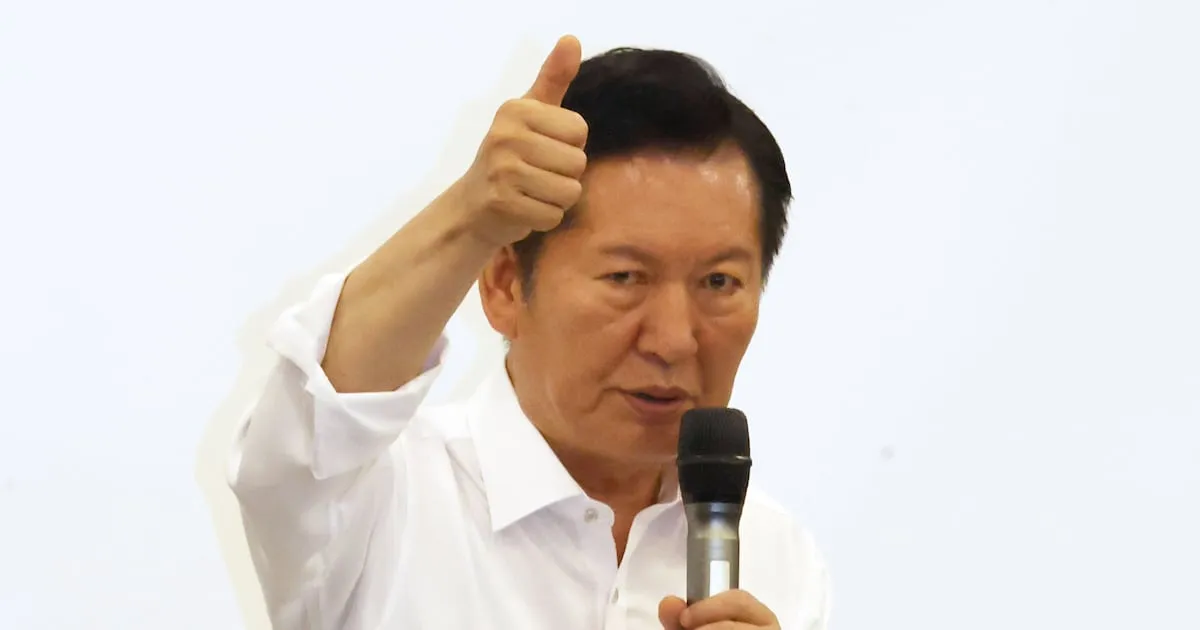
As the Democratic Party of Korea gears up for its national convention on August 17th, a notable shift in focus has emerged. The party appears to be rallying behind former leader Jeong Cheong-rae or emphasizing the accomplishments of former Secretary-General Kim Min-seok. Jeong, known for his strong stance against the People Power Party (PPP), has declared he will not engage in “malicious exchanges” with the opposition, solidifying his image as a hardliner. Political observers interpret this strategic positioning as a tactic by the Democratic Party to potentially limit its own expansion by highlighting a figure who might alienate moderate voters.
The Democratic Party’s Leadership Race Intensifies
The Democratic Party is currently navigating a close contest between Jeong Cheong-rae and Kim Min-seok, with both candidates reportedly within a 1% point margin in their respective primary races. This competition follows the party’s recent primary campaigns in the Chungcheong and Gyeongsang regions. Amidst this dynamic, some conservative commentators have begun predicting a victory for Jeong, a perspective that diverges from the general expectation within the broader political sphere, which tends to favor Kim.
Conservative Voices Weigh In on Jeong Cheong-rae’s Prospects
Seo Jung-wook, a lawyer and conservative commentator, appeared on CBS Radio’s ‘Park Jae-hong’s One-Third’ program on August 6th. He suggested that the key battleground for the leadership race lies in the Honam region. Seo characterized the upcoming convention as a contest between the legacies of the late former President Roh Moo-hyun and current party leader Lee Jae-myung. He argued that while Roh’s approval ratings remain stable, Lee’s are declining, creating an advantageous situation for Jeong Cheong-rae.
“A miracle could happen in Honam, similar to 2002 when Roh Moo-hyun was elected,” Seo predicted, suggesting that Jeong could even secure first place in the Honam region. His remarks seemed to signal support for Jeong, a former Democratic Party leader.
Further adding to this narrative, Chung Kwang-jae, a former spokesperson for the People Power Party, also made comments that appeared to endorse Jeong. Chung noted that Jeong has never defected from a party and, even when facing unfavorable circumstances, has acted as a loyal member. “Attaching the frame of a traitor to candidate Jeong will not be well-received,” Chung stated. In a separate YouTube broadcast, he explicitly declared, “The People Power Party is supporting candidate Jeong,” adding, “The misfortune of the enemy is my happiness.”
Strategic Maneuvering and Criticisms of Kim Min-seok
Within the broader political arena, there’s also a focus on Kim Min-seok, with some highlighting his past. Representative Han Dong-hoon of the Democratic Party brought up allegations that Kim received illegal political funds from the SK Group in the past, a case that resulted in a suspended prison sentence. Han criticized Kim’s remarks during his visit to Jeonbuk, where he seemed to solicit large-scale investments from businesses, stating, “Pressuring companies publicly is inappropriate.” Han pointed out that this demonstrated an “understanding that political power can pressure specific corporations,” a sentiment he found concerning.
Interpreting the ‘Jeong Cheong-rae Promotion’ Trend
The trend of promoting Jeong Cheong-rae is being interpreted by some in the political sphere as a calculated move by the conservative camp. A political insider suggested that this strategy is fueled by the expectation that Jeong’s ascension to party leadership would complicate the Democratic Party’s efforts to broaden its appeal. “Ultimately, it’s a strategic decision aimed at weakening the opposing party’s competitiveness,” the source explained.
Jeong Cheong-rae’s Political Stance
Jeong Cheong-rae has consistently positioned himself as a staunch opponent of the People Power Party. His public declarations, such as refusing to engage in “malicious exchanges” with the PPP, underscore his firm stance. This hardline image has resonated with a segment of the Democratic Party’s base, particularly those who favor a more confrontational approach to political opposition. His supporters often point to his consistent record and his willingness to challenge the status quo as reasons for his appeal.
Kim Min-seok’s Background and Challenges
Kim Min-seok, on the other hand, brings a different set of experiences to the leadership race. As a former Secretary-General, he has a deep understanding of the party’s internal workings. However, his past controversies, including the allegations of receiving illegal political funds, continue to be a point of contention. Critics argue that these past issues could hinder his ability to unite the party and appeal to a wider electorate. The focus on these past events by political opponents aims to cast doubt on his suitability for leadership.
The Honam Factor and Electoral Dynamics
The Honam region, historically a stronghold for the Democratic Party, is being closely watched as a critical indicator of the leadership race’s outcome. Seo Jung-wook’s prediction of a “miracle” in Honam for Jeong Cheong-rae highlights the potential for unexpected shifts in regional support. The dynamics within this region are complex, influenced by historical loyalties, current political trends, and the specific appeal of each candidate. A strong showing in Honam could significantly bolster Jeong’s chances, potentially defying expectations.
Conclusion: A Strategic Game of Political Chess
The unfolding leadership contest within the Democratic Party is more than just an internal selection process; it appears to be a complex interplay of strategy, legacy, and public perception. The conservative camp’s apparent endorsement of Jeong Cheong-rae, coupled with criticisms leveled against Kim Min-seok, suggests a calculated approach to influencing the outcome. Whether Jeong can indeed replicate a “miracle” in the Honam region and secure the party’s leadership remains to be seen, but the current political maneuvering indicates a high-stakes battle with significant implications for the future of the Democratic Party and its relationship with the opposition.
