

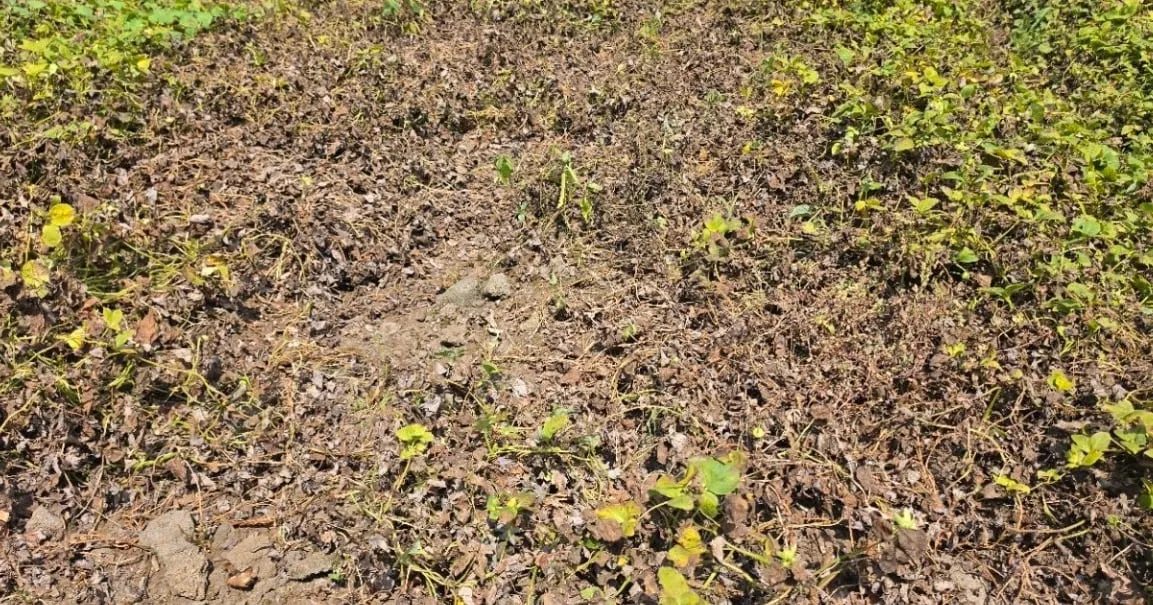
Jeju Island’s vital bellflower (doraji) crops are suffering extensive damage, with leaves and stems withering or melting away due to a prolonged drought and intense heatwave. As of July 13, the Jeju provincial government has begun receiving damage reports from bellflower farmers and initiating on-site investigations, particularly in the eastern regions of Seongsan, Pyoseon, and Gujwa, where the impact is most severe. The estimated damage spans approximately 130 hectares, equivalent to about 400,000 pyeong, with the potential for this figure to increase as assessments continue.
Widespread Crop Devastation Across Jeju
The current agricultural crisis is hitting bellflower cultivation particularly hard, especially for crops planted this spring. Many farmers are reporting instances where newly planted bellflowers either failed to sprout due to the lack of rain or sprouted only to wither and die in the harsh conditions. The damage is not limited to first-year plants; second-year crops are also showing signs of distress.
According to Lim Hong-cheol, Director of the Jeju Provincial Climate and Environment Bureau, while some areas with shade are showing signs of continued growth, exposed bellflower plants are experiencing severe damage. “In areas exposed to the sun, the damage is so severe that the stems and leaves of the bellflowers are almost entirely gone,” Lim stated. For one-year-old bellflowers, the leaves and stems have been observed to dry out and die. In two-year-old plants, the leaves are turning yellow, a phenomenon known as chlorosis, leading to concerns about stunted root growth and a significant reduction in overall yield.
Jeju: The Nation’s Bellflower Hub
Jeju Island stands as the largest producer of bellflowers in South Korea. Based on the 2025 agricultural business registry, the island hosts 470 bellflower farms cultivating an area of 314 hectares (approximately 950,000 pyeong). The Jeju City area accounts for 162 farms covering 137.54 hectares, while Seogwipo City has 308 farms across 177.2 hectares.
Within Jeju City, the Gujwa and Jocheon regions are particularly concentrated with bellflower cultivation. Gujwa-eup alone comprises 112 farms and 101.1 hectares, with Jocheon-eup adding 25 farms and 28.41 hectares. Together, these two areas represent a substantial 84.6% of Jeju City’s total bellflower cultivation area.
While bellflower cultivation typically requires about three years to reach harvestable yield in other regions, Jeju’s milder climate allows for harvesting in approximately two years. This advantage has solidified Jeju’s position as the nation’s primary bellflower cultivation center. Data from the Korea Forest Service’s 2024 Forest Products Production Survey indicates that Jeju’s bellflower production reached 4,687 tons, valued at 77.861 billion KRW. This represents a significant portion of the national output, accounting for 48% of the total production volume (9,822 tons) and 48% of the total production value (163.233 billion KRW).
Contributing Factors: Drought and Infrastructure Gaps
The severity of the current damage is partly attributed to a lack of adequate irrigation facilities. Director Lim noted that many farms visited were not equipped with proper watering systems. “Given that bellflowers are generally considered a drought-resistant crop, many farmers did not anticipate such extensive damage,” he explained. This perception led to a lack of preparedness and investment in robust irrigation infrastructure, exacerbating the impact of the prolonged dry spell and heat.
The Jeju provincial government plans to finalize its damage assessment, including the exact area affected, the number of farms impacted, and the estimated reduction in yield. Following this comprehensive survey, the government will formulate support measures to assist the affected farmers and mitigate the economic fallout from this agricultural disaster.
Looking Ahead: Support and Recovery
The provincial government’s commitment to addressing the crisis involves a multi-pronged approach. Firstly, the immediate priority is the accurate assessment of the damage, which will form the basis for any subsequent aid. Secondly, the government is expected to explore various support mechanisms, which could include financial assistance, provision of drought-resistant seeds for future planting, and potentially investments in improved irrigation infrastructure for the region. The goal is not only to provide immediate relief but also to build resilience against future climate-related challenges.
The current situation underscores the vulnerability of even traditionally hardy crops to extreme weather events. As Jeju’s bellflower industry faces this significant setback, the collaborative efforts between farmers, agricultural authorities, and the provincial government will be crucial in navigating the recovery process and ensuring the long-term sustainability of this important agricultural sector.
