

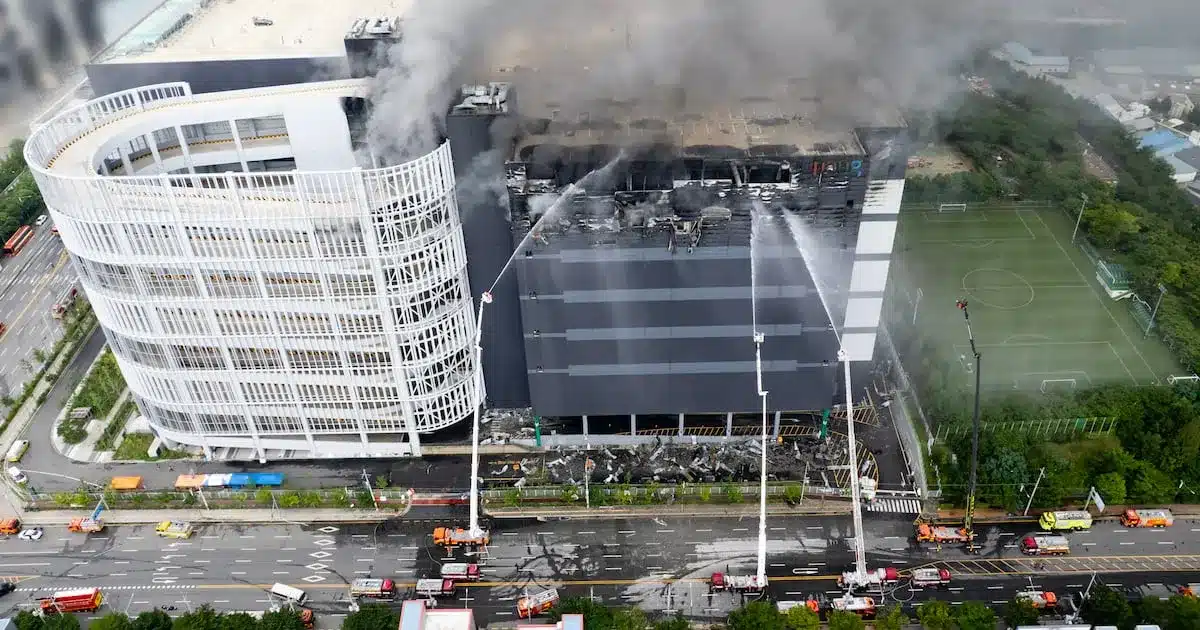
Firefighting operations are continuing at the Coupang logistics center in Incheon, with officials estimating that the blaze, which began on June 17th, could be fully contained by late evening on June 18th. If this timeline holds, it means the fire will have been under control approximately 40 hours after it first ignited. The scale and complexity of the facility present significant challenges to extinguishing the flames.
Intense Firefighting Operations
During a briefing at the scene on June 18th, Heo Seok-gyeong, Head of the Incheon Seo-gu Fire Station, addressed the progress of the containment efforts. While acknowledging the difficulty in providing an exact timeframe, he stated that a preliminary estimate for full containment was set for around 11 PM on June 18th, based on the situation as of 7 AM that morning. This indicates a protracted battle against the fire.
Fire authorities have deployed a specialized strategy, combining ground and aerial attacks to combat the inferno. The Seo-gu Fire Station’s disaster response headquarters reported that 28 specialized fire vehicles have been positioned around the building to conduct defensive operations, particularly focusing on preventing the fire from spreading to the upper floors. In the air, firefighting helicopters are concentrating their efforts on the sections where the fire has spread to the seventh floor.
Since approximately 3:14 AM on June 18th, a ‘large-capacity water cannon system’ has been in operation, discharging vast amounts of water to help suppress the main body of the fire. The water supply for these operations is being sourced from the SK Incheon Petrochemical liquid storage facility.
Challenges Posed by the Facility’s Structure
The logistics center is a massive structure, described as a large-scale warehouse with a three-story racking system, housing a substantial quantity of goods. This extensive inventory, combined with high temperatures within the facility, has created severe visibility issues for firefighters and made internal access and operations extremely difficult. The intense heat and smoke significantly hamper the ability of crews to advance and effectively tackle the fire from within.
Despite these challenges, structural engineers have assessed the building’s integrity. Kwak Dong-sam, President of the Architectural Institute of Korea, confirmed that there is currently no immediate risk of building collapse. He emphasized that the primary focus remains on preventing further spread of the fire as quickly as possible.
Facility Details and Fire Progression
The Coupang logistics center is a significant facility, covering a total area of 299,000 square meters, with eight underground levels and additional above-ground floors. The fire reportedly originated on the sixth floor and subsequently spread to the seventh floor, indicating a rapid upward progression through the structure.
The sheer size of the facility, designed for large-scale logistics operations, means that a vast amount of flammable material could be present, contributing to the intensity and persistence of the blaze. The multi-level racking system, while efficient for storage, can also act as a conduit for fire to spread rapidly between floors.
Ongoing Assessment and Future Steps
Fire officials and structural experts will continue to monitor the situation closely. The priority remains the safety of the firefighters and the surrounding community, alongside efforts to fully extinguish the fire and prevent any further escalation. Investigations into the cause of the fire are expected to commence once the situation is fully under control.
The economic impact of the disruption to Coupang’s logistics operations is also a significant consideration. As a major e-commerce player, the Incheon center plays a crucial role in its distribution network. The duration of the firefighting efforts and the subsequent damage assessment will determine the timeline for resuming full operations at the facility.
Further updates on the containment progress will be provided as the situation develops. The resilience and dedication of the emergency response teams are crucial in managing this large-scale incident.
