

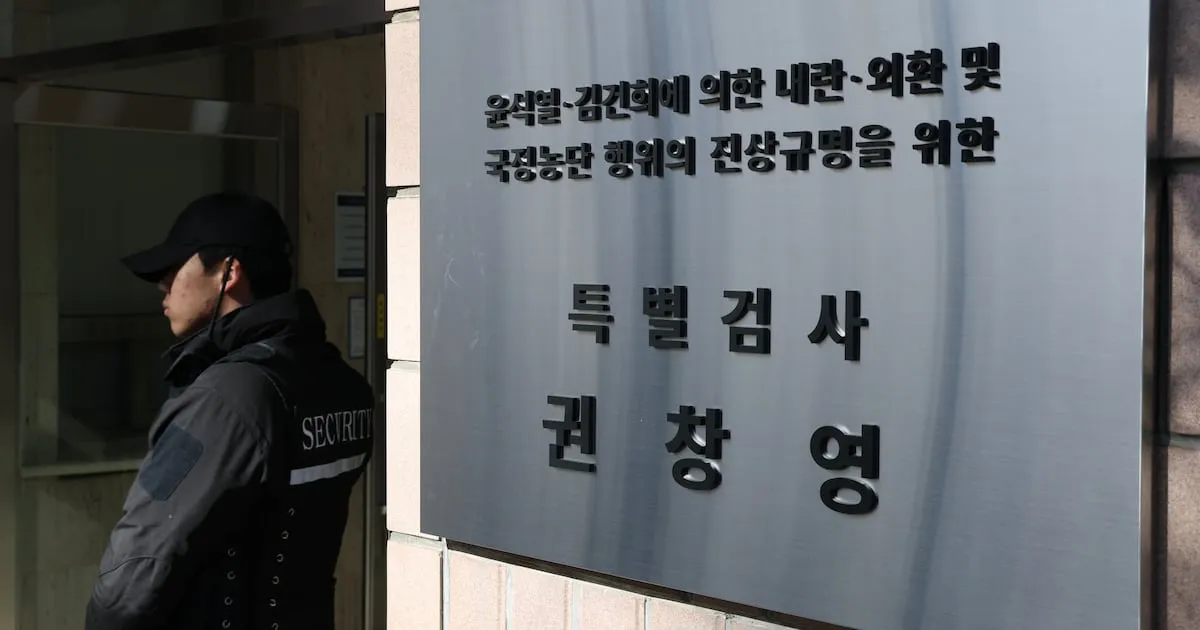
A special prosecutor has arrested a former spokesperson for the Ministry of National Defense on suspicion of violating emergency orders. The investigation centers on allegations that the former official transmitted an emergency decree via text message to reporters on December 3, 2024, the day an emergency martial law was declared.
Allegations of Transmitting Emergency Decree
The special prosecutor, Kwon Chang-young, has detained Jeon Ha-gyu, who previously served as the Defense Ministry’s spokesperson. The core of the investigation involves a text message allegedly sent by Jeon to the Defense Ministry’s press corps. This message reportedly contained the full text of Emergency Decree No. 1, which declared a nationwide martial law.
The content of the alleged message stated: “To protect the Republic of Korea’s system from the threat of anti-state forces operating within the Republic of Korea, and to safeguard the safety of the citizens, martial law is declared throughout the Republic of Korea with the following provisions.” This directive was issued under the authority of the emergency martial law.
Defense of the Actions
Following the news of Jeon’s detention, some voices have emerged defending his actions. One perspective suggests that informing the press corps about the martial law declaration was not an act of insubordination but rather a routine part of public information dissemination duties. The rationale provided is that timely and accurate information is crucial for the public during such critical times.
Eom Hyo-sik, Director of the National Defense Security Policy Institute and former Director of Public Relations for the Joint Chiefs of Staff, voiced his opinion on Facebook on December 12th. He expressed surprise and dismay at the characterization of Jeon’s actions as an “insubordination.” Eom stated, “It is a basic duty to inform the media and the public promptly and accurately. To be called insubordination for transmitting a message to reporters as instructed during the martial law declaration is truly regrettable and bewildering.”
Eom further elaborated, suggesting that if the message had not been sent at that specific time, “the public would likely have fallen into even greater confusion.” This implies that Jeon’s action, though potentially against strict protocol, served a vital purpose in informing the populace during a national emergency.
Broader Investigation into Military Leadership
This case is part of a wider investigation by the special prosecutor into alleged misconduct within the military leadership during the martial law period. The investigation aims to uncover any instances of abuse of power or violation of directives.
In addition to Jeon Ha-gyu, the special prosecutor is also expected to detain Cho Seong-hyun, former Chief of Staff for the Capital Defense Command, on suspicion of dereliction of duty. Cho is accused of refusing a directive to submit the conscription law to the National Assembly during the December 3rd martial law declaration. Reports indicate that Cho allegedly instructed his subordinate unit to “not cross the Seogang Bridge,” a directive that reportedly led to him receiving a commendation, despite the special prosecutor viewing this as an act of insubordination.
Earlier, on December 14th, the special prosecutor had already detained Yeo In-hyeong, former Director of Military Support at the Ministry of National Defense. Yeo is suspected of compiling and distributing a “blacklist” of active and retired military officials based on their political leanings. This blacklist was allegedly used to grant preferential treatment to certain individuals, an act considered a form of abuse of power.
Context of the Martial Law Declaration
The emergency martial law was declared on December 3, 2024, amidst rising political tensions and concerns about national security. The declaration aimed to stabilize the situation and prevent what was described as an existential threat to the nation’s democratic system.
The provisions of the martial law were extensive, impacting various aspects of public life and government operations. The subsequent investigations by the special prosecutor highlight the scrutiny faced by military and government officials during this period of heightened alert. The focus on information dissemination and adherence to directives underscores the complexities of managing national security crises and maintaining public trust.
Conclusion
The ongoing investigations by the special prosecutor’s office underscore the intense scrutiny applied to military and government actions during the recent period of martial law. The detention of former Defense Ministry spokesperson Jeon Ha-gyu for allegedly transmitting an emergency decree via text message raises questions about protocol, public information, and accountability within the chain of command. As the special prosecutor continues to examine these events, the focus remains on ensuring adherence to legal procedures and maintaining transparency during critical national security situations.
