

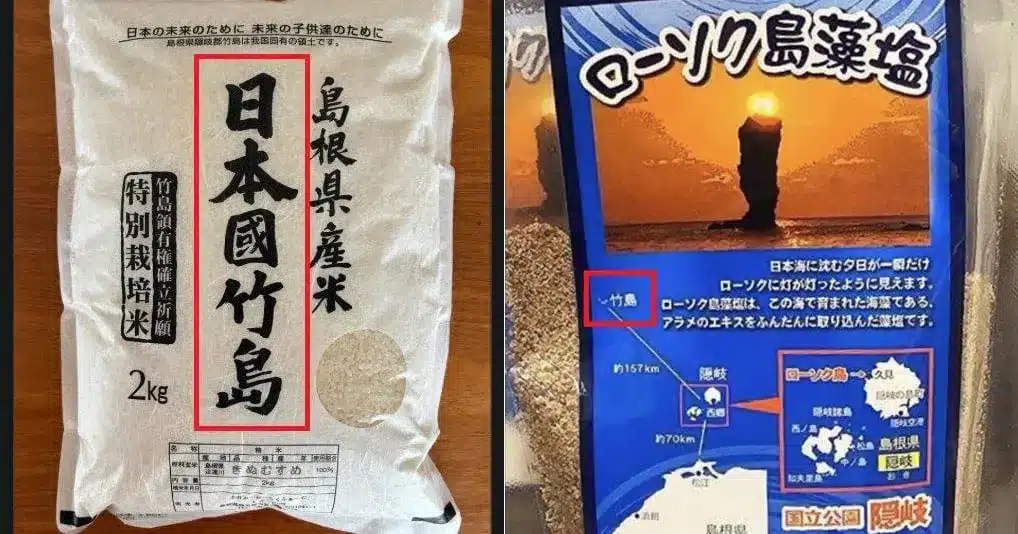
A controversy has emerged in Japan concerning the sale of rice bags in Shimane Prefecture that label the disputed territory of Dokdo as ‘Takeshima’. Professor Seo Kyung-deok of Sungshin Women’s University highlighted the issue on social media, revealing images of the rice packaging. The bags, containing 2kg of rice, prominently feature the text ‘Japan’s Takeshima’ (日本國竹島) and ‘Shimane Prefecture Rice’, alongside a declaration that ‘Shimane Prefecture’s Takeshima is Japan’s inherent territory’.
Details of the Rice Packaging
The rice bags are also marked with ‘Special Cultivation’ and include a statement asserting Japanese sovereignty over Takeshima. Professor Seo shared images of these bags, drawing attention to the specific wording used to promote the territorial claim. This marketing strategy by Shimane Prefecture aims to reinforce its assertion of sovereignty over the islets.
Previous Incidents and Professor Seo’s Criticism
This is not the first instance of products being marketed with territorial claims related to Dokdo/Takeshima. Professor Seo recalled that in April, salt products labeled ‘Takeshima’ were sold to domestic and international tourists at Yonago Airport in Japan. Furthermore, the prefecture has previously organized events such as ‘Takeshima Day’ in February, where ‘Takeshima Curry’ was sold at a public cafeteria in Shimane Prefecture.
Professor Seo strongly criticized these ongoing efforts, stating, “Shimane Prefecture in Japan appears to be accelerating continuous product development to promote its territorial claims over Dokdo. This is truly a foolish act.” He emphasized that such actions are misguided and do not reflect historical facts.
Historical Context and Territorial Dispute
The islets, known as Dokdo in Korea and Takeshima in Japan, are a recurring point of contention between the two East Asian nations. Both countries claim sovereignty over the small group of islets located in the Sea of Japan (East Sea). The dispute has led to various manifestations, including the marketing of products and the designation of commemorative days.
South Korea has administered the islets since the 1950s, viewing them as an integral part of its territory. Historical records and international law are frequently cited by both sides to support their respective claims. The Korean government maintains that Dokdo is unequivocally Korean territory, based on historical documents, geographical evidence, and effective control.
Japan’s Stance and Shimane Prefecture’s Actions
Japan, however, asserts its historical claim to the islets, which it calls Takeshima. Shimane Prefecture, in particular, has been active in promoting its territorial claims through various means, including administrative measures and public campaigns. The prefecture officially designated February 22nd as ‘Takeshima Day’ in 2005 to commemorate its claim, a move that has been met with strong opposition from South Korea.
The sale of rice bags bearing the ‘Takeshima’ label is seen as another attempt by Shimane Prefecture to solidify its position and influence public perception, both domestically and internationally. The inclusion of phrases like ‘Japan’s inherent territory’ on consumer goods is a direct effort to embed this narrative into everyday life.
International Reactions and Professor Seo’s Call to Action
Professor Seo’s public denouncement of the rice bags aims to raise international awareness about Japan’s persistent territorial claims through commercial products. He urged Japan, specifically Shimane Prefecture, to cease its attempts to distort history and abandon its unfounded claims over Dokdo.
“Shimane Prefecture in Japan must correct history and stop making absurd claims about Dokdo any further,” Professor Seo stated. His remarks underscore the ongoing diplomatic and cultural friction surrounding the islets, highlighting how territorial disputes can extend into the realm of consumer products and public messaging.
Conclusion
The incident involving the ‘Takeshima’ labeled rice bags serves as a stark reminder of the enduring territorial dispute between South Korea and Japan over Dokdo/Takeshima. While Shimane Prefecture continues its efforts to assert sovereignty through product marketing and commemorative events, figures like Professor Seo Kyung-deok are actively working to counter these claims and advocate for historical accuracy. The international community often observes these developments, recognizing the sensitivity and complexity of the Dokdo/Takeshima issue in East Asian relations.
