

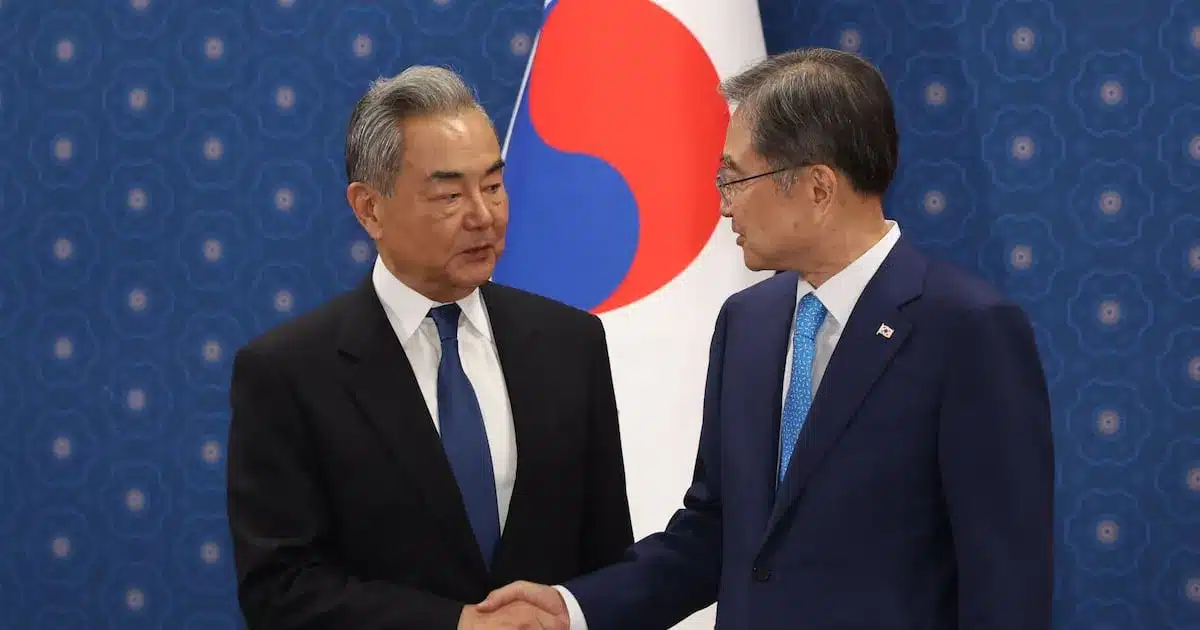
A South Korean lawmaker has urged the government to firmly address remarks made by China’s Foreign Minister, Wang Yi, who referred to South Korea and North Korea as “two countries.” Kim Gun, a member of the People Power Party, stated on his Facebook page that if neighboring countries are not corrected when they refer to the Korean peninsula as “two countries” in front of South Korea, it will eventually become a reality. He emphasized that in international diplomacy, names and expressions are never trivial matters.
Concerns Over Diplomatic Language
Kim Gun highlighted that during a meeting with his South Korean counterpart, China’s Foreign Minister Wang Yi used the phrase “South Korea and North Korea, two countries” (韩朝两个国家). This, he noted, is a distinct departure from China’s usual diplomatic practice, which has typically employed terms like “South-North both sides” or “South-North relations” when discussing the Korean Peninsula issue in high-level talks.
As a former diplomat, Kim argued that China’s government has previously acknowledged the sovereignty of both Koreas, for instance, by referring to “leaders of the two Koreas” or stating that “Korea and North Korea are both sovereign states admitted to the UN.” He expressed concern that China might be downplaying its recent statement as just one of many diplomatic expressions, especially given past instances where China has used different terminology in internal briefings compared to official dialogues.
Kim drew an analogy to a hypothetical situation where a foreign country might refer to the East Sea as the Sea of Japan during official bilateral meetings. He questioned whether the South Korean government would consider this a minor issue simply because the country had used the same term in its own internal media or public statements. He stressed that the context of official, face-to-face diplomatic engagements carries a different weight.
North Korea’s Shift in Stance
The lawmaker’s remarks come in the wake of North Korean leader Kim Jong Un’s declaration in December 2023. At a plenary meeting of the Workers’ Party of Korea Central Committee, Kim Jong Un stated that inter-Korean relations had solidified into “two states in a state of hostility,” rather than a “confrontational” or “same people” relationship. He further asserted that discussing unification issues while being a “subordinate” to the United States was inappropriate for North Korea’s status.
Kim Jong Un also called for preparations for a “great change” to “level” North Korean territory, including the potential use of nuclear weapons, in response to nuclear threats and to achieve reunification.
China’s Diplomatic Engagements
Chinese Foreign Minister Wang Yi reportedly used the “two countries” designation not only during his meeting with the South Korean Foreign Minister on January 19th but also in a subsequent meeting with the Director of the National Security Office on January 20th. According to China’s official Xinhua News Agency, Wang told the South Korean official that Beijing hopes the “Korean Peninsula can achieve lasting peace and stability” through the peaceful coexistence of “South Korea and North Korea, the two countries.”
Some observers suggest that China’s explicit use of the “two countries” phrasing in official bilateral meetings, following North Korea’s redefinition of inter-Korean relations, reflects a deliberate policy choice. They place responsibility on South Korean officials for not adequately challenging this terminology.
Concerns About National Identity and Unification Policy
Kim Gun specifically criticized former Unification Minister Jeong Dong-young for advocating for a “peaceful two-state” concept and suggesting North Korea should be referred to by its historical name, Joseon. Kim argued that such internal discussions create an environment where neighboring countries feel emboldened to refer to the Korean Peninsula as “two countries” without hesitation during official dialogues, as exemplified by Wang Yi’s recent visit.
The core issue, Kim emphasized, is that these linguistic shifts are not merely semantic. He warned that by downplaying the importance of terminology, South Korea risks weakening its own claim over North Korea as part of its sovereign territory and undermining the constitutional principle of pursuing unification.
“If perceptions change, expressions change, and if expressions are repeated, they become normalized,” Kim stated. “And if that normalization solidifies in the international community, it can become an irreversible reality.”
Former Official Echoes Concerns
Kim Cheon-sik, former head of the Korea Institute for National Unification and a former Vice Minister of Unification, echoed these sentiments in a separate Facebook post. He suggested that if South Korea were to accept living as two separate states, neighboring countries would likely actively support and solidify the division of the Korean Peninsula.
Regarding Wang Yi’s “two Koreas” remark, Kim Cheon-sik described it as a manifestation of China’s underlying desire for a divided Korean Peninsula. He placed the responsibility for this situation squarely on the current South Korean government, which he believes is promoting the idea of “two countries.”
He urged the government to reaffirm the joint statements made during the establishment of diplomatic ties between South Korea and China, specifically emphasizing “peaceful unification of the Korean Peninsula” and “adherence to the One-China policy.” Kim asserted that if China abandons its support for one aspect, South Korea must reciprocate by withdrawing its support for the other.
Historical Diplomatic Agreements
The joint communiqué signed when South Korea and China established diplomatic relations in 1992 states in Article 5: “The Government of the People’s Republic of China respects the desire of the Korean people for the peaceful unification of the Korean Peninsula and supports the efforts of the Korean people to achieve peaceful unification through their own efforts.”
Article 3 of the agreement addresses the “One-China policy,” stipulating: “The Government of the Republic of Korea recognizes that the Government of the People’s Republic of China is the sole legal government of China, and respects the position of the PRC that Taiwan is an inalienable part of China.”
A past dispute arose when South Korea’s immigration forms listed departure and destination points as “Dandong (China)” instead of “Dandong (North Korea)” or simply “Dandong.” China strongly protested, reiterating its principled stance that the “One-China principle is a basic norm of international relations and a widely recognized consensus of the international community.” At the time, South Korea’s Ministry of Justice had planned to change the name “Korea” to “South Korea” on the residency cards of foreign nationals, a move that also faced strong opposition from Beijing.
Recalling this incident, Kim Gun reiterated his point: “In international diplomacy, names and expressions are by no means trivial matters.” He concluded, “Names and notations for a country are diplomatic messages and matters of national identity that must be handled with utmost seriousness.””
