

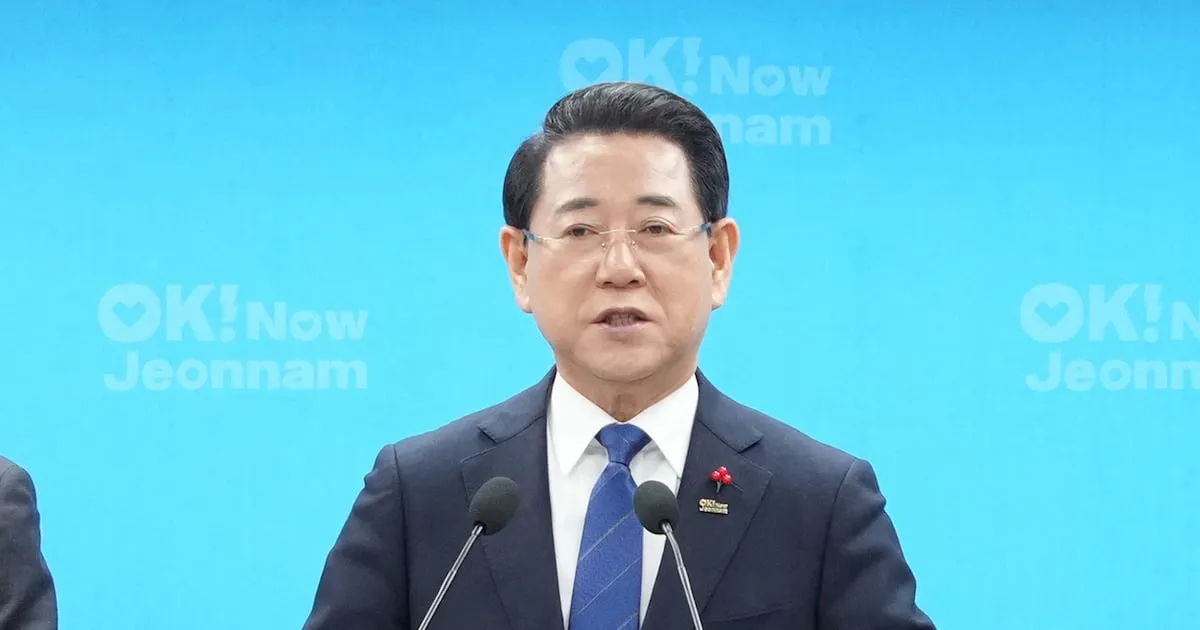
Kim Young-rok, the former governor of Jeollanam-do province, has been deemed ineligible for a position at Korea Hydro & Nuclear Power (KHNP) following a government review. The Public Service and Anti-Corruption Commission (PSACC) announced the results of its re-employment screening for retired public officials on October 23rd, covering 87 cases reviewed on October 21st.
Re-employment Screening Results
The PSACC’s review resulted in 7 cases being classified as ’employment restricted’ and 11 cases as ’employment ineligible’. Employment restriction applies when a direct and close professional relationship is identified between the duties performed at the applicant’s previous department or institution within the five years preceding their retirement and the prospective employer.
The ’employment ineligible’ designation is made when the proposed employment does not meet the specific approval criteria outlined in the relevant laws and regulations. Kim Young-rok was among those determined to be ineligible for employment. The commission concluded that his proposed role did not align with the stipulated grounds for approval under the Enforcement Decree of the Public Service and Anti-Corruption Act.
Grounds for Employment Ineligibility
According to the Enforcement Decree, employment may be approved under specific circumstances, including:
- Situations where employment is deemed necessary for national security, enhancing national competitiveness, or serving the public interest.
- Cases where the nature of the work at the prospective employer, considering the duties handled by the individual in the five years prior to retirement, presents a low risk of post-employment influence peddling.
- When an individual’s expertise is demonstrably proven through specialized knowledge, qualifications, professional experience, or research achievements.
The PSACC determined that Kim Young-rok’s case did not fall under any of these permissible categories. The commission’s decision implies that his proposed position at KHNP did not satisfy the legal requirements for re-employment approval for retired public officials, particularly concerning potential conflicts of interest or undue influence.
Other Ineligible Cases
In addition to Kim Young-rok’s case, the PSACC also ruled two individuals, formerly high-ranking civil servants in the Ministry of Trade, Industry and Energy’s industrial policy division, ineligible for re-employment. One was slated for a position as a research fellow at the Korea Transportation Safety Authority’s Automotive Safety Research Division (KATRI), and the other was set to become a vice president at the Korea City Gas Association.
These decisions underscore the PSACC’s commitment to upholding the integrity of public service and preventing potential improprieties related to the transition of officials from public roles to the private or quasi-public sector. The rigorous screening process aims to ensure that re-employment decisions are based strictly on legal frameworks and public interest considerations, thereby maintaining public trust in governmental institutions.
The Public Service and Anti-Corruption Commission plays a crucial role in regulating the post-employment activities of retired public officials to prevent the abuse of power and ensure fair competition. By scrutinizing applications for re-employment, particularly in roles that might intersect with their previous responsibilities, the commission seeks to safeguard against potential conflicts of interest and maintain a high ethical standard within the public sector.
The specific details of Kim Young-rok’s application and the exact reasons for his ineligibility, beyond not meeting the general criteria, were not publicly disclosed, adhering to privacy regulations. However, the broad categories outlined by the PSACC provide insight into the stringent requirements that former officials must meet to secure new positions, especially within industries related to their prior governmental oversight or influence.
The outcome for Kim Young-rok highlights the increasing scrutiny applied to the re-employment of former high-ranking officials. This trend reflects a broader societal demand for transparency and accountability in public life. The PSACC’s findings serve as a reminder that adherence to legal stipulations and ethical guidelines is paramount for individuals transitioning from public service, ensuring that their future roles continue to serve the public good without compromising the principles of fairness and integrity.
Korea Hydro & Nuclear Power, as a significant state-owned enterprise, operates under a framework that necessitates careful consideration of all personnel appointments, especially those involving individuals with extensive public service backgrounds. The commission’s decision in this instance reinforces the importance of a robust and impartial review process for such appointments, aiming to prevent any perception of undue advantage or preferential treatment.
Ultimately, the PSACC’s role is to act as a guardian of public trust. By enforcing regulations designed to prevent conflicts of interest and the leveraging of past public positions for private gain, the commission contributes to a more accountable and ethical public administration system. The ineligibility ruling for Kim Young-rok is a concrete example of this regulatory function in action, demonstrating that compliance with anti-corruption laws is a non-negotiable aspect of post-public service careers.
