

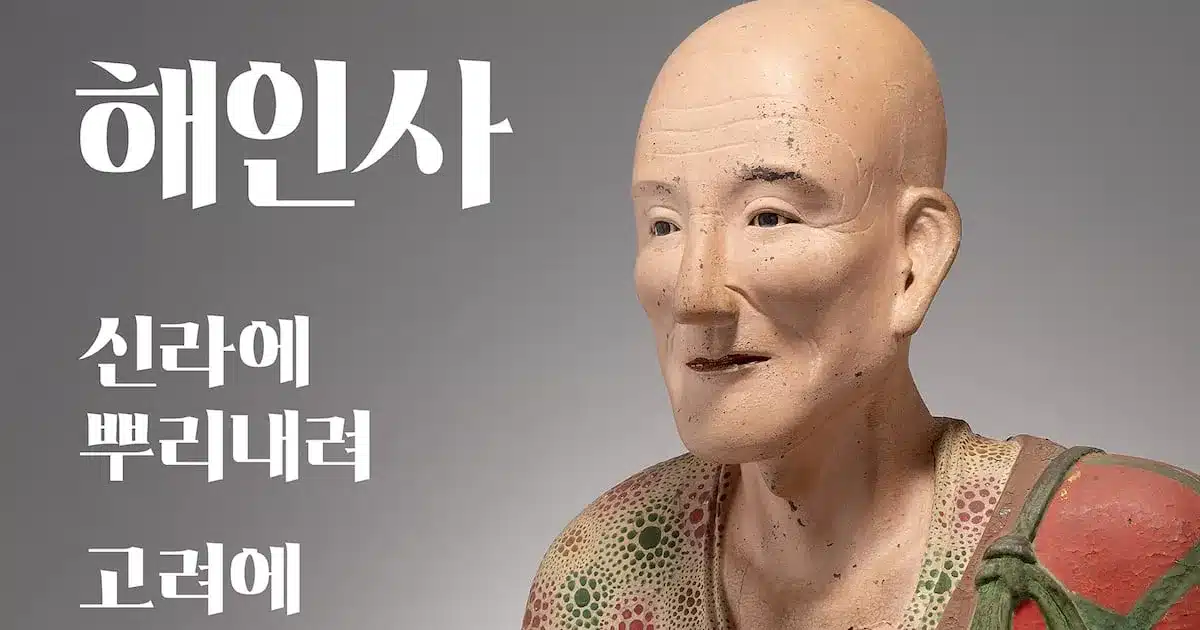
The Haeinsa Temple Museum is set to unveil a special exhibition titled ‘Haeinsa: Rooted in Silla, Blooming in Goryeo,’ offering the public a rare opportunity to view the national treasure ‘Uisangdaesajwasang’ (Seated Buddha Statue of Monk Uisang). The exhibition opens on December 22nd and will run until January 3rd of the following year.
Showcasing Buddhist Culture from Silla to Goryeo
This significant exhibition delves into the rich Buddhist culture and recorded heritage of Korea, focusing on the Silla and Goryeo dynasties. The exhibition is thoughtfully divided into three distinct sections, each offering a unique perspective on the historical and artistic evolution of Buddhism in the region.
Part 1: ‘The Sea of Hwaeom’
The first section, ‘The Sea of Hwaeom,’ centers on the foundational records of Haeinsa Temple. Visitors can explore historical texts such as ‘Samguk Sagi’ (History of the Three Kingdoms) and the ‘Gayasans Haeinsa Gojeok’ (Haeinsa Temple Record), which provide insights into the temple’s establishment and early history. This part highlights the early development and significance of Buddhist thought and practice.
Part 2: ‘Winds of a New Era’
Moving into the second section, ‘Winds of a New Era,’ the exhibition shifts focus to the turbulent period following the Later Three Kingdoms and the subsequent establishment of the Goryeo dynasty. This segment examines the societal and political changes of the time and how they influenced the development of Buddhism, reflecting the transition to a new era of unified rule and cultural flourishing.
Part 3: ‘Sacred Site of Recorded Heritage’
The final section, ‘Sacred Site of Recorded Heritage,’ illuminates the vibrant activities surrounding the printing and dissemination of Buddhist scriptures during the Goryeo period. A key highlight is the Goryeo dynasty’s woodblock printing of Buddhist texts, showcasing the era’s dedication to preserving and spreading Buddhist teachings through meticulously crafted wooden blocks. This section underscores the importance of Haeinsa Temple as a repository of invaluable cultural and religious records.
The Revered Monk Uisang and His Iconic Statue
Central to the exhibition is the ‘Uisangdaesajwasang,’ a remarkable artifact associated with Monk Uisang (889-956). Monk Uisang is historically noted for his significant contributions to Hwaeom (Avatamsaka) Buddhism and is credited with aiding the establishment of the Goryeo dynasty’s founder, King Taejo. While renowned as a leading scholar of Hwaeom Buddhism, his enduring legacy is also embodied in this unique 10th-century seated Buddha statue.
The statue, standing 88 cm tall, is distinguished by its vibrant, original coloring. It is celebrated as one of the few extant examples of three-dimensional Buddhist sculptures in Korea, representing a significant artistic achievement. Originally designated as a Treasure in 1989, its cultural and historical importance led to its elevation as a National Treasure in 2020.
The ‘Uisangdaesajwasang’ has been displayed publicly on a few occasions, allowing wider audiences to appreciate its artistry and historical context. It was exhibited at the National Museum of Korea in 2018 during the ‘Great Goryeo Exhibition,’ marking its first departure from Haeinsa Temple in over 1100 years. More recently, it was featured in a special exhibition at the Busan Museum in 2022.
Other Priceless Treasures on Display
In addition to the ‘Uisangdaesajwasang,’ the special exhibition at Haeinsa Temple Museum will showcase other significant Buddhist relics, referred to as ‘Seongbo’ (sacred treasures). Among these is the Treasure ‘Hapcheon Haeinsa Neojansuimun Gwon 490 Mokpan’ (Woodblock for the Dharani Sutra of the Immeasurable Life and Death of the Tathagata, Gwon 490), a testament to the meticulous craftsmanship of the Goryeo era. Another notable item is the Treasure ‘Gamjigeum Nimunsu Chaesang Beop’ (The Great Dharani Sutra), a rare example of a complete illustrated Buddhist text, believed to be a reproduction of a Chinese original, highlighting the extensive reach of Buddhist art and literature.
This exhibition provides a unique window into Korea’s rich Buddhist heritage, bringing together significant artifacts that tell the story of faith, art, and culture across pivotal historical periods.
