

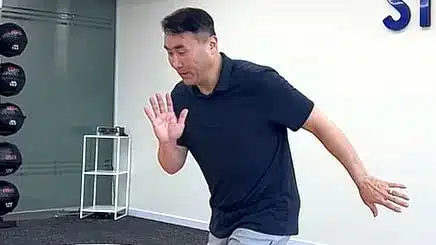
Persistent shoulder and neck pain can often be linked to a disruption in what’s known as ‘scapular rhythm.’ This crucial coordination between the shoulder blade, arm, and spine is essential for fluid, pain-free movement. When this rhythm is compromised, it can lead to chronic discomfort and even injury. Understanding and restoring proper scapular rhythm can significantly alleviate pain and improve the effectiveness of exercises.
What is Scapular Rhythm?
Scapular rhythm refers to the coordinated movement of the shoulder blade (scapula) in relation to the arm and the thoracic spine during arm elevation and movement. For the shoulder joint to function optimally, the scapula must move smoothly and predictably. This synchronized action allows the shoulder to achieve a full range of motion without excessive stress on the joint or surrounding muscles.
The scapula acts as a stable base, or ‘platform,’ for the arm to move upon. When this platform is unstable or moves incorrectly, the shoulder joint itself is forced to compensate, leading to abnormal stress. This can manifest as pain, impingement, and a reduced ability to perform everyday activities or athletic movements.
The Connection Between Neck, Shoulder, and Scapula
The neck, shoulder, and scapula are intricately connected through a network of muscles and connective tissues. Key muscle groups involved include the trapezius (upper, middle, and lower), rhomboids, serratus anterior, and rotator cuff muscles. These muscles work together to control the position and movement of the scapula.
Specifically, the scapula is linked to the neck via the upper trapezius and levator scapulae muscles. When the neck is stiff or the upper traps are overactive, it can pull the scapula into an elevated or protracted position, disrupting its normal mechanics. Conversely, if the scapula is not moving correctly, it can lead to tension and stiffness in the neck muscles, creating a cycle of pain.
The shoulder joint itself rests upon the scapula. If the scapula’s ‘platform’ is unstable or tilted due to muscular imbalances or poor movement patterns, the shoulder joint experiences abnormal forces. This can result in conditions like shoulder impingement syndrome, where soft tissues get pinched during movement, causing pain and inflammation.
When the neck is tight, the scapula often follows suit, becoming stiff. If the scapula becomes tight and elevated, it can restrict the neck’s mobility, making it feel stiff and ‘stuck.’ This interconnectedness means that addressing neck pain often requires attention to the shoulder and scapula, and vice versa.
Restoring Proper Scapular Rhythm: Exercise Guidance
Correcting poor scapular rhythm involves exercises that retrain the muscles to work in harmony. The goal is not to force movement but to allow the scapula to respond naturally to the arm’s motion. Here are some exercises that can help:
1. Gentle Arm Swings (Forward and Backward)
- Stand with your feet hip-width apart.
- Slightly bend your elbows.
- Gently swing your arms forward and backward, like a pendulum.
- Repeat for 10 repetitions.
Key Point: Avoid excessive forward or backward movement of the arms that takes the elbows out of your field of vision. Keep the elbows slightly bent and the movement controlled.
2. Gentle Arm Swings (Side to Side)
- Stand with your feet hip-width apart.
- Slightly bend your elbows.
- Keeping your elbows slightly bent, swing your arms out to the sides and then back towards your body, as if you were a bird flapping its wings gently.
- Repeat for 10 repetitions.
Key Point: Do not let your arms drift too far out to the sides, beyond your peripheral vision. Keep the elbows slightly drawn in towards your sides.
3. Gentle Squats with Arm Movement
- Stand with your feet about shoulder-width apart, or slightly wider, with your toes pointing slightly outward.
- Place your hands on your hips.
- Slightly bend your knees to perform a shallow squat, then return to a standing position.
- Repeat for 10 repetitions on each side.
Key Point: Avoid squatting too deeply. The movement should be light and bouncy, like a gentle recoil. Pushing down forcefully can strain the joints. Focus on feeling the weight shift naturally to your glutes and the balls of your feet maintaining firm contact with the ground.
4. Forward and Backward Lunge with Arm Swing
- Stand with your feet hip-width apart.
- Place your hands on your hips.
- Step one foot forward a comfortable distance, lowering your hips to perform a lunge. Ensure your front knee stays behind your toes.
- Return to the starting position.
- Step the same foot backward a comfortable distance, lowering your hips into a backward lunge.
- Return to the starting position.
- One forward and one backward lunge constitutes one repetition. Repeat for 10 repetitions.
- Switch legs and repeat for 10 repetitions.
Key Point: As your legs move forward and backward, allow your arms to swing gently forward and backward as well, coordinating with the leg movement. Feel the weight shift forward onto your front leg during the forward lunge, engaging the muscles at the front of your thigh (quadriceps). This movement should help engage the anterior muscles of the thigh and hip.
Understanding the Mechanics of Scapular Rhythm
Scapular rhythm is a complex interplay between the shoulder, arm, and thoracic spine. When this rhythm is functioning correctly, these three components work in harmony. The goal of rehabilitation and exercise is to restore this natural coordination, rather than forcing movements through the neck or shoulder.
For instance, when lifting the arm overhead, the scapula should upwardly rotate and posteriorly tilt. This allows the shoulder joint to achieve its full range of motion without the structures within the shoulder impinging. If the scapula doesn’t move correctly—perhaps it stays ‘stuck’ or elevates excessively—the arm’s movement becomes restricted, and compensatory patterns emerge.
This often leads to overuse of the upper trapezius muscle, which can cause neck pain and stiffness. The muscles around the scapula, such as the rhomboids and serratus anterior, may become weak or inhibited, further contributing to poor scapular positioning.
Restoring scapular rhythm involves strengthening the muscles that control the scapula, improving thoracic spine mobility, and retraining the neuromuscular patterns that dictate how the scapula moves with the arm. This holistic approach ensures that movement originates from a stable base and is distributed efficiently throughout the kinetic chain.
Conclusion
Chronic shoulder and neck pain are frequently rooted in a disrupted scapular rhythm.
