

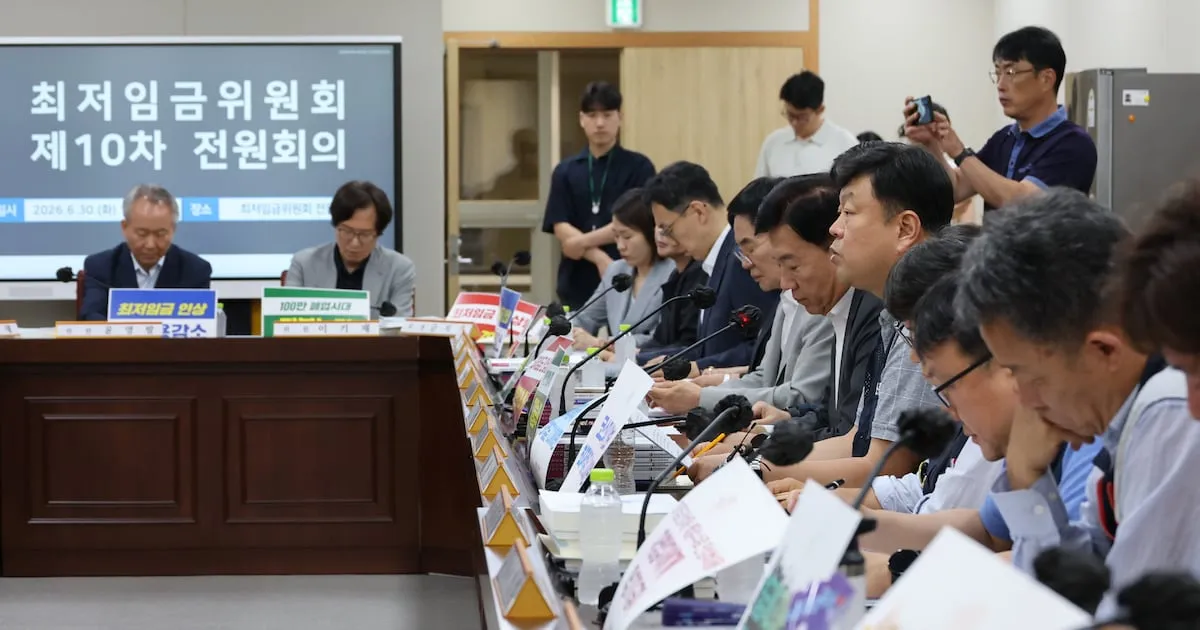
The deliberation range for South Korea’s minimum wage in 2025 has been narrowed to between 10,060 and 10,080 won per hour. This proposed increase represents a rise of 2.7% to 5.25% compared to the current minimum wage. The figures emerged from the 14th plenary session of the Minimum Wage Committee held at the Government Complex Sejong on the 14th, where public interest representatives presented a “tentative range” aimed at bridging the gap between labor and management.
Understanding the Tentative Range Mechanism
The concept of a “tentative range” is a procedural tool employed by public interest representatives on the Minimum Wage Committee. When direct negotiations between labor and management representatives fail to yield an agreement, these public interest members step in. They propose a provisional wage band, taking into account the demands of both sides, economic indicators, and other relevant data. This range serves as a new basis for further negotiation, allowing labor and management to submit revised proposals within its boundaries. The final minimum wage is then determined through consensus or a vote.
Basis for the Proposed 2025 Minimum Wage Range
The lower end of the proposed range, 10,060 won per hour, reflects a 2.7% increase. Public interest representatives explained that this figure incorporates the projected consumer price inflation rate for the current year, which stands at 2.7%. This aligns the minimum wage increase with the expected rise in the cost of living, aiming to maintain the purchasing power of low-wage workers.
The upper limit of the proposed range, 10,080 won per hour, was calculated by averaging the economic growth forecasts from two key economic institutions: the Bank of Korea and the Korea Development Institute. Both institutions projected economic growth rates of 2.6% and 2.5%, respectively. The average of these two figures is 2.55%. To this average, the projected consumer price inflation rate of 2.7% was added, resulting in the upper bound of 5.25% increase (effectively 10,080 won per hour).
This methodology attempts to balance the need for wage increases with the projected capacity of the economy to absorb such changes, considering both growth potential and inflationary pressures.
Labor and Management Positions
Prior to the public interest representatives’ proposal, the labor and management sides had presented their respective initial demands for the 2025 minimum wage. The management side proposed an hourly wage of 10,050 won. The labor side, on the other hand, requested a higher figure of 11,150 won per hour.
The tentative range presented by the public interest representatives falls between these two initial positions. The lower end of the range (10,060 won) is just 10 won higher than the management’s proposal, while the upper end (10,080 won) is 970 won lower than the labor’s proposal. This positioning suggests an effort to find a middle ground that acknowledges both the concerns of employers regarding cost burdens and the demands of workers for a more substantial wage increase.
Next Steps in the Deliberation Process
Following the presentation of the tentative range, the next phase of the deliberation process will involve both labor and management representatives submitting revised proposals. These revised proposals must fall within the 10,060 to 10,080 won per hour band established by the public interest members.
The ultimate decision on the 2025 minimum wage will be reached through further negotiation, aiming for a consensus between the labor and management camps. If an agreement cannot be reached through discussion, the final amount will be determined by a vote within the committee. This structured approach aims to ensure a fair and economically sound decision for the upcoming year.
Economic Context and Implications
The annual minimum wage adjustment in South Korea is a closely watched economic event, impacting millions of workers and numerous businesses. The process involves a delicate balancing act between ensuring a living wage for workers and managing the potential economic consequences for employers, such as increased labor costs and potential impacts on employment levels.
Factors such as inflation, economic growth, employment rates, and the overall business environment are critical considerations. The proposed range for 2025 appears to reflect a cautious approach, with the lower end closely tied to inflation and the upper end incorporating moderate economic growth projections. This suggests a recognition of the need to support workers’ purchasing power without placing undue strain on the economy, particularly in light of global economic uncertainties.
The outcome of these deliberations will have significant implications for household incomes, consumer spending, and the operational costs for small and medium-sized enterprises, which often bear the brunt of minimum wage increases. Stakeholders will be closely monitoring the final decision as it shapes the economic landscape for the coming year.
