

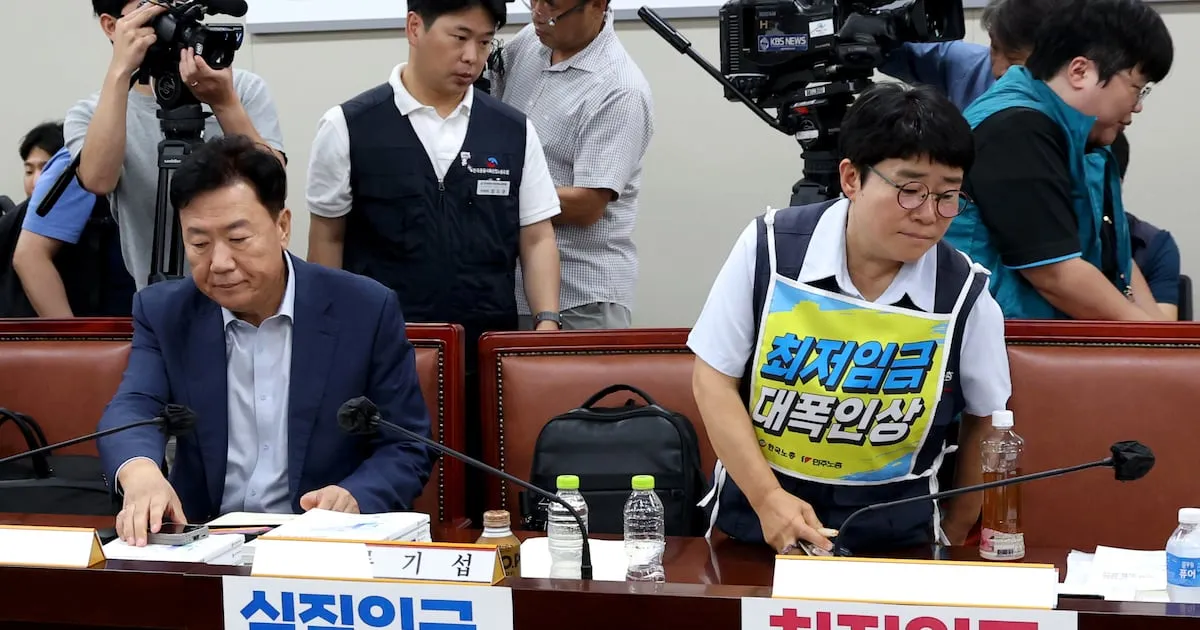
South Korea’s minimum wage for 2025 has been set at 10,070 won per hour, marking a 3.7% increase from the current year’s rate of 9,860 won. This decision was finalized during the 14th plenary session of the Minimum Wage Commission held on June 14th at the Government Complex in Sejong.
Minimum Wage Commission Deliberations
The Minimum Wage Commission, composed of 27 members representing public interest, labor, and employer groups (with nine members from each sector), convened to determine the hourly wage for the upcoming year. The commission operates with a tripartite structure, aiming to balance the interests of workers and businesses.
During the session, two proposals were put to a vote: the labor sector’s final proposal of 10,130 won (a 4% increase) and the employer sector’s proposal of 10,070 won (a 3.7% increase). The employer’s proposal ultimately passed with 15 votes, while the labor sector’s proposal received 11 votes in favor and one abstention.
Key Figures and Comparisons
The approved minimum wage of 10,070 won per hour translates to approximately 2,110,740 won per month for a standard 209-hour workweek. This figure is notably higher than the projected consumer price inflation rate for the year, which stands at 2.7%, indicating a real increase in purchasing power for minimum wage earners.
This increase follows a trend of significant minimum wage hikes over the past decade. Data from the Korea Employers Federation reveals that between 2015 and 2025, the minimum wage rose by approximately 79.7%, far outpacing the cumulative consumer price inflation of 22.9% during the same period. This substantial growth in the minimum wage has been a point of contention between labor and employer groups.
Employer Concerns Over Rising Labor Costs
The decision has reignited concerns among small and medium-sized business owners regarding increased labor cost burdens. Business groups argue that the continuous rise in the minimum wage, especially when exceeding inflation rates, places significant financial pressure on small enterprises and sole proprietors.
These concerns are underscored by recent data on business closures. According to statistics from the Ministry of SMEs and Startups, approximately 976,000 businesses closed down last year. A separate survey of these former business owners identified ‘rising labor costs’ as a primary reason for business failure, cited by 28.8% of respondents who pointed to ‘deteriorating profitability’ as the main cause.
Economic Impact and Future Outlook
The annual adjustment of the minimum wage is a critical economic policy in South Korea, impacting millions of workers and a vast number of businesses. While the increase aims to improve the livelihoods of low-wage workers and stimulate domestic consumption, it simultaneously presents challenges for businesses, particularly those operating on thin margins.
The government and the Minimum Wage Commission face the ongoing task of striking a balance between ensuring a decent standard of living for workers and maintaining the competitiveness and sustainability of businesses. Future deliberations will likely continue to weigh economic growth, inflation, employment levels, and the capacity of businesses to absorb increased labor costs.
Understanding the Minimum Wage System
The minimum wage system in South Korea is designed to protect the rights of workers by guaranteeing a baseline income. It is set annually by the Minimum Wage Commission, a body established under the Minimum Wage Act. The commission’s decisions are legally binding and come into effect from January 1st of the following year.
The commission’s deliberations typically involve extensive discussions and data analysis concerning economic conditions, employment trends, and the cost of living. Both labor and employer representatives present their cases, supported by economic data and forecasts, before the commission votes on the final wage level. Public interest members play a crucial role in mediating and facilitating consensus.
Historical Context of Minimum Wage Adjustments
The minimum wage has seen substantial increases over the years, particularly in recent times. This has been part of a broader policy effort to address income inequality and boost domestic demand. However, the pace of these increases has often been a subject of debate, with labor unions advocating for higher rates to ensure a living wage and business associations calling for more moderate adjustments to prevent job losses and business failures.
The 3.7% increase for 2025 reflects a more moderate adjustment compared to some of the double-digit percentage increases seen in previous years. This suggests a potential shift towards a more calibrated approach, acknowledging both the need for worker income support and the economic realities faced by businesses.
Conclusion
The decision to set the 2025 minimum hourly wage at 10,070 won represents a significant policy outcome for South Korea’s economy. This adjustment aims to provide a modest boost to the income of low-wage workers while navigating the concerns of businesses regarding increased operational costs. As the new wage rate takes effect, its broader economic implications on employment, inflation, and business viability will continue to be closely monitored by policymakers, industry stakeholders, and the public.
