

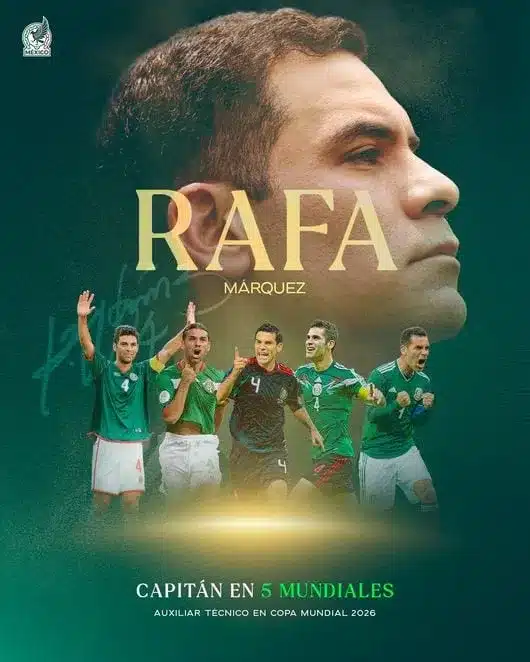
Following their elimination from the World Cup in the Round of 16, Mexico has appointed Rafael Márquez as the new head coach of the national team. Márquez, who served as an assistant coach under former head coach Jaime Lozano during the tournament, steps into the top role as part of a pre-planned succession. This transition marks a new chapter for Mexican football, with a focus on the 2030 project.
Márquez Takes the Helm
The Mexican Football Federation confirmed the appointment of Márquez on September 9th (Korean time). His promotion was anticipated, as he was already integrated into Lozano’s coaching staff with a view to taking over. Márquez’s familiarity with the national team setup and his extensive experience as a player are expected to be key assets.
Lozano’s World Cup Campaign
Jaime Lozano’s final World Cup campaign with Mexico showed promise. The team topped their group, securing victories against South Africa, South Korea, and Czech Republic. A crucial goal from Luis Romo in the second half against South Korea proved decisive, giving Mexico an early advantage in the group stage on home soil.
The momentum carried into the knockout stages, where Mexico faced England in the Round of 16. Despite a strong effort, with goals from Julián Quiñones and Raúl Jiménez, Mexico ultimately fell short. The roar of the crowd at the Estadio Azteca fueled the team throughout the match, but a single goal was not enough to overcome their opponents, ending Mexico’s home World Cup run in the Round of 16.
Familiar Faces and New Beginnings
Lozano is a familiar name to South Korean football fans, having previously coached Lee Kang-in at Mallorca. Under Lozano’s guidance, Lee Kang-in became a central figure in Mallorca’s tactics, leading to a successful 2022-2023 season with six goals and seven assists, paving the way for his transfer to PSG. This World Cup saw coach and former protégé face each other from different benches and in different uniforms.
Márquez: A Legend’s Transition
Rafael Márquez is a towering figure in Mexican football history. During his playing career, he excelled as a center-back and defensive midfielder, captaining the national team through 148 appearances and five World Cup tournaments. His experience at the highest level, including his time with Barcelona, makes him uniquely qualified to understand the pressures faced by players on the global stage.
A Team on the Rise, Despite Setbacks
Márquez inherits a team that, while not entirely broken, is looking for renewed direction after the Round of 16 exit. Mexico achieved a clean sweep in the group stage, marking their first tournament victory in 40 years. Lozano’s tenure saw a record of 22 wins, 9 draws, and 6 losses in 37 matches. The team also has future competitions like the 2024-2025 CONCACAF Nations League and the 2025 Gold Cup ahead.
However, the Round of 16 elimination in their home World Cup remains a significant disappointment. Despite the advantage of hosting, the passionate home crowd, and a successful group stage, the quarterfinals remained out of reach. Márquez faces the dual challenge of building on past successes while addressing the shortcomings that led to the exit.
The Road to 2030
Mexico has a history of alternating between high expectations and painful disappointments. While strong in the group stages, they have often faltered in the knockout rounds. The home World Cup followed this pattern, with the team unable to overcome the final hurdle against England despite a spirited performance. The coaching change is thus seen less as a punishment for failure and more as a strategic handover for the next phase.
Márquez’s task begins with instilling defensive solidity. As a player, he was known for his disciplined positioning, precise passing, and fearless commitment. He must now translate that ethos to the team. Mexico played courageously at home, but moments of instability in the latter stages of matches were evident. The team needs to develop the resilience to hold leads or fight back against stronger opponents.
The emergence of a new generation of attacking talent is also crucial. While veterans like Raúl Jiménez remain important, the team must cultivate new faces for the 2030 cycle. Márquez, a national legend who also gained coaching experience in Spain, is in a position where his development speed, rather than just his name, will be paramount. His legendary status alone won’t sustain the team for four years; he must now prove himself from the dugout.
A Connection to South Korea
This transition has a notable connection to South Korea. Mexico was the team that ended South Korea’s group stage run, and Lozano was Lee Kang-in’s former coach. Now, the reins have passed to Márquez. Mexico’s World Cup journey, which saw them defeat South Korea, has concluded, and the next four years begin under the guidance of a former Barcelona star, with the sights set firmly on 2030.
