

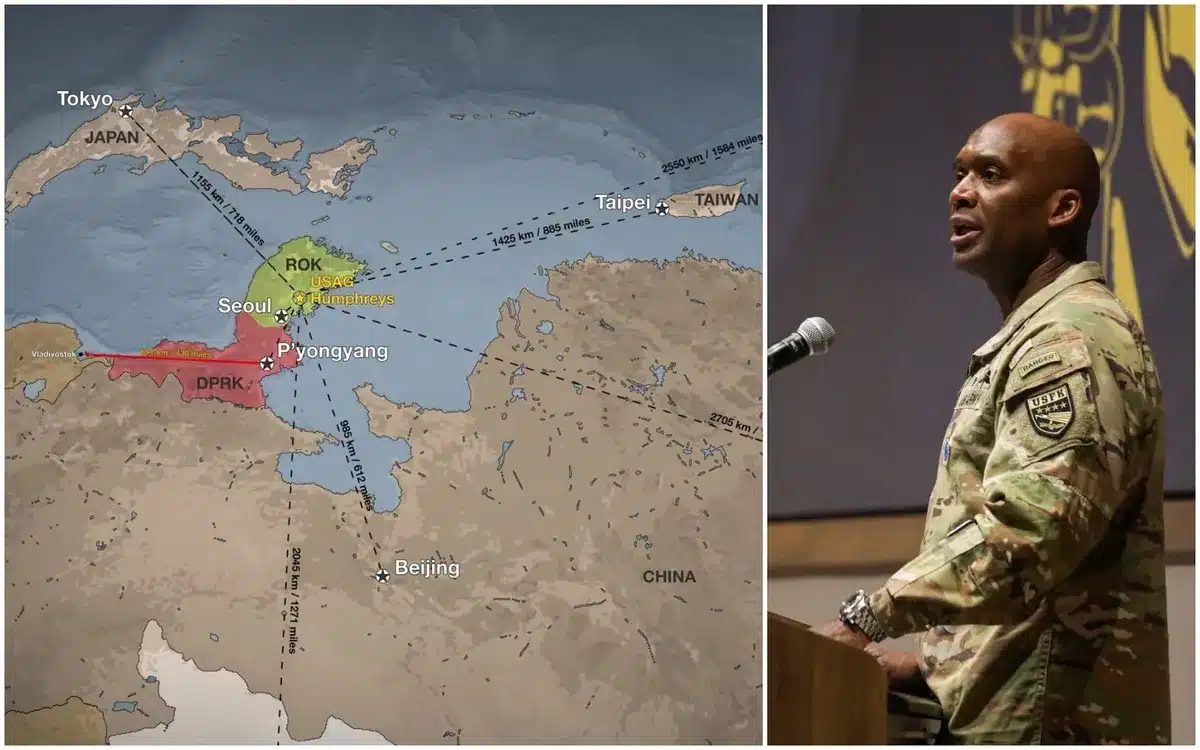
US Forces Korea Commander Addresses ‘Dagger’ Remark on South Korea
General JB “Randy” Brunson, the commander of US Forces Korea, has clarified a recent statement where he described South Korea’s geopolitical position as a “dagger” pointed at China. General Brunson stated that his intention was to “explain the operational environment” that US Forces Korea faces.
Previously, General Brunson had characterized South Korea’s location as an “island floating between Japan and mainland China, or like a fixed air base.” The “dagger” analogy, however, has drawn strong criticism from China.
South Korean Presidential Office Acknowledges Communication
A South Korean presidential office official confirmed on May 30th that they are aware of General Brunson’s recent remarks and that ongoing communication between Seoul and Washington regarding these issues is taking place.
During a question-and-answer session following a speech by US Secretary of Defense Pete Hegseth at the 23rd Asia Security Summit (Shangri-La Dialogue) in Singapore, a Chinese professor asked if General Brunson’s “dagger” statement represented the official stance of the Trump administration or if it had Pentagon approval.
Secretary Hegseth deferred the question to General Brunson, who was present in the audience.
Historical Context of the ‘Dagger’ Analogy
General Brunson explained that his previous remarks were an invocation of historical expressions that used the “dagger” metaphor in relation to South Korea. He clarified that the full context of those statements was about understanding the region’s evolving perspectives.
He specifically referenced a past statement by Lieutenant General Jacob L. Devers, a US Army officer, who described the Korean Peninsula as a “dagger pointed at the heart of Japan.” This expression, he noted, was widely circulated in Japan at the time.
General Brunson elaborated that Devers’ “dagger” theory was used to justify Japan’s colonial expansion, arguing that if continental powers like Russia and China were to dominate Korea, mainland Japan would be threatened, thus necessitating Japanese preemptive control.
Shifting Perspectives and Mutual Understanding
General Brunson emphasized that his intention during his time at the War College was to encourage students to “change their perspectives and consider their positions.” He stressed the importance of students understanding and respecting viewpoints beyond their own.
Referencing the concept of a “map oriented towards the East,” General Brunson stated that by altering one’s perspective, it becomes possible to consider how other nations in the region perceive them. He added, “We must be strong and possess military capabilities within the Republic of Korea, but we must also understand that such (foreign) perspectives still exist.””
Diplomatic Engagements and Dialogue
General Brunson also alluded to the recent US-China summit, calling the visit of the President and Secretary of Defense to China “a tremendous event” that could foster dialogue and strengthen relations.
In a previous appearance on a US Army War College podcast on May 22nd, General Brunson had stated, “From the perspective of China’s east coast, they see Korea as a dagger in the heart of Asia.” He further argued that beyond Korea lies Japan, which he described as a “kind of shield and last line of defense” for China in its ambitions to expand into the South China Sea.
China’s Strong Condemnation
The Chinese government strongly condemned these remarks as hostile and aggressive. The Chinese Embassy in Seoul issued a statement on May 28th, asserting that General Brunson’s comments had “clearly crossed the line.””
