

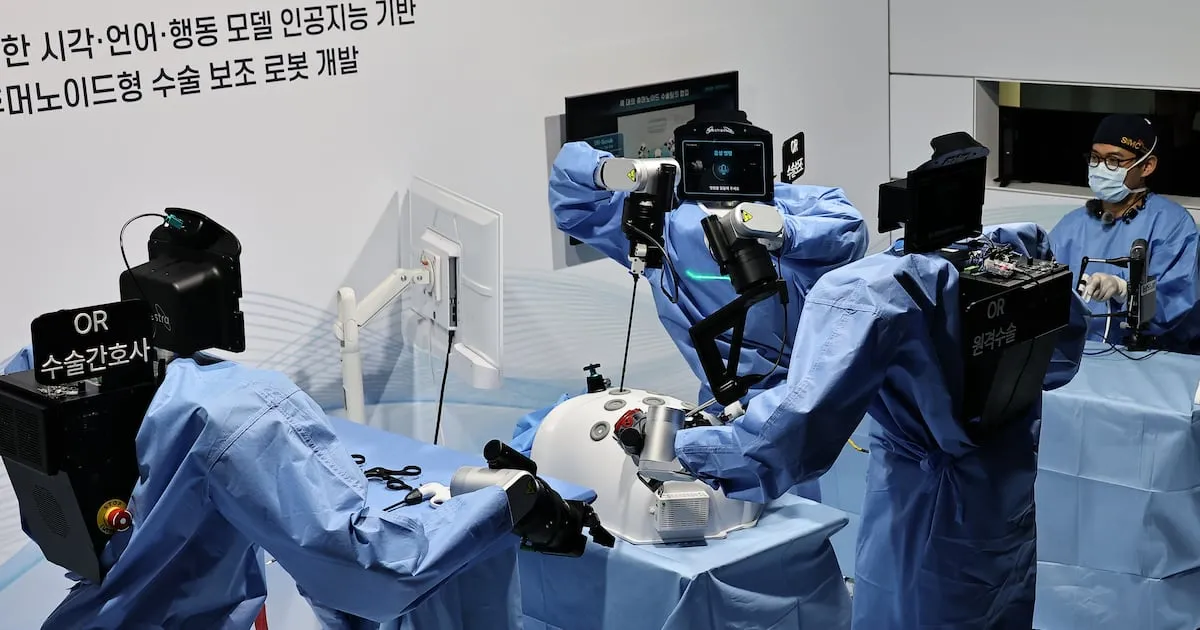
In a groundbreaking demonstration, surgical robots have successfully collaborated with human surgeons, performing complex procedures by sharing tasks and responding to verbal commands. This innovative approach, showcased at a simulated operating room in Seoul, marks a significant step forward in the integration of artificial intelligence and robotics into healthcare.
Robots as Surgical Partners
During a simulated gallbladder removal procedure on April 16th, two specialized robots, standing approximately 1.4 meters tall and weighing between 130-170 kg, sprang into action. These robots, designed to assist surgeons, were directed by Professor Oh Nam-gi of Samsung Seoul Hospital. One robot, acting as a nurse assistant, used its camera to identify and retrieve surgical instruments, such as graspers, handing them to the professor. Simultaneously, another robot, serving as an assistant surgeon, manipulated an endoscope under the professor’s guidance, retracting tissue to expose the surgical site.
The demonstration culminated with the announcement that the gallbladder had been completely removed, drawing applause from over 100 observers, including medical professionals and journalists. While the procedure was a simulation using artificial materials, it represented the world’s first instance of a surgical team comprising a human surgeon and two robots working in concert.
Introducing the ‘Humanoid Surgical Assistant Robot’
This demonstration was part of the first public unveiling of the ‘Humanoid Surgical Assistant Robot,’ developed over the past 14 months. The ‘Humanoid’ robot is designed to mimic the human body’s structure and movements. Samsung Seoul Hospital, selected as the lead institution for the ‘Korea ARPA-H’ project last July, partnered with robotics company Raybow Robotics to develop this advanced surgical assistant.
The event served as a mid-project progress report, featuring a series of surgical simulations. These included a scenario with three robots (one controlled by the surgeon) and the main demonstration involving Professor Oh and two robots. Samsung Seoul Hospital emphasized that their approach differs from existing surgical robots like the da Vinci system. While da Vinci requires a surgeon to directly control the robot from a console, the Humanoid robot is designed to enter the operating room and utilize existing surgical tools, working alongside the lead surgeon.
Key Features and Technologies
Professor Jeong Yong-gi, the research lead from Samsung Seoul Hospital, highlighted the system’s ability to leverage existing operating room structures and instruments without modification. The Humanoid robot boasts several advanced technological features:
- Dexterous Manipulation: The robot’s arms can bend and rotate, allowing for adjustments in working height and posture. Each arm can lift up to 3 kg.
- Sensory Input: Cameras and sensors function as the robot’s ‘eyes,’ while voice recognition technology acts as its ‘ears.’
- AI Brain: An integrated artificial intelligence system processes information from cameras, sensors, and voice recognition to determine actions. The robot can recognize verbal commands like “Pass the scissors” and initiate the action in under two seconds.
- Instrument Handling: The system demonstrated a 100% success rate in grasping five types of surgical instruments and a 98.7% success rate in handing them to the surgeon.
- Visual Servoing: This technology allows the robot to track the movement of surgical instruments and automatically adjust the endoscope’s position to maintain a clear view of the surgical site, crucial for tasks like manipulating the endoscope.
The research team anticipates that these robots could become valuable assets in addressing the shortage of skilled surgical assistants, particularly in regional hospitals or for emergency surgeries in larger institutions. Professor Jeong noted, “If the Humanoid can take over some tasks, the lead surgeon can operate more comfortably.”
Future Prospects and Challenges
Despite the promising advancements, the Humanoid surgical assistant robot is still in the validation and testing phase. Significant challenges remain before widespread clinical adoption.
- Safety Verification: Rigorous testing is required to ensure the robot operates safely, for instance, by confirming it does not apply excessive or insufficient force when manipulating instruments.
- Liability and Regulation: Clear protocols must be established regarding who is responsible if a robot malfunctions and causes patient harm.
- Clinical Trials: The project aims to complete commercialization by the end of 2029, with initial human clinical trials planned for gallbladder and pituitary gland tumor resections.
The research project is set to undergo competitive evaluation later this year. If selected, it will receive approximately 13.8 billion won (about $10 million USD) in government funding until the end of 2029. This funding will support the completion of the surgical assistant robot’s commercialization and facilitate the first human clinical trials.
Professor Jeong expressed optimism about South Korea’s potential to lead in this field, stating, “Surgical assistant robots are an area where Korea can take the lead, given its skilled medical professionals and excellent robotics and AI researchers.” The ultimate goal is to develop technology where robots can proactively prepare instruments even before the surgeon verbally requests them.
