

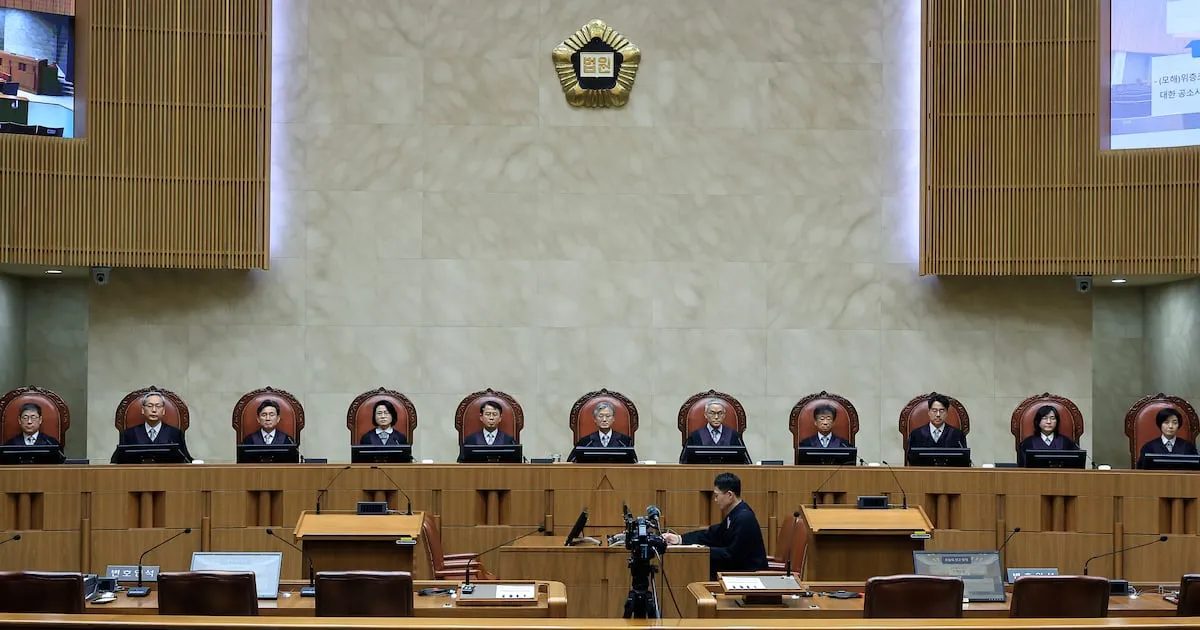
The appointment of Noh Kyung-pil as the new Supreme Court Administrator marks his first major test, as the court grapples with a prolonged vacancy in one of its key positions. This situation has persisted for four months, raising concerns about the court’s composition and the allocation of cases.
New Administrator Takes Office Amidst Court Vacancy
On August 15th, Noh Kyung-pil officially assumed the role of Supreme Court Administrator. His predecessor, Park Young-jae, resigned approximately four months prior. Park’s departure stemmed from his opposition to certain judicial reforms, including the introduction of a ‘three-strike’ system for legal professionals and proposed increases in the number of Supreme Court justices. The Administrator position is crucial, overseeing administrative affairs such as personnel, budget, and organizational matters within the Supreme Court. While one Supreme Court Justice typically holds this administrative role concurrently, they do not handle case adjudication during their tenure. Currently, Supreme Court Division 3, where Noh served, operates with three justices.
The immediate challenge for Noh is compounded by the fact that another Supreme Court Justice, Lee Heung-gu, is set to retire in September. This means that two significant positions within the Supreme Court could become vacant in quick succession. The delay in appointing a successor to Noh Tae-ak, who retired in March, further exacerbates the situation. If these appointments are not resolved promptly, it could lead to imbalances in the court’s structure and affect how cases are assigned and handled.
Noh’s Role in Bridging Political Divides
The Supreme Court Administrator plays a vital role in communicating the judiciary’s stance to the National Assembly and the Blue House (the presidential office). They also participate in key judicial personnel recommendations. Noh Kyung-pil’s background, having served as a liaison between the judiciary, the Blue House, and the National Assembly, positions him to potentially navigate these complex political discussions and resolve the issue of the vacant seat. His ability to foster consensus among political factions will be closely watched.
Noh, a graduate of Kwangwoon University’s Law Department and Seoul National University’s College of Law, hails from the Honam region. He is the first Administrator from this region in approximately ten years, following Go Young-han. Unlike his predecessor, Park Young-jae, who faced significant friction with the ruling party over the handling of a high-profile case involving then-presidential candidate Lee Jae-myung, Noh is expected to have a more cooperative relationship with political circles. Park’s resignation followed calls from the ruling party after the Supreme Court’s decision to send back the case concerning alleged violations of election law by Lee Jae-myung.
Delayed Appointment Process for Successor to Noh Tae-ak
The process to appoint a successor to former Supreme Court Justice Noh Tae-ak has been stalled for over six months. In January, the Supreme Court Justice Recommendation Committee nominated four candidates: Kim Min-ki and Park Soon-young (both Seoul High Court presiding judges), Son Bong-ki (Daegu District Court chief judge), and Yoon Sung-sik (Seoul High Court deputy chief judge). Subsequently, the Chief Justice of the Supreme Court is meant to recommend one of these individuals to the President, who then makes the final appointment after confirmation by the National Assembly’s legislation and judiciary committee.
However, disagreements between the Supreme Court and the Blue House have reportedly led to delays in this recommendation process. Acting Administrator Ki Woo-jong addressed the issue during a National Assembly legislation and judiciary committee meeting on August 8th. Responding to a question about the timing of the Supreme Court Justice appointment, he stated, “The consultations have not been entirely unsuccessful,” and pledged to “make efforts.”
There is anticipation within the judiciary that Noh, with his experience in inter-branch communication, might be able to facilitate a smoother appointment process compared to his predecessor. The judiciary is hopeful that Noh’s appointment will help break the deadlock.
Extensive Candidate Pool for Supreme Court Vacancies
The Supreme Court is expected to proceed with filling the vacancies left by Noh Tae-ak and Lee Heung-gu, either simultaneously or sequentially. Last month, the court disclosed a list of 28 potential candidates for these positions. The Justice Recommendation Committee is currently reviewing these nominees.
The pool of candidates includes numerous individuals at the level of Supreme Court Chief Judge, as well as presiding judges from various district courts. Notable figures include Seol Beom-sik (Gwangju High Court Chief Judge), Jeong Jun-yeong (Seoul Central District Court Chief Judge), Kim Moon-gwan (Busan District Court Chief Judge), Kim Tae-eop (Seoul Southern District Court Chief Judge), Yoo Jin-hyun (Ulsan District Court Chief Judge), and Im Hae-ji (Daegu Family Court Chief Judge).
Candidates with experience in the Supreme Court’s appellate divisions are also in contention. Hwang Jin-gu, a deputy chief judge at the Seoul High Court, is among them. Additionally, individuals who were appointed as ‘senior judges’ after the abolition of the deputy chief judge promotion system for high courts in 2020, and deputy chief judges of district courts, are also on the list. These include Jeong Jae-oh and Kim Mu-shin (both Seoul High Court senior judges), Kwon Soon-min (Seoul High Court, Incheon Appellate Division senior judge), Kim Jin-seok (Daejeon High Court, Cheongju Appellate Division senior judge), Kim Jeong-jung (Gwangju District Court deputy chief judge, formerly Seoul Central District Court Chief Judge), and Kim Guk-hyun (Suwon District Court deputy chief judge, formerly Seoul Administrative Court Chief Judge).
Presidential Appointment and Potential Judicial Leanings
This upcoming appointment marks the first Supreme Court Justice nomination under the current administration. Therefore, the political and ideological leanings of the candidates are expected to be significant factors. The President previously appointed Kim Sang-hwan and Oh Young-jun as Supreme Court Justices in June of last year, who are generally considered to have progressive or moderately progressive leanings.
The list of candidates also includes individuals with connections to the President’s past legal cases. Jeong Jae-oh, a senior judge at the Seoul High Court, was part of the panel that acquitted the President in a case related to alleged violations of election law during his presidential campaign. Jeong, who graduated from Salesio High School in Gwangju and Seoul National University’s College of Law, has also published research advocating for the necessity of legalizing same-sex marriage. If appointed, Jeong would be the first Supreme Court Justice to have a background as a senior judge.
Lee Jae-kwon, a deputy chief judge at the Seoul High Court, who had his judicial clerkship extended due to the President’s case, is also a candidate. His inclusion suggests that the administration’s approach to judicial appointments may consider past professional interactions and affiliations.
