

A significant controversy has erupted in South Korea’s K League following a series of questionable refereeing decisions made by a prominent official. The debate centers on whether the referee, Kim Dong-jin, adequately addressed player safety and maintained consistency in his rulings during a recent match between Ulsan HD and Jeonbuk Hyundai Motors. This incident has drawn comparisons to a similar situation involving a top international referee at the recent FIFA World Cup.
Contrasting Incidents on the World Stage and Domestic League
The controversy gained traction after a match on November 11th (Korean time) during the 2026 FIFA World Cup. In the 35th minute of the quarter-final match between Spain and Belgium, Spanish midfielder Dani Olmo was involved in a collision with referee Michael Oliver. The incident occurred as Olmo attempted to receive a pass near the penalty box. Oliver, who had just blown his whistle to signal a dropped ball for Belgium after they had won possession, was moving backward when the collision happened. The referee immediately apologized to Olmo, acknowledging his mistake and expressing his sincere regret to the Spanish players who approached him.
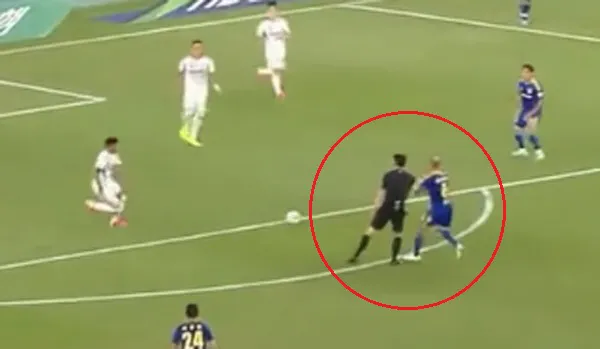
Remarkably, a nearly identical situation unfolded just hours later in the K League 1 match between Ulsan HD and Jeonbuk Hyundai Motors at Munsu Football Stadium. In the 30th minute, Ulsan’s Kang Sang-woo played a pass towards Brazilian forward Leonardo near the right side of the penalty area. As Leonardo moved to receive the ball, he collided with referee Kim Dong-jin, who was moving sideways after attempting to avoid the play. Leonardo stumbled and fell after the impact.
Inconsistent Officiating Sparks Outrage
The crucial difference lay in the referees’ reactions. While Michael Oliver immediately stopped play, apologized, and acknowledged his role in the collision, Kim Dong-jin’s response was starkly different. He did not blow his whistle and did not appear to check on the fallen player, Leonardo. Instead, Kim continued to follow the play, trailing behind Jeonbuk midfielder Obirendan as play continued. Obirendan then passed the ball to Ulsan’s Lee Dong-jun, who in turn passed to Kim Jin-gyu. Kim Jin-gyu scored what became the opening goal of the match.
The sequence of events, from the collision to the goal, unfolded rapidly. Astonishingly, Kim Dong-jin allowed the goal to stand, despite the earlier collision and the protests from Ulsan players and coaching staff. Video Assistant Referee (VAR) checks did not intervene in the decision.
Ulsan HD ultimately lost the match 3-1, with Jeonbuk adding two more goals in the second half. The controversial opening goal, which shifted the game’s momentum, is widely seen as having significantly impacted the final result.
Past Precedents and Questions of Consistency
Kim Dong-jin, who was named the Korea Football Association’s (KFA) Referee of the Year in 2025, had reportedly observed top-level officiating during his recent World Cup attendance. Critics are questioning whether this experience influenced his officiating or if a lack of consistency plagues his decision-making.
This is not the first time Kim Dong-jin has been involved in a controversial collision incident. In May of the previous year, during a match between Jeonbuk and Ulsan in Jeonju, Kim collided with Jeonbuk player Park Jin-seop. On that occasion, Kim did blow his whistle and stopped the game, a decision considered standard procedure when a referee’s involvement potentially affects play. This past action highlights a perceived inconsistency in his rulings, leading many to question why a similar approach wasn’t taken in the recent Ulsan-Jeonbuk match.
Football officials and observers are raising concerns about the lack of clear guidelines regarding referee-player collisions and the potential for subjective interpretations. While football’s Laws of the Game do not explicitly detail specific protocols for collisions between referees and players, it is generally understood that referees should stop play if their involvement impacts the game or player safety. This principle is often referred to as ‘common sense’ in officiating.
When questioned by the Ulsan side, the referee’s committee reportedly stated that the decision was made according to the rules. However, this explanation has done little to quell the growing dissatisfaction.
Calls for Explanation and Future Implications
The Ulsan HD club is planning to submit a formal request to the KFA on the 13th, demanding an explanation for the controversial decision. The KFA’s Referee Committee is expected to respond to this request.
There is a strong sentiment within the football community that this issue should not be dismissed lightly. Many believe that Kim Dong-jin, who also reportedly holds a position as a former head of KFA refereeing instructors, should provide a clear explanation, especially to aspiring referees. The concern is that inconsistent decisions, made based on the ‘mood’ of the moment, could set a problematic precedent for the future of K League officiating.
The incident underscores the ongoing challenges in ensuring fair and consistent officiating in professional football, particularly when high-stakes matches and player safety are involved.
The debate continues regarding the interpretation of rules and the responsibility of referees to maintain the integrity of the game, even in unforeseen circumstances like collisions with players.
