

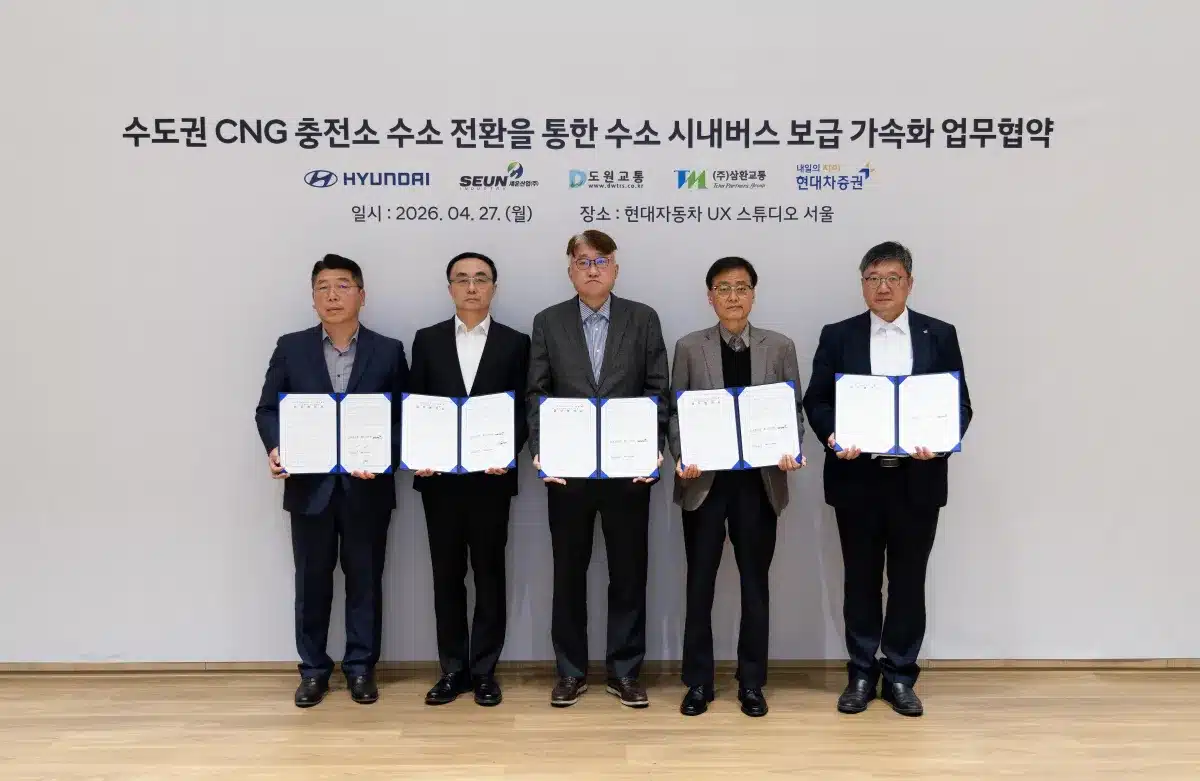
Hyundai Motor advances city bus infrastructure by transitioning from city gas to hydrogen power. The company signed a memorandum of understanding (MOU) with Dongwon Transportation, Samhwan Transportation, Seun Industry, and Hyundai Motor executives to support operations and related services.
MOU Ceremony Details
The agreement took place on the 27th at the UX Studio in Seoul’s Gangnam district. Key participants included Kim Jeong-hwan, head of domestic parts sales at Hyundai Motor; Han Kang-soo, representative from Samhwan Transportation; Ahn Kwang-heon, representative from Seun Industry; and Yang Young-geun, executive director from Hyundai Motor’s manufacturing division.
Infrastructure Expansion Goals
The partnership focuses on converting Capital Region CNG (compressed natural gas) fueling stations to hydrogen fueling stations, significantly boosting hydrogen bus adoption. Dongwon and Samhwan Transportation plan to deploy over 400 hydrogen buses within the next five years, replacing existing CNG vehicles operationally.
Hyundai Motor supplies the ‘Elecity’ hydrogen city buses and offers maintenance training to operators. These buses feature a high-output 180kW hydrogen fuel cell system, a single-drive motor, and a 78.4kWh lithium-ion battery, achieving a maximum range of 751.2km per charge—ideal for urban routes. Infrastructure upgrades accompany the rollout.
Future Station Developments
Seun Industry commits to converting current CNG stations to hydrogen by 2029 and constructing 10 new hydrogen stations in Seoul and Incheon areas. Hyundai Motor provides essential materials and personnel support during operations.
Alignment with National Goals
This initiative supports South Korea’s ‘2030 National Determined Contribution (NDC)’ for zero-emission gas reductions, targeting a 37.8% cut in city gas emissions from 2018 peak levels by 2030.
A Hyundai Motor representative stated, “This collaboration with operators, charging companies, and financiers delivers a practical solution to curb city bus emissions amid rising concerns. It also strengthens new urban standards.”
