

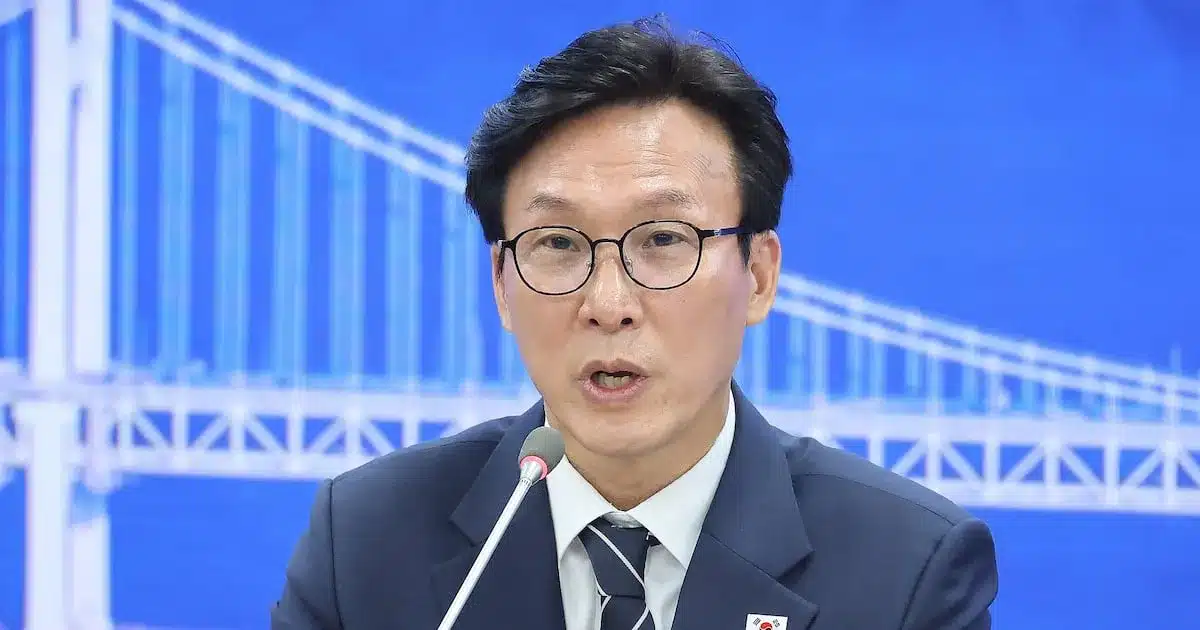
Kim Min-seok, the leader of the Democratic Party, has strongly criticized Justice Minister Cho Kuk, demanding his immediate resignation. Speaking in Busan on October 19th, Kim Min-seok likened Cho Kuk’s actions to those of a “delinquent student begging to be expelled” after failing to consult with President Lee Jae-myung before appointing a prosecutor general. Kim characterized the appointment process as a “legal farce” and signaled a significant push for judicial reform within his party.
Accusations of “Legal Farce” and “Judicial Farce”
During his address at the party’s Supreme Council meeting, Kim Min-seok drew a parallel between Justice Minister Cho Kuk’s current situation and that of former Prime Minister Han Duck-soo. He asserted that Cho Kuk’s recent actions represented a departure from established legal and administrative norms. Kim argued that while past appointments of the prosecutor general involved consultation with the president, Cho Kuk’s unilateral decision-breaking this historical precedent. He described this as an “unlawful act” and a “legal farce.”
Kim further elaborated on his criticism, stating that Cho Kuk’s actions were an attempt to mask his own legal and administrative missteps by committing further procedural errors. He suggested that Cho Kuk was trying to reverse the narrative, making it appear as though the President and the National Assembly were at fault for adhering to legal procedures. Kim provocatively stated that Cho Kuk should no longer be referred to as the “Prosecutor General” but rather the “Minister of Legal Tricks.”
Calls for Accountability and Judicial Reform
Kim Min-seok’s sharp remarks at the first Supreme Council meeting under the new leadership were interpreted by some in the political sphere as an attempt to consolidate support among the party’s hardline base. He reiterated his stance, claiming that Cho Kuk’s behavior was another legal transgression aimed at covering up previous mistakes. Kim used the analogy of a student who breaks a window and then pleads for expulsion and promises not to study, highlighting what he perceived as a defiant and irresponsible attitude.
The Democratic Party leader also accused Cho Kuk of failing to adequately address suspicions of impropriety within the Ministry of Justice during a national crisis, and of not showing sufficient respect for the President despite the urgency of the situation. Kim declared that Cho Kuk, whom he labeled the “worst prosecutor general since liberation,” must step down.
Beyond demanding Cho Kuk’s resignation, Kim Min-seok called for collective action from legal professionals. He questioned why other legal officials remained silent on Cho Kuk’s actions, especially when they had been vocal about other issues. Kim urged the Prosecutor’s Office to issue a statement declaring Cho Kuk’s actions as wrong and called for an immediate meeting of legal officials to discuss Cho Kuk’s removal.
Broader Implications for Judicial Reform
Kim Min-seok announced that the Democratic Party had decided to “put aside” its plans for prosecutorial reform for the time being. However, he emphasized that the controversy surrounding Cho Kuk would serve as the catalyst for initiating a new phase of judicial reform. He issued a stark warning: “Resign or apologize immediately. If not, the entire Prosecutor’s Office must rise up. The Republic of Korea’s Prosecutor’s Office will not be able to escape the fierce wave of judicial reform.”
Some analyses suggest that Kim’s mention of temporarily shelving prosecutorial reform while simultaneously calling for a new wave of judicial reform is a strategic move to appease the party’s more conservative factions while still signaling a strong commitment to change, driven by the current demands of his supporters.
Further Criticism from Within the Party
Echoing similar sentiments, Han Byung-do, the party’s floor leader, also criticized Cho Kuk’s appointment. Han pointed out that Cho Kuk, who had held the position of prosecutor general for over half a year without a formal appointment, bypassed the President, the appointing authority, and communicated his decision unilaterally the day before a plenary session of the National Assembly. Han also noted that the Supreme Prosecutors’ Office, which had delayed its decision for a considerable period, had finally approved the appointment of the prosecutor general, following controversies involving Kim Keon-hee, Han Duck-soo, and Lee Sang-min.
Han Byung-do contrasted the swift handling of the presidential election law case, which involved reviewing 70,000 pages in just nine days, with the apparent lack of urgency regarding the recent flood damage. He questioned where the swiftness shown when confronting the President had gone. Han concluded by stating that the Democratic Party would thoroughly investigate Cho Kuk’s actions on behalf of the public at the upcoming plenary session and warned that the National Assembly would not be a mere rubber stamp.
Context and Potential Political Maneuvering
The strong stance taken by Kim Min-seok and Han Byung-do reflects a significant political development. The calls for Cho Kuk’s resignation are intertwined with ongoing debates about the role and independence of the judiciary and the prosecution service in South Korea. The Democratic Party’s push for judicial reform, now seemingly accelerated by the Cho Kuk controversy, signals a potential shift in the balance of power within the country’s legal and political landscape. The situation highlights the deep divisions and intense scrutiny that legal appointments and reforms are subjected to in the current political climate.
