

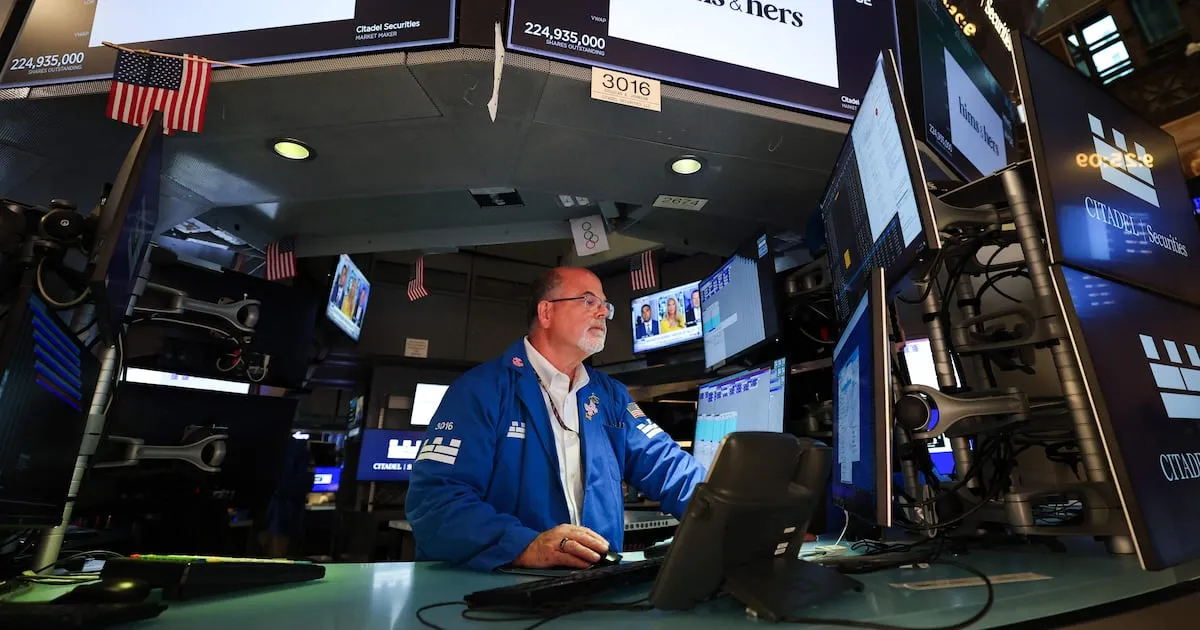
Major U.S. stock indices experienced a downturn on July 18th, with the Dow Jones Industrial Average, S&P 500, and Nasdaq Composite all trading lower. This market movement is largely attributed to rising U.S. Treasury yields, particularly the 30-year bond, which reached its highest level since 2007, creating pressure on equities.
Market Performance Amidst Rising Yields
As of mid-morning trading on July 18th, the Dow Jones Industrial Average was down 66.12 points, or 0.12%, trading at 53,393.66. The S&P 500 index saw a more significant decline, falling 38.36 points, or 0.50%, to 7,706.70. The tech-heavy Nasdaq Composite also registered losses, dropping 286.73 points, or 1.08%, to 26,358.18.
The prevailing bearish sentiment in the stock market appears to be a direct consequence of the upward trend in U.S. Treasury yields. Investors are becoming increasingly cautious as the cost of borrowing for the U.S. government rises.
The Impact of Soaring Bond Yields
The yield on the U.S. 30-year Treasury bond climbed above 5.3%, marking a 17-year high. Concurrently, the 10-year Treasury yield hovered around 4.7%, also reaching levels not seen since the previous year. This surge in bond yields typically makes fixed-income investments more attractive relative to riskier assets like stocks, leading investors to reallocate their capital.
Several factors are contributing to the rise in bond yields. One significant element is the ongoing geopolitical tensions and their potential impact on inflation. The market is closely watching the situation between the U.S. and Iran, as a prolonged conflict could exacerbate inflationary pressures, particularly concerning oil prices.
Geopolitical Tensions and Inflation Concerns
The U.S. and Iran had entered into a negotiation period for a potential peace agreement, with a 60-day ceasefire in place since early June. However, by the deadline of July 17th, no substantial breakthroughs were announced. The failure to reach a formal agreement has increased the possibility of a prolonged conflict, which could have significant economic ramifications.
Adding to the uncertainty, former U.S. President Donald Trump indicated that he would not extend the current ceasefire. Iran’s stance remains firm, suggesting that they will intensify their actions if their demands are not met. This diplomatic stalemate fuels concerns about future stability and its potential to drive up energy costs.
Sector-Specific Performance: Semiconductors Under Pressure
Within the stock market, semiconductor stocks experienced notable declines. Micron Technology saw a significant drop of 7.58% compared to the previous trading day. Other semiconductor companies also faced selling pressure, with SanDisk down 9.19%, Nvidia off by 2.56%, and SK Hynix ADR declining 8.45%.
While many technology stocks are struggling, some large-cap tech companies showed resilience. Meta Platforms experienced a modest decline of 2.87%. However, Apple managed to eke out a gain of 1.7%, and Microsoft saw a slight increase of 0.3%, indicating a mixed performance among the tech giants.
Looking Ahead: The Federal Reserve’s FOMC Minutes
Market participants are now keenly awaiting the release of the U.S. Federal Reserve’s Federal Open Market Committee (FOMC) meeting minutes from July. Scheduled for release on July 19th, these minutes are expected to provide crucial insights into the Fed officials’ perspectives on inflation and economic growth. Investors will be looking for clues regarding the central bank’s future monetary policy decisions, particularly any indications of further interest rate adjustments.
The minutes could offer a clearer picture of the Fed’s assessment of the current economic landscape and its potential impact on interest rate policy. Any signals of a more hawkish stance could further influence bond yields and stock market sentiment.
Oil Prices Reflect Geopolitical Uncertainty
In line with the heightened geopolitical tensions and the potential for prolonged conflict, oil prices have also seen an upward trend. The September U.S. West Texas Intermediate (WTI) crude oil futures contract rose by 0.3% to $84.80 per barrel on July 18th, reflecting market concerns about supply disruptions.
The interplay between rising bond yields, geopolitical instability, and inflation concerns creates a complex environment for investors. The upcoming FOMC minutes will be a key event to watch as the market seeks direction amidst these prevailing economic and political crosscurrents.
