

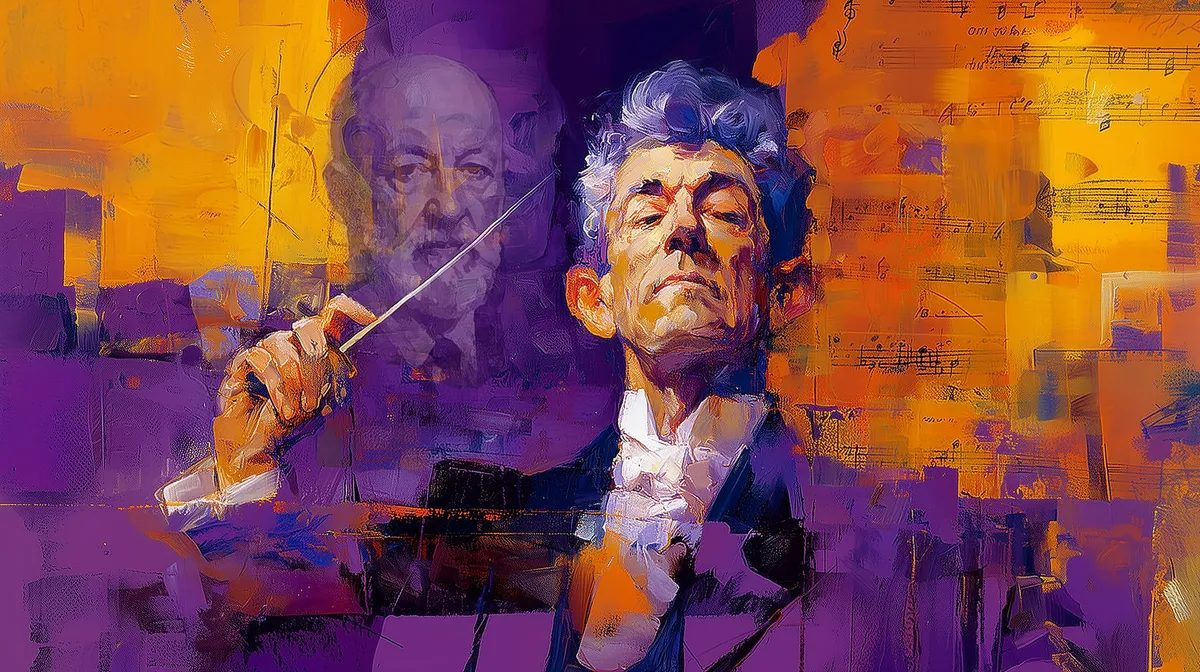
The enduring legacy of American composer Charles Ives, particularly his groundbreaking Symphony No. 2, was deeply championed by conductor Leonard Bernstein. Premiered in 1951 at New York’s Carnegie Hall, the symphony was a culmination of Ives’s work, begun in 1897 and completed in 1902, yet it remained largely unheard for nearly half a century. Bernstein, who conducted the premiere, was profoundly moved, describing the music as a revelation of an “American sound” unlike anything heard before, as if “Mark Twain, Emerson, and Lincoln had been fused into one.” For Bernstein, Ives was not merely a composer but a visionary who forged a distinctly American musical language, free from European conventions. He lauded Ives as a “founder, a prophet, and a patriot.
Charles Ives: The ‘Part-Time Composer’ Who Redefined American Music
Despite the significance of his work, Charles Ives himself was absent from the premiere of his Symphony No. 2. At 78 years old, he harbored considerable reservations about the music establishment that had long overlooked his compositions. It is said that he only heard the performance through a radio broadcast from his neighbor’s house, after persuasion from family and friends. Reports suggest Ives expressed dissatisfaction with Bernstein’s tempo, finding it too slow. Though the music had existed only in the composer’s mind for decades, its emotional impact and imagery remained vivid. Whether Ives heard of his own critique is uncertain, but Bernstein never lost the pride of having introduced this pivotal work to the world. He consistently programmed Ives’s music, both in the United States and during international tours. Notably, he featured Ives’s compositions during the New York Philharmonic’s historic 1959 Soviet Union tour and introduced his music to young audiences on the Philharmonic’s TV program, ‘Young People’s Concerts,’ in the 1960s.
Bernstein’s Vision: Unpacking Ives’s Unique Sound
Bernstein consistently characterized Ives as a “founder and prophet,” explaining the origins of his unique creative spirit. Ives, a “part-time composer,” worked as an insurance executive by day, composing music in his spare moments. His symphonies incorporated a rich tapestry of American musical idioms, including marches, hymns, patriotic songs, and even country fiddle tunes. More remarkably, he experimented with avant-garde techniques that would become commonplace in later 20th-century music, predating many of his contemporaries. In 1987, shortly before conducting Ives’s Symphony No. 2 with the German Bavarian Radio Symphony Orchestra, Bernstein shared an anecdote with the German audience. While landing at Munich Airport, a music-loving driver, pronouncing “Ives” in a French manner as “Charles Yves,” sparked curiosity about who this composer was. Even a century after his birth, Ives remained a relatively obscure figure in Europe. Bernstein vividly described Ives’s Symphony No. 2 as “putting American tom-toms into a European soup tureen to create a new symphonic dish.” He praised it as a “truly original and brilliant work, chaotic and starry, yet as captivating as a Christmas card.”
The Influence and Innovation in Ives’s Symphony No. 2
Indeed, Ives’s Symphony No. 2 draws inspiration from the symphonic traditions of Brahms, Dvorak, and Tchaikovsky, while ingeniously weaving in the melodies of American folk songs and popular tunes. Familiar childhood songs like ‘Camptown Races,’ ‘Turkey in the Straw,’ and ‘America the Beautiful’ unexpectedly surface within the classical framework. The integration of hymns, patriotic songs, and folk melodies with the established grammar of the symphony created a distinctly American sound. Bernstein aptly summarized the musical allure of Ives’s work as “authentic primitive.” This spirit is further exemplified in the 1987-1988 New York Philharmonic live recording of Ives’s complete works.
‘The Unanswered Question’: A Philosophical Inquiry in Music
In his seminal work, ‘The Unanswered Question,’ Ives presents a profound musical dialogue. A trumpet poses an existential query, to which four woodwinds respond with seemingly competing answers. Yet, like life itself, a definitive answer remains elusive, leaving only the lingering resonance of the strings. Bernstein was particularly captivated by this piece. He even titled his 1973 six-part lecture series at Harvard University, based on Noam Chomsky’s linguistic theories, ‘The Unanswered Question.’ In these lectures, he explored phonetics, atonality, and the crisis in 20th-century music. In the fifth lecture, he delved deeply into Ives’s ‘The Unanswered Question,’ returning to it again at the conclusion of his final lecture.
Bernstein’s Final Revelation: The ‘Yes’ in Life and Music
Bernstein concluded his lectures with a reflection on Ives’s piece: “I am no longer sure what the question was. But I do know that the answer was ‘Yes.'” Though the question remains unresolved, the answer, both to life and to music, can be affirmed with a resounding ‘Yes.’ This profound message, heard in Ives’s music, may have been the most significant insight Bernstein gained throughout his lifelong engagement with the composer’s work. It speaks to an affirmation of existence and artistic creation, even in the face of uncertainty and the unanswerable nature of fundamental questions.
