

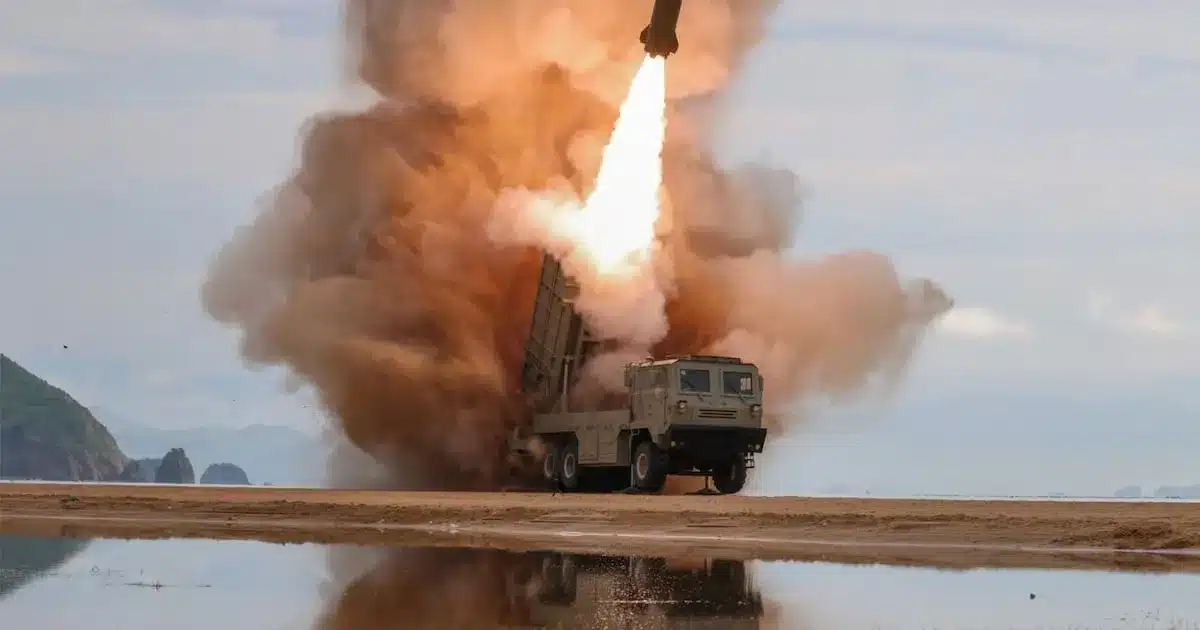
North Korea launched an unidentified projectile into the East Sea on the afternoon of the 20th, according to the Joint Chiefs of Staff (JCS). The JCS is currently analyzing the origin and trajectory of the launched object. If confirmed as a ballistic missile, this would mark North Korea’s first ballistic missile launch in eight days.
Recent Missile Activity and Military Drills
The latest launch follows a period of heightened military activity and joint exercises in the region. Just one day after the conclusion of the ‘Freedom Edge’ joint military drills involving South Korea, the United States, and Japan on December 12th, North Korea fired short-range ballistic missiles. State-controlled media later reported on December 14th that this exercise was a “fiery storm” live-fire drill that incorporated four types of weapons: short-range ballistic missiles, the Bangudae missile, and drones.
Following the December 12th missile firings, Japan’s Ministry of Defense announced that the objects launched by North Korea had a potential to be ballistic missiles and were presumed to have fallen outside of Japan’s Exclusive Economic Zone (EEZ).
Context of Regional Tensions and Denuclearization Talks
This recent projectile launch occurs against a backdrop of ongoing geopolitical tensions and stalled denuclearization talks between North Korea and the international community. North Korea has consistently used missile tests as a means of demonstrating its military capabilities and exerting pressure on the United States and its allies. The frequency and type of these launches are closely monitored by regional powers, as they can signal shifts in North Korea’s strategic posture and intentions.
The international community, particularly the United States, South Korea, and Japan, has condemned North Korea’s repeated ballistic missile launches, viewing them as violations of United Nations Security Council resolutions. These resolutions prohibit North Korea from conducting any launches that utilize ballistic missile technology. Despite these international sanctions and condemnations, Pyongyang has continued its weapons development programs, citing self-defense and the need to counter perceived threats from joint military exercises conducted by its adversaries.
Analysis of North Korea’s Missile Capabilities
North Korea’s missile program has seen significant advancements in recent years. While the specific type of projectile launched on the 20th is still under investigation, past launches have included a range of ballistic missiles, from short-range tactical weapons to intermediate-range and potentially intercontinental ballistic missiles (ICBMs). The JCS’s ongoing analysis will aim to determine the exact nature of the launched object, including its range, altitude, and trajectory, which will provide further insights into North Korea’s evolving missile technology.
The mention of the Bangudae missile, a short-range ballistic missile, in the context of previous drills, highlights the diversity of North Korea’s arsenal. Drones have also become an increasingly prominent feature in North Korea’s military demonstrations, suggesting an effort to diversify its strike capabilities beyond traditional missile systems.
International Response and Diplomatic Efforts
The international community’s response to North Korea’s missile activities typically involves strong statements of condemnation and calls for adherence to UN resolutions. The United States, South Korea, and Japan often share intelligence and coordinate their responses to these provocations. The primary goal of these coordinated efforts is to maintain regional stability and encourage North Korea to return to dialogue and diplomacy aimed at achieving complete, verifiable, and irreversible denuclearization (CVID).
However, diplomatic channels have remained largely inactive in recent times, with North Korea showing little willingness to engage in meaningful negotiations without preconditions. The regime has often stated that it will not abandon its nuclear and missile programs as long as it perceives a threat from U.S. and South Korean military activities. This stalemate in diplomacy means that missile tests are likely to continue, further complicating efforts to de-escalate tensions on the Korean Peninsula.
Conclusion: Ongoing Monitoring and Future Implications
The unidentified projectile launch by North Korea into the East Sea on December 20th underscores the persistent security challenges posed by Pyongyang’s weapons development. As the Joint Chiefs of Staff continue their analysis, the international community will be closely watching for any confirmation of the projectile’s nature and its implications for regional security. The incident serves as a stark reminder of the volatile situation on the Korean Peninsula and the ongoing need for vigilance and coordinated diplomatic efforts to promote peace and stability.
