

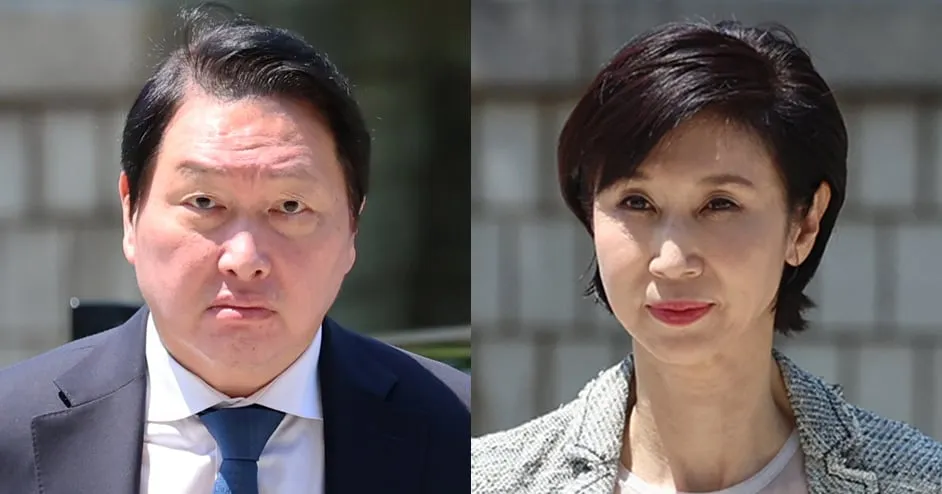
SK Group Chairman Choi Tae-won has appealed a lower court’s decision regarding the division of assets in his divorce from Roh Soh-yeong, former director of the Art Center Nabi. The case has now reached the Supreme Court, with Chairman Choi having paid an interim payment of 850 million won. The Supreme Court received the appeal on the 14th, though the appellate panel has not yet been assigned.
Background of the Asset Division Dispute
The dispute centers on the division of assets between Chairman Choi and Ms. Roh. The Seoul High Court had previously ordered Chairman Choi to pay Ms. Roh 944 billion won in cash. Chairman Choi’s side appealed this decision, leading to the current Supreme Court proceedings. Following the appeal, Chairman Choi’s legal team requested a reduction in the scope of the dispute, stating they would only contest the remaining 244 billion won after an initial payment of 700 billion won from the total 944 billion won. This move was aimed at expediting a resolution to the prolonged legal battle.
The interim payment of 850 million won was made by Chairman Choi as part of his appeal to the Supreme Court. This payment is distinct from the total amount ordered by the lower court. The initial ruling by the Seoul High Court determined that the divisible assets amounted to 2.9 trillion won, excluding approximately 1 trillion won in alleged undisclosed or improperly handled stock value accumulated during Chairman Choi’s tenure at SK Group. The court had set the asset division ratio at 66.6% for Chairman Choi and 33.3% for Ms. Roh.
Key Issues in the Supreme Court Appeal
The appeal to the Supreme Court is expected to scrutinize several critical points. One significant question is whether the lower court’s decision to grant Ms. Roh a 33.3% share was appropriate, even after excluding the alleged political funds of former President Roh Tae-woo from the calculation of the division ratio. Another point of contention is whether the SK Siltron shares, acquired in 2017 after the breakdown of the couple’s marriage, should be included in the divisible assets.
Ms. Roh’s side has not yet submitted their counter-appeal. In such legal contests, when one party appeals a ruling, the opposing party typically has the opportunity to file a cross-appeal, allowing them to challenge any aspects of the original judgment that were unfavorable to them.
Chairman Choi’s Financial Contributions
Chairman Choi’s legal team has emphasized that the substantial assets in question were primarily built during his leadership of SK Group. They argue that the court’s initial calculation did not fully account for the complexities of corporate asset growth and his personal contributions to the business’s expansion. The initial ruling by the Seoul High Court was based on a comprehensive review of the couple’s assets and their respective contributions, but the appeal seeks to re-evaluate these factors.
Ms. Roh’s Position and Potential Counter-Appeal
While Ms. Roh’s legal representatives have not yet filed a formal counter-appeal, their stance is expected to focus on maximizing her share of the assets. Her legal strategy will likely involve arguing for the inclusion of assets that Chairman Choi’s side seeks to exclude and potentially challenging the 66.6% to 33.3% split. The inclusion of SK Siltron shares, acquired post-separation, is likely to be a key point in her argument, as it represents a significant increase in corporate value during the marriage, albeit after the separation.
The Path Forward: Supreme Court Deliberation
The Supreme Court’s role will be to review the legal interpretations and factual findings of the lower courts. The court will consider whether the asset division was equitable and in accordance with relevant laws and precedents. The inclusion or exclusion of specific assets, such as the SK Siltron shares, and the calculation of Ms. Roh’s contribution to the marital estate will be central to the deliberation.
The court’s decision will hinge on how it weighs the evidence presented by both sides, particularly concerning the nature of the assets and the timeline of their acquisition and growth. The proceedings could take considerable time as the Supreme Court meticulously examines the complex financial and legal arguments.
Conclusion
The appeal by SK Chairman Choi Tae-won to the Supreme Court marks a significant escalation in the high-profile divorce asset division case. With an interim payment made and the case now before the highest court, the focus shifts to whether the previous ruling will be upheld, modified, or overturned. The Supreme Court’s final judgment will have substantial implications for both parties involved and could set important precedents for future asset division cases in South Korea, particularly those involving complex corporate holdings.
