

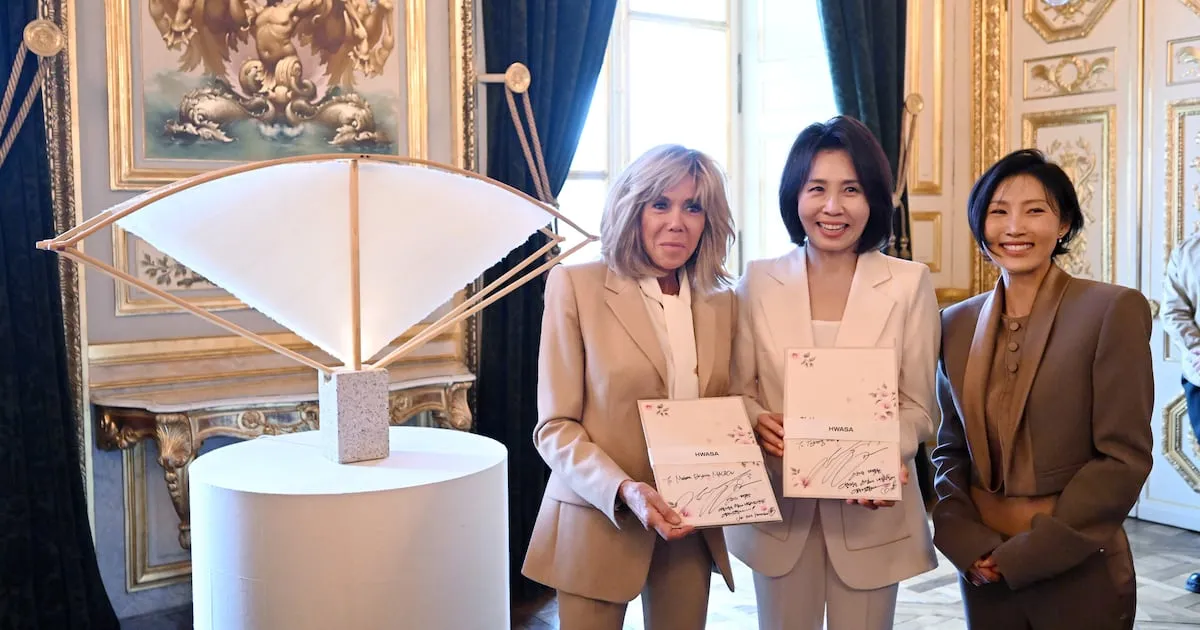
First Lady Kim Hye-kyung, accompanying the President of South Korea on a state visit, visited the ‘HanjiMania’ special exhibition in Paris on October 8th (local time). She was joined by Brigitte Macron, the First Lady of France, at the Hôtel de la Marine. The exhibition showcases contemporary art utilizing Hanji, the traditional Korean paper.
A Shared Appreciation for Hanji Art
Singer Hwasa also attended the event, accompanying the two First Ladies as they explored the modern artistic creations crafted from Hanji. During the visit, Kim Hye-kyung highlighted the exceptional durability and versatility of Hanji, particularly in front of an architectural piece by artist Yoo Yi-hwa. She explained how the material’s unique properties lend themselves to complex structural designs.
Kim Hye-kyung shared an anecdote about presenting First Lady Macron with shoes made from Hanji, emphasizing its use in cultural heritage restoration. She noted that Hanji is currently employed in the preservation and restoration of significant cultural assets at major international institutions, such as the Louvre Museum. This revelation sparked considerable interest from Mrs. Macron, who expressed a keen curiosity regarding the broad applicability of Hanji.
Experiencing Hanji Through the Senses
The engagement with Hanji went beyond visual appreciation. Both First Ladies had the opportunity to experience the material through multiple senses. They smelled the distinct fragrance of Hanji, carefully prepared by a perfumer, and participated in a performance demonstrating the structural completion of a Hanji framework. This immersive experience allowed them to understand the tactile and aromatic qualities of the traditional paper.
Kim Hye-kyung expressed her hopes for Hanji’s global recognition, stating, “I hope that in December, Hanji will be designated as UNESCO Intangible Cultural Heritage, becoming a heritage that the entire world will protect together.” This statement underscores the cultural significance and the desire for international preservation of this traditional craft.
Hwasa’s Artistic Perspective on Hanji
Singer Hwasa shared her impressions of the exhibition, remarking, “It was deeply impressive to see the qualities of Hanji brought to life through sophisticated contemporary artworks.” Her comment highlighted the successful transformation of Hanji’s inherent characteristics into modern artistic expressions. Hwasa also presented both First Ladies with albums, specially encased in custom-made Hanji cases, as a personal token of appreciation.
The Enduring Legacy and Future of Hanji
The ‘HanjiMania’ exhibition serves as a powerful testament to the enduring legacy of Korean papermaking. Hanji, traditionally made from the inner bark of the mulberry tree, has been a cornerstone of Korean culture for centuries. Its strength, longevity, and unique texture have made it suitable for a wide range of applications, from calligraphy and painting to architectural elements and even clothing.
In recent years, there has been a global resurgence of interest in traditional crafts, with Hanji leading the way in artistic innovation. Artists like Yoo Yi-hwa are pushing the boundaries of what is possible with this ancient material, creating works that are both aesthetically striking and structurally sound. The exhibition at the Hôtel de la Marine provided a platform for these contemporary interpretations, demonstrating that Hanji is not merely a relic of the past but a vibrant medium for present-day artistic expression.
The collaboration between South Korea and France on cultural initiatives, such as this exhibition, further strengthens bilateral ties. The shared experience of appreciating Hanji art by the two First Ladies symbolizes a mutual respect for cultural heritage and a commitment to fostering international understanding through the arts. The potential designation of Hanji as a UNESCO Intangible Cultural Heritage would undoubtedly elevate its global profile, ensuring its preservation and continued appreciation for generations to come.
The involvement of a prominent artist like Hwasa also brings a contemporary cultural perspective to the traditional craft. Her ability to connect Hanji’s traditional essence with modern artistic sensibilities resonates with a younger audience and broadens the appeal of Hanji beyond traditional art circles. The presentation of her music album in a Hanji case is a subtle yet effective way to showcase the material’s adaptability and aesthetic potential in everyday objects.
Ultimately, the ‘HanjiMania’ exhibition in Paris offered a compelling glimpse into the multifaceted nature of Hanji. It highlighted its historical significance, its remarkable material properties, and its exciting potential in contemporary art. The event underscored the importance of preserving such traditional crafts while embracing their evolution and integration into the modern world.
