

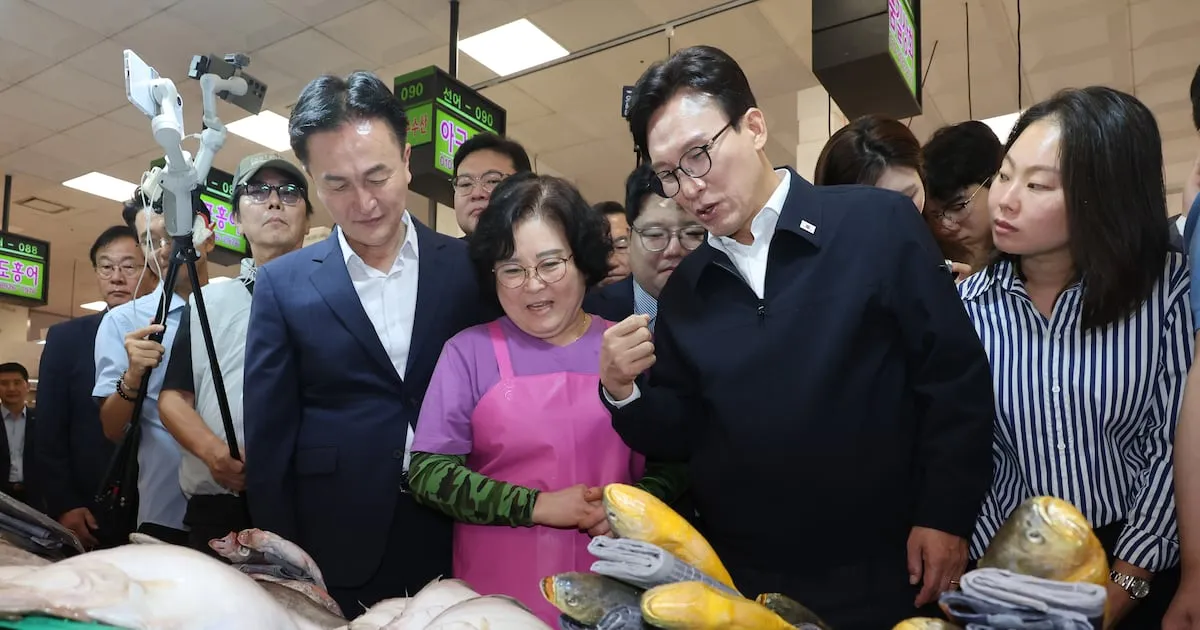
Kim Min-seok, a prominent figure in the Democratic Party, visited the Noryangjin Fisheries Market in Seoul just two weeks before the Chuseok holiday. His visit aimed to boost seafood consumption and support livelihoods, highlighting concerns about the economic impact of current regulations.
Kim Min-seok Proposes Revisions to Anti-Graft Law
During his visit to the bustling market, Kim Min-seok engaged with vendors to understand their challenges and explore potential solutions. A key topic of discussion was the Improper Solicitation and Graft Act, often referred to as the “Kim Young-ran Act.” Vendors expressed that while the law has been somewhat relaxed, consumer spending, particularly through corporate cards, has not fully recovered. They specifically requested further easing of restrictions, such as allowing higher spending limits for certain items like Hanwoo beef.
In response, Kim Min-seok acknowledged the difficulty of completely nullifying the act’s original intent. However, he suggested that there might be room for consideration regarding exceptions for business dinners, distinguishing them from gift-giving. “While it’s difficult to completely disregard the legislative intent of the Improper Solicitation and Graft Act, there might be room for consideration regarding business dinners, as opposed to gifts,” Kim stated. He pledged to explore measures to stimulate consumption through business dinners, especially during peak holiday seasons like Chuseok.
Revitalizing Noryangjin Market and Tourism
Beyond the immediate concerns about the anti-graft law, Kim Min-seok also emphasized the need to enhance the Noryangjin Fisheries Market’s global competitiveness. He proposed developing the market into a world-class destination by incorporating elements that appeal to international visitors. These ideas included creating photo zones, potentially introducing attractions like “rakko” (a type of fish), and improving transportation infrastructure.
“We need to revitalize the Noryangjin Fisheries Market into a market with global competitiveness,” Kim remarked. He further elaborated on potential enhancements, stating, “We will discuss with relevant authorities and cooperatives about establishing areas for photos with the facade, and also consider measures such as tour buses during peak tourist hours to improve transportation.” This vision aims to transform the market into a vibrant hub that attracts both domestic and international tourists.
Market Visit and Interactions
Kim Min-seok’s visit involved a thorough tour of the market, where he interacted with numerous vendors. He inquired about the prices of various seafood items and warmly greeted a vendor who introduced himself as a “Minti subscriber” (likely a reference to a fan or supporter). Kim also sampled seasoned skate, a popular Korean dish, directly at one of the stalls, further engaging with the market’s offerings.
The visit underscores a broader effort to understand and address the economic pressures faced by traditional markets and small business owners. By engaging directly with stakeholders and proposing policy considerations, Kim Min-seok aims to foster a more supportive environment for businesses, particularly in the lead-up to significant holiday periods.
Upcoming Meeting with Constitutional Court Officials
Following his market visit, Kim Min-seok was scheduled to meet with officials at the Constitutional Court of Korea, located at the National Assembly. This meeting was expected to include discussions with President Jeong Dae-cheol and Vice Presidents Kim Dong-ju, Kim Yong-gyun, Park Sang-hee, Yoo In-hak, and Yoo Jun-sang, as well as Advisor Kwon No-gap. The agenda for this meeting was not detailed, but it suggests ongoing engagement with various branches of government and legal institutions.
The dual focus of Kim Min-seok’s activities—addressing immediate economic concerns at the Noryangjin market and engaging with constitutional legal bodies—highlights a multifaceted approach to policy-making and public engagement. His proposals regarding the anti-graft law and market revitalization reflect a commitment to balancing regulatory frameworks with economic realities and promoting consumer activity.
