

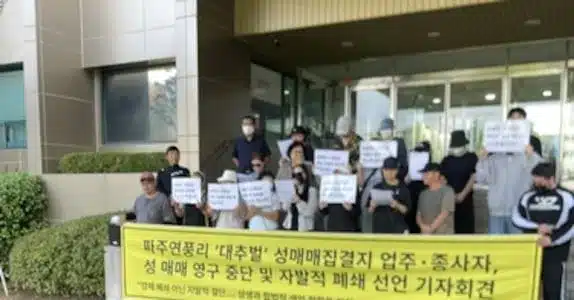
Operators and workers from a district in Paju, Gyeonggi Province, formerly known as a ‘red light district,’ have publicly declared their intention to cease all prostitution activities. This announcement signifies a pivotal moment in the ongoing efforts to transform the area and address long-standing community concerns.
End of an Era: Operators Announce Cessation of Prostitution
On October 3rd, approximately twenty individuals representing the business owners and workers of the Paju Daechubul red light district held a press conference in front of the Paju City Hall. They formally declared, “As of today, we will cease all prostitution activities and publicly pledge before the citizens that we will not engage in prostitution again.” This declaration marks a significant shift for the district, which has been a focal point of controversy for years.
The group attributed their decision to the persistent efforts and strong will of Paju Mayor Sohn Byeong-seok, as well as the continuous collaboration from various stakeholders. These include the Paju City Women’s Association, the Paju Eup Mayor, the police, and women’s organizations. “Although there have been many conflicts, we now wish to align with the policy of dismantling the red light district,” they stated.
They emphasized that this decision was made voluntarily by the parties involved to resolve the prolonged disputes. “We will transition to legitimate businesses and build a new community together with the residents,” they added, signaling a commitment to a new path forward.
Nuances and Caveats in the Declaration
However, the operators were careful to clarify that this declaration does not represent the unanimous opinion of all individuals associated with the district. “While we respect the opinions of some business owners who are individually participating in the preparation meetings for the public hearing,” they explained, “the participation of a few should not be generalized or exaggerated to represent the views of all business owners, workers, and residents of the Daechubul area.”
This announcement comes at a critical juncture as Paju City is actively pursuing administrative procedures aimed at the complete dismantling of the red light district. The city is proceeding with plans for urban planning facilities and the implementation of related urban planning in the affected area.
Past Proposals and Future Hopes
Previously, on October 24th, the business owners and workers of the district had submitted a proposal to Paju City. This proposal outlined plans for the permanent cessation of prostitution, the transition to legitimate businesses, and measures for the recovery of the local commercial environment.
They expressed that what is now needed is “practical cooperation for the transition of livelihoods for residents and workers after prostitution ceases, and the normalization of the stagnant commercial area and neighborhood.” They requested that the Paju Mayor acknowledge their voluntary decision to cease prostitution as a success of the dismantling policy and to review their submitted proposal. Furthermore, they urged the Mayor to engage in direct dialogue with residents and workers.
The group reiterated their desire to create a new model of coexistence, stating, “We want you to create a new model of coexistence where prostitution is completely eradicated, and people, the commercial district, and the neighborhood are revitalized together.” They clarified that their current declaration pertains only to the cessation of prostitution activities and does not imply agreement with forced labor, specific development methods, or the forfeiture of property rights.
Regarding property rights and development methods, they requested separate consultations with all stakeholders, including residents, landowners, and building owners.
City’s Response and Path Forward
Paju City acknowledged the positive aspects of the operators’ declaration while emphasizing that future discussions will be primarily conducted through public hearings. In a statement, the city affirmed, “Paju City has consistently pursued the principle of dismantling the red light district and positively evaluates the operators’ announcement to voluntarily cease prostitution and transition to legitimate businesses.”
The city further elaborated that the subsequent measures, including proposals for revitalization, regional development plans, and discussions on property rights, cannot be determined through individual consultations or informal means. “The dismantling of the red light district and the subsequent changes involve complex issues that require the voices of numerous stakeholders, including not only the operators but also local residents, civic groups, and experts,” the statement explained.
Paju City reiterated its commitment to avoiding unilateral actions and instead utilizing the objective and neutral platform of a “public hearing” to accommodate diverse opinions. “We urge the business owners and workers of the red light district not to distrust or avoid the public hearing but to participate promptly,” the city urged.
The city concluded by stating that if any aspects of the proposals presented at the public hearing require further clarification or additional communication, consultations will be conducted through necessary methods and procedures. “Based on the outcomes of discussions at the public hearing, the city plans to receive final proposals in December and will proceed with administrative work and policy development accordingly,” the city added.
