

The South Korean government has finalized its budget proposal for the upcoming year, earmarking significant funds for both the advancement of Artificial Intelligence (AI) and the issuance of regional gift certificates. A substantial 1.45 trillion won (approximately $1.05 billion USD) has been allocated to support the distribution of these regional vouchers, an increase of 300 billion won compared to the current year’s revised budget of 1.15 trillion won. Additionally, the government plans to invest 1.4696 trillion won (approximately $1.06 billion USD) in initiatives aimed at establishing an ‘AI-driven government’, encompassing projects such as upgrading aging IT infrastructure, migrating public information systems to private cloud environments, and integrating AI into administrative tasks.
Ministry of Interior and Safety Budget Overview
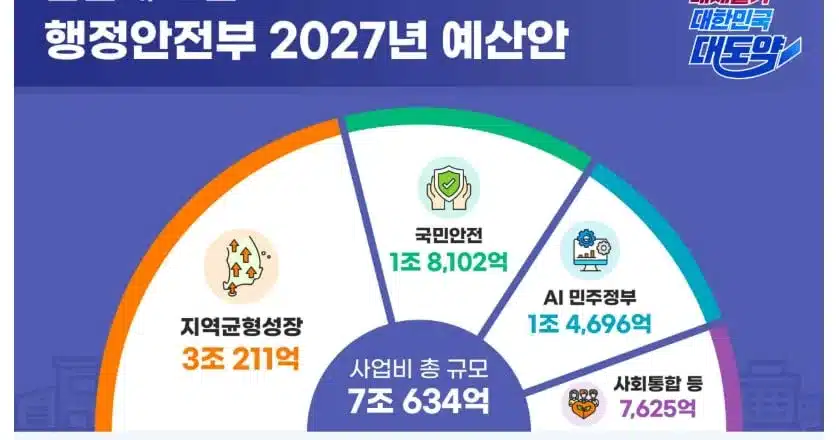
The Ministry of Interior and Safety (MOIS) has presented a total budget request of 84.7036 trillion won (approximately $61 billion USD) for the next year. This represents a 10.1% increase over the current year’s budget. The largest portion of this budget, 77.1899 trillion won (approximately $55.7 billion USD), is designated for local government transfer payments, including grants for local taxes. The remaining funds are allocated to project expenses (7.634 trillion won) and operational costs, including personnel and basic expenses (450.3 billion won).
The MOIS budget is broadly categorized into four key areas: Balanced Regional Development, Public Safety, AI Government, and Social Integration. Each area receives substantial funding to address national priorities and enhance public services.
Boosting Regional Economies and Local Commerce
Within the Balanced Regional Development sector, a total of 3.0211 trillion won (approximately $2.18 billion USD) will be invested. The most significant allocation within this category is the 1.45 trillion won dedicated to supporting the issuance of regional gift certificates, often referred to as ‘Local Love Gift Certificates’. These certificates are designed to stimulate local economies by encouraging spending at small businesses within specific regions. The central government subsidizes a portion of the discount offered to consumers when these vouchers are purchased, thereby easing household financial burdens and promoting local commerce.
Further initiatives under regional development include a new 44.9 billion won (approximately $32.5 million USD) investment in social solidarity economy projects, aimed at fostering local growth. The ‘Self-reliant Growth Capacity Enhancement’ program, which supports local communities in solving their own problems and building growth foundations, will also see an expansion from 23.8 billion won this year to 32 billion won next year. To revitalize island tourism, a new budget of 1.2 billion won (approximately $870,000 USD) has been established for discounted travel support.
Enhancing Public Safety and Disaster Preparedness
The Public Safety domain is set to receive 1.8102 trillion won (approximately $1.31 billion USD). This includes 1.1579 trillion won (approximately $837 million USD) for the management of disaster risk areas and 200.1 billion won (approximately $145 million USD) for post-disaster recovery efforts. To mitigate urban flooding, 43 billion won (approximately $31 million USD) has been allocated for the construction of temporary rainwater storage facilities in areas prone to inundation during heavy downpours. Additionally, 39.3 billion won (approximately $28.5 million USD) is earmarked for insurance programs that provide partial government subsidies for national disaster insurance premiums, helping to protect citizens from catastrophic losses due to unforeseen natural disasters like typhoons or earthquakes.
Advancing the AI Government Initiative
A significant portion of the budget, 1.4696 trillion won (approximately $1.06 billion USD), is dedicated to the AI Government initiative, a key priority for the current administration. Over 770 billion won (approximately $557 million USD) will be invested in upgrading aging nationwide communication and broadcasting infrastructure. To enhance citizen services, 20.3 billion won (approximately $14.7 million USD) has been allocated for the development of an ‘AI Integrated Civil Service Platform’. This platform aims to assist citizens with everything from navigating civil affairs to processing applications, representing an eleven-fold increase from the current year’s budget of 1.8 billion won.
Furthermore, 326.4 billion won (approximately $236 million USD) will be used to strengthen the stability and continuity of critical public information systems. This involves establishing redundant operating environments (Disaster Recovery systems) and migrating government IT systems to a cloud-based infrastructure. To foster the widespread adoption of AI among public officials, 54.2 billion won (approximately $39 million USD) has been allocated for the expansion of ‘On-AI’, a government-wide AI utilization initiative.
Government’s Vision for a Better Korea
Minister of Interior and Safety, Yoon Hee-jung, stated that the 2027 budget proposal prioritizes areas directly impacting citizens’ daily lives and safety. These focus areas include the AI Government, national security, balanced regional development, and social integration. The aim is to realize a ‘Republic of Korea that cannot be replaced’ by implementing projects that citizens can tangibly feel and benefit from.
The budget reflects a strategic investment in both technological advancement and grassroots economic support. By bolstering AI capabilities, the government seeks to modernize public services and administrative efficiency. Simultaneously, the continued support for regional gift certificates and local development programs underscores a commitment to fostering equitable growth and strengthening community ties across the nation.
