

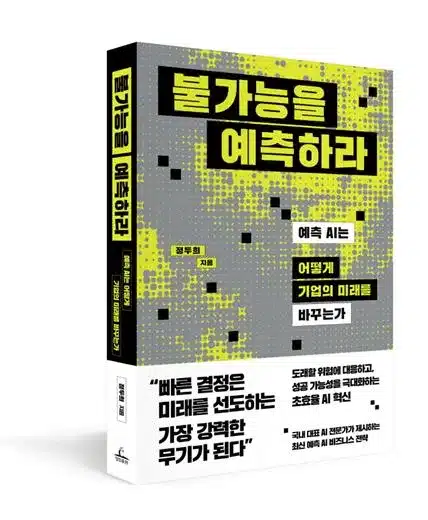
In the rapidly evolving business landscape, the ability to anticipate future trends is no longer a luxury but a necessity. A new book, ‘Predict the Impossible,’ by Jung Doo-hee, proposes ‘predictive AI’ as a crucial frontier for businesses in the age of generative AI. While generative AI excels at creating content like documents and images, predictive AI focuses on forecasting future events, such as demand, pricing, sales volume, and supply chain fluctuations, to aid in strategic business decision-making.
Understanding Predictive AI
Predictive AI, as defined in the book, is a technology that analyzes vast amounts of data scattered across markets and within companies to calculate the probability of future occurrences. Instead of merely reacting to past performance, businesses can leverage predictive AI to proactively adjust production levels, purchasing strategies, and inventory based on anticipated demand or price changes in the coming month. This forward-looking approach contrasts with traditional methods that often rely on historical data or the intuition and experience of individuals, which can be insufficient in fast-moving markets.
The book argues that by moving beyond analyzing past events to considering future possibilities, the nature of business discussions and strategies can fundamentally change. This perspective is informed by the author’s practical experience in the field.
Author’s Expertise and the Book’s Scope
Jung Doo-hee, an associate professor at Handong Global University and CEO of Impactive AI, founded the company in 2021. Impactive AI developed ‘DeepFlow,’ an AI-based demand and price forecasting solution. The company has since collaborated with 85 businesses across various sectors, including manufacturing, distribution, retail, food and beverage, semiconductors, and fashion.
The book draws upon these real-world experiences, detailing case studies of companies grappling with demand forecasting, price volatility, new product sales, and supply chain issues. It explores how predictive AI can offer solutions to these complex challenges. The narrative covers the reasons why businesses often lag behind market shifts, provides practical examples of predictive AI implementation, explains the underlying technology, and discusses the process of organizational adoption.
Key Applications and Methodologies
The book delves into specific applications of predictive AI, such as forecasting:
- Sales volume for new products
- Raw material prices
- The effectiveness of promotions
- Cannibalization effects (when a new product reduces sales of an existing one)
- Supply chain disruptions
Furthermore, it addresses strategies for situations with limited data, introduces market simulation techniques, and explores the integration of predictive AI with agent-based AI systems. These methodologies aim to provide businesses with a more robust framework for understanding and navigating market dynamics.
The True Goal of Predictive AI
A central theme of the book is that the objective of predictive AI is not to achieve perfect foresight into the future. Instead, its primary value lies in identifying subtle signals of change within data that might otherwise go unnoticed. The crucial step is then connecting these insights to a company’s decision-making processes and guiding concrete actions.
The author emphasizes that the accuracy of predictions is less important than how the results are utilized to inform business strategy. By uncovering potential shifts and trends, predictive AI empowers organizations to make more informed, proactive decisions, thereby gaining a competitive edge and mitigating risks in an increasingly unpredictable global market.
The book, titled ‘Predict the Impossible,’ is published by Cheongrim, spans 316 pages, and is priced at 20,000 KRW. It aims to equip business leaders and strategists with the knowledge and tools to harness the power of predictive AI for future success.
