

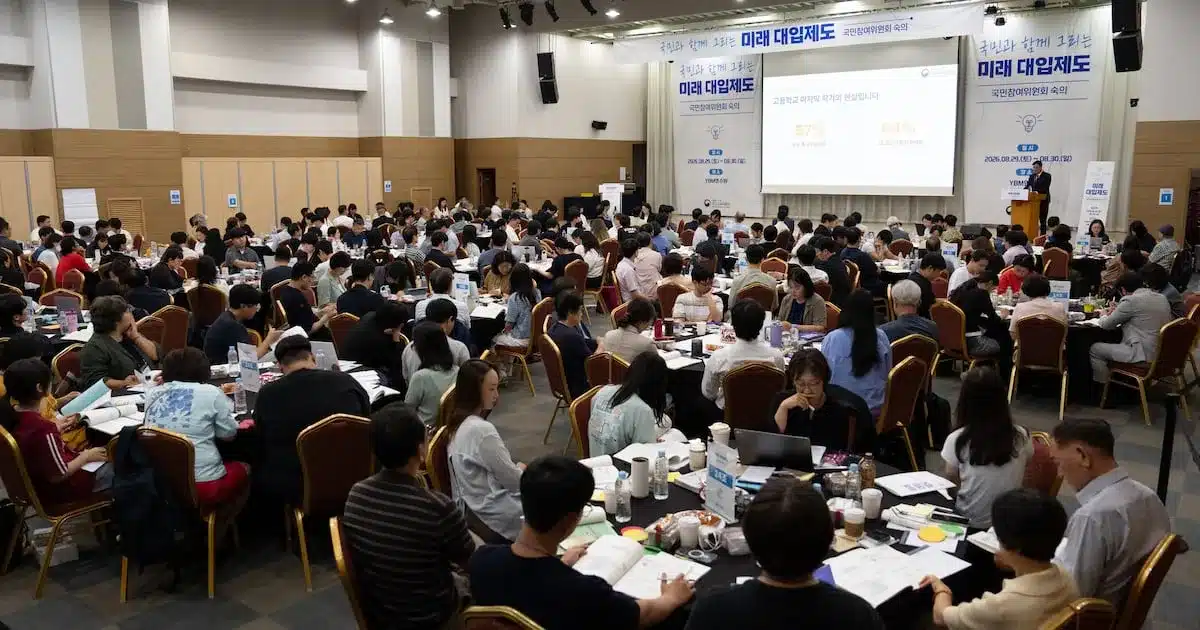
South Korea’s National Education Council (NEC) has initiated a public deliberation on future college admission system reforms, including the potential introduction of essay-style evaluations to supplement the current standardized college entrance exam, the Suneung. This move aims to address perceived limitations of the existing system while sparking discussions about fairness, the potential expansion of private tutoring markets, and increased student burdens.
Addressing Limitations of the Current Suneung System
The deliberation, held at the YBM Training Center in Hwaseong, Gyeonggi Province, brought together 203 participants representing students, youth, parents, educators, and the general public. These participants, after studying pre-distributed materials, engaged in small group discussions over two days to explore directions and key issues for future admission policies.
NEC Chairperson Cha Jeong-in emphasized that changing the college admission system is not merely about altering the exam format. Instead, it’s about fundamentally improving the quality of education across all levels, from elementary to high school, by transforming student learning experiences. He addressed concerns that the NEC’s public deliberation might be pre-determining outcomes, stating that the discussions are in a critical review phase and not a process to legitimize a specific proposal.
Evaluating the Present and Charting the Future
The first session focused on evaluating the current admission system and discussing the direction for future reforms. Participants largely agreed that the present system, which emphasizes selecting correct answers in a standardized format, is overly focused on a narrow definition of academic achievement and competitive ranking. Many expressed the need to shift towards a system that can evaluate students’ learning processes and individual capabilities more comprehensively.
Exploring Essay-Style Evaluations: Potential and Pitfalls
The second session delved into the necessity of transitioning to an essay and performance-based evaluation system. A central concern raised by participants was how to ensure fairness and credibility in scoring if such a system were implemented. Questions also arose regarding how to manage the increased workload and ensure the professional expertise of educators who would be responsible for these evaluations.
Concerns Over Private Education and Student Stress
A significant worry is the potential for a new private education market to emerge, similar to the current ‘cram schools’ or specialized tutoring services, if essay-style evaluations are introduced. Participants debated whether essay-style evaluations could truly resolve the issues inherent in the current system.
Some argued that given the functional limitations of the current multiple-choice Suneung, a gradual, phased transition to essay and performance-based evaluations is necessary. However, they stressed the need for a detailed roadmap, specifying which grade levels and subjects would be affected and when such a transition would occur.
Another concern raised is that essay-style evaluations might actually increase student stress. While the potential for more detailed assessment through partial or mid-term scores exists, allowing for a more nuanced evaluation of student abilities, the introduction of such a system does not automatically guarantee a reduction in admission-related pressure.
Broader Public Consultation Efforts
Prior to this intensive deliberation, the NEC conducted on-site forums in Incheon on November 11th, and in Jeonnam/Gwangju on November 20th, and Daegu on November 26th. These forums, also themed around the direction of the admission system for future society, included participation from students, parents, teachers, and the general public. Additionally, since November 14th, the NEC has been collecting online opinions through its national opinion platform.
The opinions gathered from these online and offline consultations, along with the outcomes of the current public deliberation, will be incorporated into the drafting process of the ‘National Education Development Plan (2028-2037)’. The NEC plans to release a draft of this development plan by the end of October and finalize it by the end of March next year.
Conclusion: A Path Towards Educational Evolution
The ongoing discussions surrounding the reform of South Korea’s college admission system highlight a critical juncture in the nation’s educational landscape. The proposed shift towards incorporating essay-style evaluations reflects a desire to move beyond rote memorization and standardized testing, aiming for a more holistic assessment of student potential. However, the path forward is complex, requiring careful consideration of fairness, the potential impact on private education, and the overall well-being of students. The NEC’s commitment to broad public consultation suggests a deliberate effort to navigate these challenges and shape an admission system that better serves the needs of future society.
