

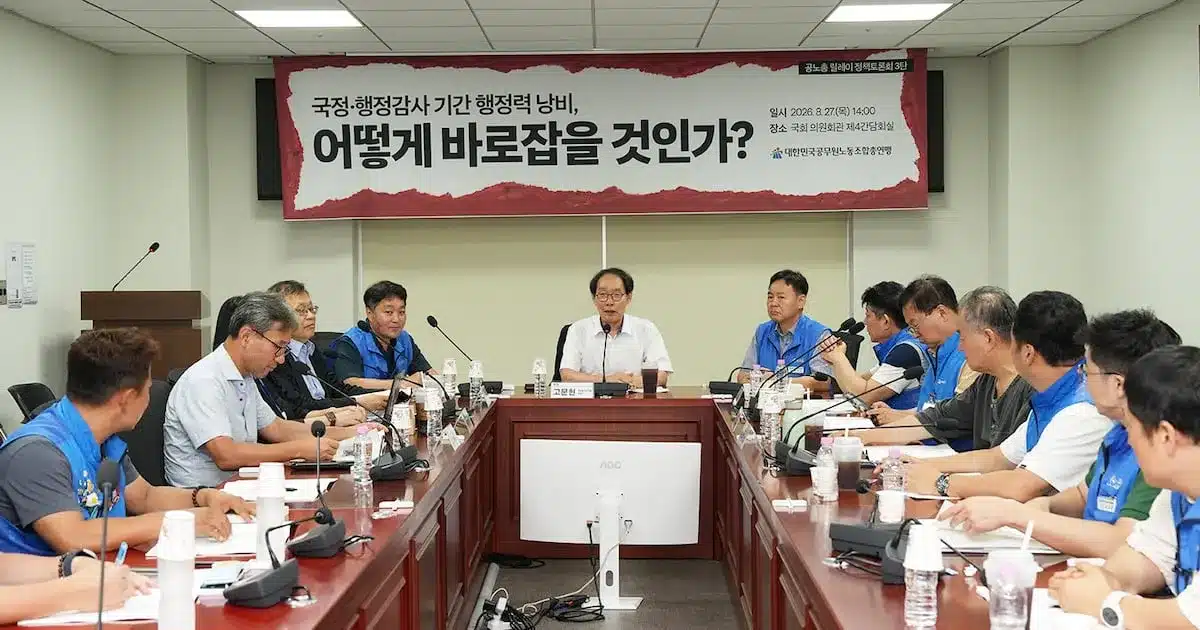
A forum convened to address the burdensome demands and potential abuses associated with government and administrative audits has called for significant improvements. The Korean Public Officials’ Labor Union Federation (KPOULF) hosted the event, titled ‘Government and Administrative Audits: How to Correct Abuse of Power?’, on October 27th at the National Assembly Members’ Office Building in Yeongdeungpo-gu, Seoul. The discussion aimed to find solutions for issues such as excessive data requests and the strain these audits place on public servants.
Addressing Audit Process Inefficiencies
The forum featured a presentation by Go Moon-hyun, President of the Korea ESG Society, who chaired the session. Jo Jeong-chan, CEO of IPBEOP Q&A, delivered a keynote on ‘Investigation of Government Audits and Measures for Constructing Cooperative Governance Between Legislation and Administration.’ Panelists included Kim Myung-soo, former Chairman of the National Federation of Metropolitan City and Provincial Public Officials’ Unions (Metropolitan Federation); Ju Han-joon, Chairman of the National Data Office Workers’ Union at the National Public Officials’ Union; Lee Su-jong, Preparatory Committee Member of the Policy Alliance Party; Park Yun-mi, Deputy Director of the Wolyo Shinmun newspaper; and Kang Ki-cheol, former Secretary-General of the National Assembly.
During the discussions, a significant concern raised was the excessive workload and potential for abuse of power stemming from government and local council audits. Many public servants reported receiving last-minute requests for data or being asked to resubmit information that had already been provided. Jo Jeong-chan highlighted these issues, stating, “During audits, there are excessive data requests, tight submission deadlines, repeated and duplicated data demands, and inappropriate on-site inspections. This leads to situations where public servants must work overnight to prepare and respond to requests, even when the quality of the information is not high.”
Survey Data Reveals Widespread Overwork
Further underscoring the problem, a survey conducted by KPOULF in May on ‘Preparation for Government Audit Data Submission’ revealed the extent of the burden. Approximately 45% of national and fire service public officials and 56% of metropolitan and provincial public officials responded that preparing for government audits was ‘impossible without overtime work.’
The survey also indicated that an average of over 10 days of overtime was spent on audit preparations by 36% of national and fire service officials and 34% of metropolitan and provincial officials. When asked about receiving similar data repeatedly, 35% of national and fire service officials reported being asked for the same or similar data ‘7 or more times.’ For metropolitan and provincial officials, 59% indicated receiving such requests ‘3 or more times.’
Administrative Audit Challenges Mirror National Audits
The situation is similar for administrative audits. A significant majority of officials found these audits also necessitated overtime. For metropolitan and provincial governments, 61% stated that audit preparation was ‘impossible without overtime.’ This figure rose to 66% for city, county, and district governments, and 59% for metropolitan and provincial education offices. Furthermore, 58% of metropolitan and provincial officials, 44% of city, county, and district officials, and 50% of metropolitan and provincial education officials reported being asked for similar data ‘3 or more times.’
Proposals for Systemic Reform
Kim Myung-soo emphasized the need for a systemic solution rather than individual unions addressing the issue piecemeal. “We need to establish a systematic framework to prevent unnecessary data requests from occurring in the first place,” he stated.
Several concrete proposals were put forth to reform the audit process:
- Establishment of specific criteria to limit excessive data demands.
- Ensuring sufficient time for data preparation and implementing a system for advance notice.
- Creating a database for identical or similar data and establishing a system for its continuous sharing and utilization.
- Developing a channel for prior agreement on data requests before their formal issuance.
A representative from KPOULF concluded the forum by stating, “We must reduce unnecessary data requests, eliminate duplicate demands and excessive reliance on interpretations, and create ‘audits worthy of the name’ that properly connect policy with accountability.” The goal is to foster a more efficient, fair, and less burdensome audit environment for public servants.
