

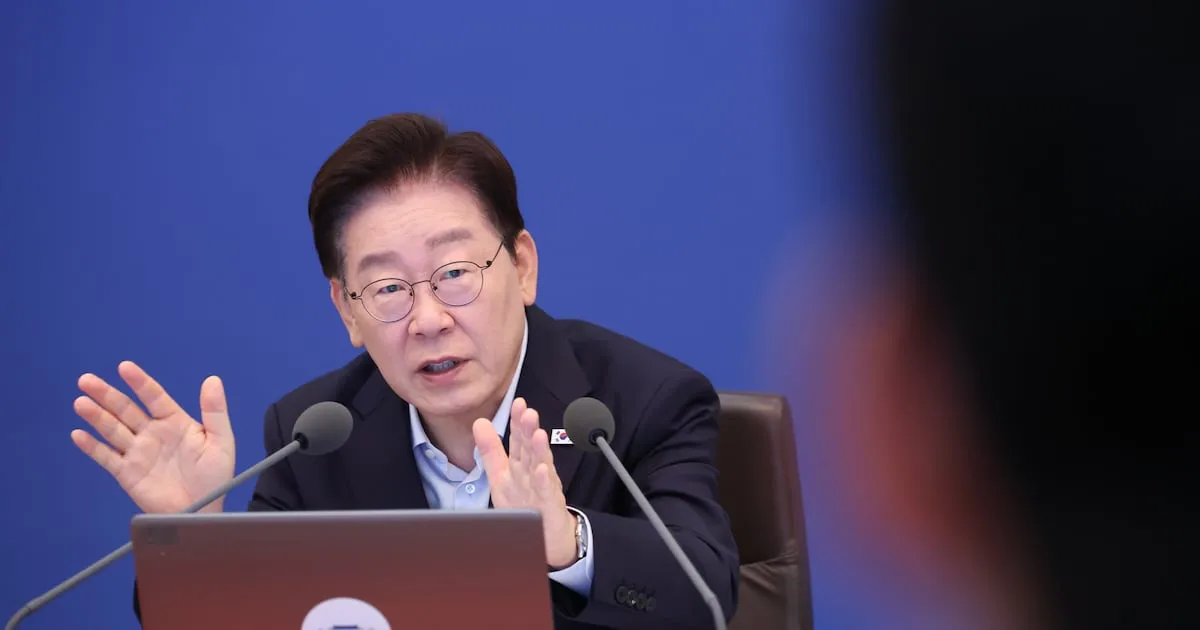
President Lee Jae-myung’s approval rating for his administration has fallen below 40% for the first time since taking office, with a new poll indicating that 57.9% of respondents disapprove of his performance. The positive approval rating recorded was 38.9%.
Presidential Approval Rating Declines
A recent public opinion survey conducted by Realmeter between October 22nd and 24th revealed a significant drop in President Lee Jae-myung’s job performance evaluation. The poll, which surveyed 2,001 adults nationwide, found that 38.9% approved of his performance, while 57.9% disapproved. This marks the first time since his inauguration in June of the previous year that his approval rating has dipped below the 40% threshold.
Breaking down the approval figures, 25.7% of respondents indicated that the President was doing a “very good job,” and an additional 13.2% felt he was doing a “fairly good job.” Conversely, negative assessments were more pronounced, with 12.8% stating he was doing a “fairly poor job” and a substantial 45.1% believing he was doing a “very poor job.” The remaining percentage likely falls into a “no opinion” or “don’t know” category, though not explicitly detailed in the provided data.
Comparison with Previous Polls
The latest survey results show a notable shift compared to the previous poll conducted from August 8th to 10th. In that earlier survey, the President’s approval rating stood at 42.9%, with disapproval at 54.1%. The current figures represent a 4.0 percentage point decrease in approval and a 3.8 percentage point increase in disapproval, highlighting a downward trend in public sentiment.
Regional Approval Variations
Analysis of the survey data by region indicates that positive approval ratings for President Lee’s administration were only dominant in the Jeonnam, Gwangju, and Jeonbuk areas, where 65.3% of respondents expressed approval. Other regions showed significantly lower approval rates:
- Daejeon, Sejong, and Chungcheong provinces: 33.5% approval
- Busan, Ulsan, and Gyeongnam provinces: 34.2% approval
- Seoul: 34.9% approval
These figures suggest a regional disparity in how the President’s performance is perceived, with the southwestern regions showing considerably stronger support compared to the rest of the country.
Survey Methodology
The poll was conducted by Realmeter on behalf of the Korea Research Institute. It employed a mobile phone-based automated voice response (ARS) system, reaching out to 2,001 individuals aged 18 and above across the nation. The response rate for the survey was 3.8%. The margin of error was reported as ±2.2 percentage points at a 95% confidence level. For more detailed information regarding the survey’s methodology and findings, individuals are encouraged to consult the website of the National Election Survey Deliberation Commission.
Understanding Public Opinion on Governance
Public opinion on a president’s performance is a critical indicator of their standing and the effectiveness of their policies. Approval ratings, often tracked through regular polling, provide insights into voter satisfaction and can influence political discourse and future electoral outcomes. When approval ratings decline, it often signals public concern or dissatisfaction with the direction of the country, economic conditions, or specific government actions.
Conversely, high approval ratings can suggest public confidence in leadership and policy implementation. The factors influencing these ratings are multifaceted, encompassing economic performance, social issues, foreign policy developments, and the overall political climate. Understanding the nuances of these fluctuations, including regional and demographic variations, is essential for a comprehensive view of public sentiment towards a national leader.
Conclusion
The recent poll results indicate a challenging period for President Lee Jae-myung’s administration, with his approval rating falling below 40% for the first time. The significant majority of respondents expressing disapproval underscores the need for the administration to address public concerns and potentially re-evaluate its strategies. The regional differences in approval also highlight the varied perceptions across the country, suggesting that national policies may resonate differently in various areas. Continuous monitoring of public opinion will be crucial in understanding the evolving political landscape and the impact of the administration’s ongoing efforts.
